This Hauntingly Beautiful Cemetery And Church In South Carolina Has A Fascinating History
Circular Congregational Church in Charleston, founded in 1681, features one of the oldest graveyards in the city with monuments dating back to 1695.
Founded in 1670, the city of Charleston has quite a bit of history. From its American Revolution ties to its Civil War significance, it has always been an integral part of American history. And this includes one of its cemeteries. Located on historic Meeting Street within Charleston’s 502-acre Historic District, you’ll find Circular Congregational Church. This house of worship dates all the way back to 1681, and its graveyard in the back (as well as the remains and tombstones) go back to 1695.
Today’s Richardson Romanesque-style Circular Congregational Church was built in 1892. It is the fourth church at this site.
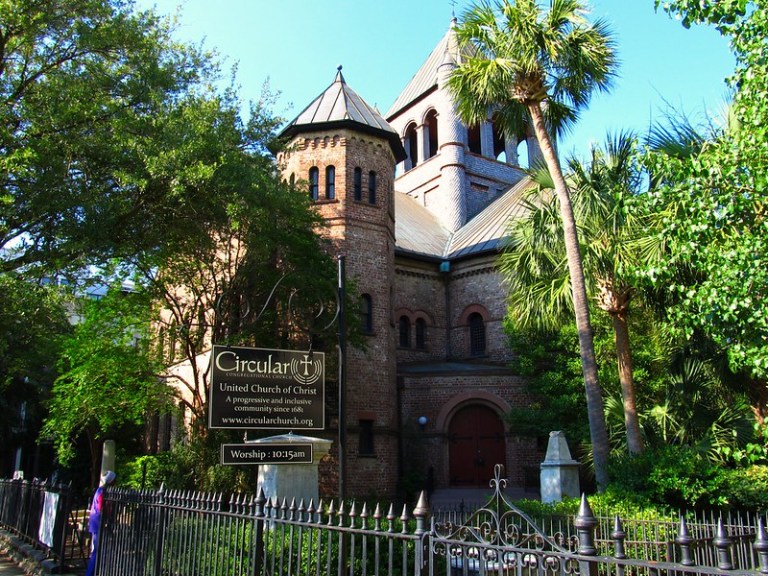
Charles Towne and others founded it in 1681. And ever since then, devotees have been worshipping at this spot, making it one of the oldest congregations with continuing attendance in all of the South.
Nestled behind the church, you’ll find the Parish House, a Greek Revival built about 1806. It was listed as a National Historic Landmark in 1973.

But while the church and Parish House are extremely interesting, it’s the graveyard that we are here to see!

Monuments date all the way back to 1695, making this one of Charleston’s oldest burial grounds.
With such a long history, it’s no wonder that some stones have been damaged over time.

Today, over 500 remain here, with more than 700 names listed. There are also several hundred deceased persons listed in church records, and in all likelihood, have their final resting place here.
What is also interesting about its long history is that one can very easily trace the evolution of funerary art and attitudes toward death over a more than 300-year span of time.

Many graves reflect both the time and popular style.

The oldest grave here is from 1695. It is unmarked, but believed to hold the remains of Henry Simonds. The first stone actually inscribed is dated 1729.
While the first markers in the 1600s have the skull and crossbone included, as the 1700s began, the skull remained on the graves, but the crossbones were replaced with wings, making the idea of life, not death, more prevalent.

There are also many portrait stones. In fact, there may be more of these 18th-century stones here than anywhere else in the US.

The largest burial vault contains members of the Hutson-Peronneau family. It is estimated that 18 or more people were buried here.

It’s interesting to note that a great deal of these gravestones were not created by South Carolinians. Wealthy residents of the city had theirs made by New England carvers and shipped here.

Steeped in both history and importance, a visit to the Circular Congregational Church and its graveyard is a step back in time and way of life in South Carolina.

Be sure to check out this beautiful resting place for yourself if you are ever in or around Charleston's Historic District. Head to the website for the church and its property for more information about visiting.
What cemeteries would you recommend visiting in South Carolina? Tell us about your favorites in the comments!
Speaking of haunts, check out some of the most haunted places in South Carolina!
Subscribe to our newsletter
Get the latest updates and news
Thank you for subscribing!