The 11 Most Spectacular Tree Tunnel Drives in America
Some roads exist just to get you somewhere else. These eleven don't, and that's exactly the point.
The best tree tunnel drives in America share a quality that's hard to plan for and impossible to manufacture: the feeling that the road you're on was made specifically for this moment. Whether it's banyan trees arching over Florida asphalt, cypress rows framing a California radio station, or a live oak canopy dripping with Spanish moss outside Savannah, these drives slow you down in the best way and turn a simple stretch of highway into the whole reason for the trip. From coast to coast, here are 11 of the most spectacular.
1. SE Bridge Road (SR-706): Hobe Sound, Florida
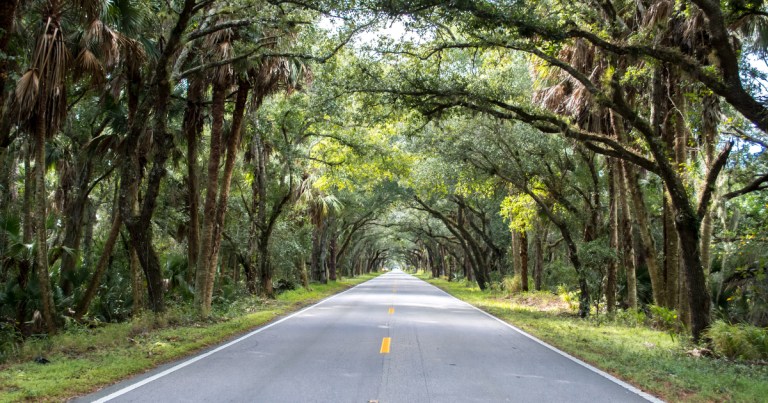
The most famous tree tunnel drive in Florida, and arguably in the country, runs along SE Bridge Road in Hobe Sound, where nearly a century of banyan growth has produced a canopy unlike anything most people have driven under. We've covered the full history and best photo spots of the Hobe Sound tunnel in depth.
The Hobe Sound Company planted banyan trees along the road in the 1930s as a landscaping project. Nobody predicted what they'd become after nine decades of growth. The densest and most photogenic stretch runs along SE Bridge Road near Hobe Sound. On a sunny afternoon, the dappled light moves across the asphalt in patterns that look edited. On an overcast morning, the tunnel reads moody and green. It delivers a completely different experience depending on when you show up, which is part of why people go back.
2. M-119 Tunnel of Trees: Harbor Springs to Cross Village, Michigan

The M-119 Tunnel of Trees runs 20 miles along the Lake Michigan shoreline from Harbor Springs north to Cross Village, and it's widely cited as one of the most scenic stretches of highway in America. The hardwoods and evergreens that line both sides of the road knit together overhead, creating a canopy that changes character completely with the seasons.
Fall brings reds, golds, and oranges that photographers drive days to reach. Spring layers the forest floor with trilliums and the canopy with fresh green light. Summer offers a cool, shaded drive with occasional glimpses of the lake between the trees. The road is narrow and winding by design, which keeps speeds low and forces the kind of attention the drive deserves. Pull over at any overlook, and Lake Michigan spreads out below in a shade of blue that surprises people every time. For a full rundown of the route's pit stops, from Pond Hill Farm to Devil's Elbow, plan the drive out before you go.
3. Blue Ridge Parkway near Craggy Gardens: Milepost 364, North Carolina

The Blue Ridge Parkway earns its title as America's Favorite Drive for 469 miles of reasons. But the section near Craggy Gardens around Milepost 364 is where it produces its most cinematic tree tunnel. The road narrows into a corridor of hardwoods and rhododendrons that arch overhead and change completely across the seasons, a stretch that pairs well with a broader waterfall road trip through the nearby Pisgah region.
Late spring is peak season, when the rhododendrons bloom in pink and purple, and the canopy turns into something photographers struggle to do justice to. Fall converts the same tunnel into a fiery corridor of amber and rust. Even in winter, the bare branches create an intricate pattern against the sky that serious photographers specifically seek out. The road is narrow enough here to force a slower pace, which the view completely warrants.
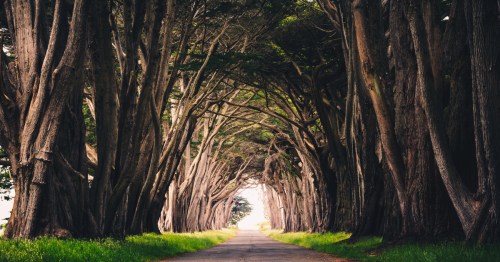
4. Cypress Tree Tunnel, Point Reyes National Seashore: Inverness, California

The Cypress Tree Tunnel at Point Reyes National Seashore sits off Sir Francis Drake Boulevard near the North District Operations Center, where Monterey cypress trees planted around 1930 have grown into one of the most photographed corridors on the West Coast. The white Art Deco radio station visible at the end of the drive adds a layer of intrigue that most tree tunnels don't carry. It's one of the standout stops in our roundup of Northern California's hidden gems, alongside Point Reyes' elk preserve and lighthouse.
The tunnel sits on an otherwise open, windswept expanse of the Point Reyes Peninsula, which is exactly why it reads as dramatic. The contrast between the treeless surroundings and the dense cypress canopy overhead makes the entrance feel like stepping through a threshold. Sunrise and sunset produce the best light, when rays cut through the branches at low angles. Parking is on the shoulder of Sir Francis Drake Boulevard, and the tunnel is a short walk from the road.
5. Wormsloe Historic Site: Isle of Hope, Savannah, Georgia

Outside Savannah, on the Isle of Hope, Wormsloe Historic Site features one of the most recognizable tree-tunnel images in the South. More than 400 live oaks line the main avenue, their branches dripping with Spanish moss and arching over the road in a canopy that has been drawing visitors and photographers for generations. We put together a dedicated guide to the site locals call Georgia's Tunnel of Trees.
The approach down the oak avenue toward the colonial ruins at the end is the kind of drive that makes people stop mid-sentence. The combination of the twisted oak geometry, the hanging moss, and the dappled light gives it a quality that photographs consistently fail to capture fully. The site is open for tours, with nature trails, ruins, and a museum on the grounds. But most people come for the avenue, and the avenue justifies the trip.
6. Pig Trail Scenic Byway (AR-23): Ozark, Arkansas

The Pig Trail Scenic Byway runs 19 miles along Arkansas Highway 23 through the Ozark National Forest, climbing from near Ozark north to the tiny community of Brashears. Trees crowd both sides of the road for long stretches, closing into the Pig Trail's tunnel of trees that gave the route its reputation among riders and road trippers alike.
USA Today has ranked this stretch among the best motorcycle rides in the country, thanks to its steep inclines, hairpin turns, and near-total lack of commercial development. Spring brings wildflowers along the shoulder, and fall turns the canopy into a corridor of red and gold. The Mulberry River runs nearby for anyone who wants to extend the day with a float or a fish. Development along the route remains minimal, which keeps the forest feeling exactly as wild as it did to the earliest Ozark settlers.
7. St. Bernard Highway (LA-46): Meraux to Violet, Louisiana

In St. Bernard Parish southeast of New Orleans, the stretch of LA-46 between Meraux and Violet produces a live oak canopy that rivals anything in the South. The road runs through a former plantation tract now known as Docville Farm, and the oaks that once lined the property have grown to envelop the entire roadway in a tunnel of arching branches and Spanish moss. Read more about the history behind the St. Bernard Highway Tunnel of Trees and what makes this stretch different from Louisiana's other oak-lined roads.
Unlike many of the more famous live oak tunnels in Louisiana, this one is a public road with no admission fee, so you can drive it anytime without planning around tours or hours. The best light comes in the early morning when the moss catches low-angled sun. The stretch is short but dense, and the surrounding wetland landscape gives it a distinctly South Louisiana context.
8. Smugglers' Notch, VT-108: Jeffersonville, Vermont

Smugglers' Notch on Vermont Route 108 is closed to traffic in winter for good reason. The road narrows to a single lane as it climbs through a rocky notch in the Green Mountains, and the hardwood canopy overhead seals the passage into a genuine tunnel of trees that peaks in fall when the maples and birches turn the entire corridor gold and red. This stretch has been ranked among the 15 best tree tunnels in the world, and it's easy to see why once you've driven it.
The notch itself has boulder fields and cliff faces that create drama beyond the canopy, but approaching from the south, the tree cover is sufficient overhead that the effect is tunnel-like before the road climbs into the rock. Fall foliage season is peak, with the canopy producing a color intensity that draws photographers from across New England. The road reopens in spring and stays accessible through October.
9. Botany Bay Road: Edisto Island, South Carolina

On Edisto Island, Botany Bay Road turns off SC-174 and runs about three miles over sand and dirt before reaching Botany Bay Plantation Heritage Preserve. Along the way, live oaks planted on either side arch overhead and drape with Spanish moss, forming Edisto Island's tunnel of trees, one of the most photographed stretches of road in the Lowcountry.
The road passes Allen AME Church, founded in 1876, just before the canopy closes in overhead. Because the oaks stay green through winter, the tunnel effect holds up in every season, unlike many deciduous tree tunnels that thin out once the leaves drop. At the end of the road, a short footpath leads to Botany Bay itself, one of the most remote and undeveloped beaches in the state, backed by the ruins of two 1930s-era plantations.
10. Upper Hoh Road to Hoh Rain Forest: Olympic National Park, Washington

The drive into the Hoh Rain Forest off Highway 101 runs 18 miles down Upper Hoh Road through a deepening canopy of Sitka spruce, western hemlock, and bigleaf maple so thick with moss it reads as green from every angle. By the time you reach the trailhead for the otherworldly Hall of Mosses, the transition from open highway to something otherworldly is complete.
The Hoh Rain Forest receives up to 140 inches of precipitation annually, resulting in a canopy so dense that the understory remains dim even on bright days. Trunks 12 feet in diameter, nurse logs the length of houses, ferns carpeting the floor in every direction. The moss-covered archway at the trailhead is the payoff, but the drive itself is a tree tunnel experience that starts well before you park the car.
11. Maluhia Road (Tree Tunnel Road): Kauai, Hawaii

On Kauai's south shore, Maluhia Road carries drivers through roughly a mile of towering eucalyptus, planted in 1911 as a gift from sugar baron Walter McBryde to the community. The trees have grown into Kauai's famous tree tunnel, a closed canopy that serves as the gateway to Koloa and Poipu on the island's south side.
Two hurricanes tore open the canopy decades ago, but the trees have since regrown into a full, unbroken tunnel again. The road has a 25-mph speed limit and no pull-offs, so most photos are taken from the passenger seat as the car moves through. Morning and late afternoon light filters best through the branches, and the drive marks the start of the Holo Holo Koloa Scenic Byway, a longer loop that continues on to Old Koloa Town and Spouting Horn.
Want to keep the exploration going? Check out the best road trips across the U.S. for more scenic adventures.
Subscribe to our newsletter
Get the latest updates and news
Thank you for subscribing!