Marvel at the Cosmos at These Stunning Stargazing and Dark Sky Destinations in the U.S.
From remote destinations to certified Dark Sky Parks, these breathtaking destinations offer the clearest night skies in the U.S. for stargazing.
Summer is the perfect time to go stargazing. Mild temperatures make it easier to stay out later, and many designated Dark-Sky Places offer tons of nighttime events like Star Parties, expert-guided star tours, and opportunities for the public to use the telescopes at research observatories to peer deeper into space than ever. These destinations have minimal light pollution away from city lights and are among the best places to see stars in the USA.
I was lucky enough to grow up in a small town in Oregon near the Cascade Mountains, so my nights were always filled with spectacularly starry skies. When I moved to California for college, I was shocked by how few stars I could see, even though my new town was far from major light pollution-producing cities like San Francisco and Los Angeles. I'm a bit of a space nerd, and I missed my starry skies so much; this was one of the many reasons I found my way back to Oregon after graduation.
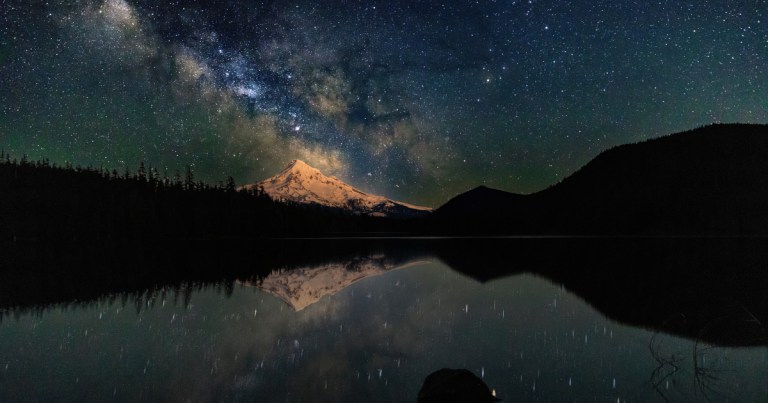
Only about 10% of Americans can see our own Milky Way galaxy due to extreme light pollution in urban areas. As an avid stargazer, this statistic makes me so sad, as marveling at the cosmos is an experience like no other and something I wish everyone had the opportunity to do. Luckily, getting out and finding a darker space to stargaze is easier than you might think!
With the Perseid Meteor Shower peaking on August 12-13, 2026, and an upcoming opportunity to see a once-in-a-lifetime star explosion from Earth without a telescope, I put together a list of some of America's best Dark-Sky destinations to help you find a spot with a front-row seat where you can set your gaze toward the starry skies.
International Dark-Sky Places in the U.S.

If you love stargazing, you have likely heard of DarkSky International (formerly the International Dark-Sky Association). This non-profit works to preserve places with exceptionally dark skies and to provide support and recognition for communities dedicated to reducing light pollution. Worldwide, there are over 250 designated Dark-Sky Places in 22 countries and six continents, but the vast majority (172) are located in the U.S.
There are six types of International Dark Sky Places: Sanctuaries, Reserves, Parks, Communities, Urban Night Sky Places, and Lodging. The most exceptional sites are Dark-Sky Sanctuaries, followed closely by Dark-Sky Reserves. There are 11 Sanctuaries and two Reserves here in the U.S., as well as 95 Parks, 42 Communities, 11 Lodging, and 11 Urban Night Sky Places. Here are some of our favorites:
1. The Oregon Outback (Oregon)

In March 2024, the Oregon Outback became the newest and largest Dark Sky Sanctuary in the world. This sparsely populated area in Lake County is home to some of the darkest skies in the country and encompasses over 2.5 million acres — but this is just Phase 1 of the plan. Once complete, the Oregon Outback will include a whopping 11.4 million acres. For perspective, if the Oregon Outback were a state, it would be the 42nd-largest in the country! This is certainly one of the best International Dark Sky Places for stargazing.
We highly recommend spending a few nights camping on the Playa of the Oregon Outback, but there are also several astronomy groups that offer regular stargazing parties and nighttime tours here, welcoming everyone from absolute beginners to seasoned stargazers.
Other great stargazing spots in Oregon: Crater Lake National Park and Prineville Reservoir State Park
2. Katahdin Woods & Waters National Monument (Maine)

While 8 of the 11 Dark Sky Sanctuaries in the U.S. are in the West and Southwest due to more spread-out population centers (and therefore, less light pollution), Katahdin Woods & Waters National Monument is an East Coast stunner. Comprised of over 100,000 acres in northern Maine and designated by Dark-Sky International in 2016, Katahdin is home to some of the most remote, unspoiled land in the world.
While astronomy events take place regularly throughout the year, the biggest and best is the annual Stars Over Katahdin event in late September. This year, it will take place on October 3, 2026 — we highly recommend timing your visit so you can join the fun at one of the best national parks for stargazing!
Other great stargazing spots in Maine: AMC Maine Woods, Acadia National Park, Baxter State Park, and Mount Desert Island
3. Rainbow Bridge National Monument (Utah)

While Utah has the highest concentration of certified Dark Sky Places in the world (around 30), only one site has earned the designation of Dark Sky Sanctuary: Rainbow Bridge National Monument. This remote area is only accessible via boat across Lake Powell, and the journey takes over two hours!
By day, visit Rainbow Bridge. Spanning 275 feet long and standing 290 feet tall, Rainbow Bridge is one of the largest natural arches in the world. By night, simply look up and marvel at the wild, wonderful universe. While there are no campgrounds within Rainbow Bridge National Monument, there are campgrounds in Glen Canyon National Recreation Area just a few miles away!
Other great stargazing spots in Utah: Canyonlands National Park, Bryce Canyon National Park, Zion National Park, Arches National Park, Capitol Reef National Park, Natural Bridges National Monument, Goosenecks State Park, Goblin Valley State Park, Dead Horse Point State Park... there are too many to list! Check out Dark-Sky International's place-finder to see them all! And if you plan on a dark-sky getaway in Utah, book a stay at Under Canvas Moab or Under Canvas Bryce Canyon — both are designated Dark Sky Lodging.
4. Boundary Waters Canoe Area Wilderness (Minnesota)

The Boundary Waters Canoe Area Wilderness barely needs an introduction — it’s one of the most famous pristine wilderness areas in the country, and it holds a well-deserved spot on many people’s bucket lists. Located in the northern part of Superior National Forest in Minnesota, this million-acre site is a playground for outdoor adventurers and a spectacular spot for stargazing.
Other great stargazing spots in Minnesota: Voyageurs National Park and the tiny town of McGregor, MN
5. Cosmic Campground (Gila National Forest, New Mexico)

With a name like Cosmic Campground, you just know this one must have amazing opportunities for stargazing! At only 3.5 acres, this Dark Sky Sanctuary within Gila National Forest in New Mexico is certainly one of the smallest sites on our list, but the unobstructed, 306-degree view of the stars is hard to beat. It's a must if you're looking to see the Milky Way in the USA. The nearest source of light pollution is over 40 miles away (and in Arizona). Obviously, you’re going to want to camp here, not just visit! For more information, visit the Cosmic Campground page on the National Forest Service website.
Other great stargazing places in New Mexico: Capulin Volcano National Monument, Chaco Culture National Historical Park, the observatory at Clayton Lake State Park, and Salinas Pueblo Missions National Monument. Check out our article about the darkest places in New Mexico to learn more!
6. Beaver Island State Wildlife Research Area (Michigan)

Located on Lake Michigan, Beaver Island is home to a diverse range of ecosystems that have attracted wildlife researchers to the area for decades, but it only received its official Dark Sky Sanctuary designation in 2024! The Sanctuary is open 24/7; however, this is a pristine natural area, so there are some rules and regulations you’ll need to follow when you visit. You’ll be shocked by just how dark it gets out here, providing prime opportunities for stargazing! Visit the Beaver Island website for more.
Other great stargazing spots in Michigan: Keweenaw Dark-Sky Park, Headlands International Dark-Sky Park, and Dr. T.K. Lawless International Dark-Sky Park
7. Greater Big Bend International Dark Sky Reserve (Texas)

One of only two Dark Sky Reserves in the U.S., the Greater Big Bend is the world’s largest Dark-Sky Reserve, encompassing over 9 million acres. In addition to the famously starry skies found in Big Bend National Park, the Greater Big Bend Reserve is also home to the McDonald Observatory, which is a must-see for astronomy enthusiasts! This research observatory is run by the University of Texas at Austin and is open to the public from noon to 5 p.m. on Tuesday through Sunday, and offers multiple evening Star Party events each week where visitors can learn about the night sky from the pros and see incredible views of the cosmos at the Rebecca Gale Telescope Park.
If you’re up for some night hiking, the Hot Springs Canyon Trail and Rio Grande Village Natural Trail provide wide-open vistas, and there are three different campgrounds within the park.
Other great stargazing spots in Texas: Devils River State Natural Area — Del Norte Unit, South Llano River State Park, and George Observatory in Brazos Bend State Park.
8. Central Idaho Dark Sky Reserve (Idaho)

America’s other Dark Sky Reserve can be found in the Sawtooth Mountains. The Central Idaho Dark Sky Reserve encompasses over 1,500 square miles of land, making it an ideal destination for dedicated stargazers. Due to the lack of human development in this region, it’s one of the best places in the nation to have an “off-grid” adventure far from electricity — and therefore light pollution. It's also the only Dark Sky Reserve in the U.S. to hold Gold-Tier status.
9. Palos Forest Preserves (Illinois)

In addition to Dark-Sky Sanctuaries & Reserves, Dark-Sky International also recognizes Urban Night Sky Places — urban areas that are working diligently to preserve nighttime views and reduce light pollution. The Palos Forest Preserves, part of the Forest Preserve District of Cook County, are located just 15 miles from downtown Chicago, yet provide a vital place for millions of city dwellers to see and learn about the starry sky above.
There are more than 40 miles of great hiking trails in the Palos Forest Preserve, so we suggest exploring the forest by day, and then sticking around to see the stars after dark!
10. Stacy Park (Missouri)

You’ll find another excellent Urban Night Sky Place in Olivette, Missouri, just 10 miles outside of St. Louis. The 35-acre Stacy Park is a popular park both day and night — there’s a flat, open area at the center of the park where telescopes can be set up to see the stars while remaining somewhat protected from light pollution by the tall trees around it. One weekend each month, nighttime stargazing events are held to encourage visitors to gaze up at the galaxy and learn more about our celestial neighborhood.
11. Cherry Springs State Park (Pennsylvania)

One of only two International Dark-Sky Parks in the Northeast, Cherry Springs State Park in Pennsylvania, is one of the best stargazing destinations on the East Coast. It’s located within Susquehannock State Forest and features an “Astronomy Field” offering an unobstructed 360-degree view of the night sky. With the increase in solar activity producing auroras at much lower latitudes than usual, Cherry Springs State Park is also a top spot to get a glimpse of this colorful phenomenon when conditions are just right!
Cherry Springs State Park holds two major Star Parties each year that draw hundreds of astronomy enthusiasts and professionals to get a peek at the starry skies via high-powered telescopes. The Cherry Springs Star Party takes place in June and is hosted by the Astronomical Society of Harrisburg, while the Black Forest Star Party takes place in September and is hosted by the Central Pennsylvania Observers. Both events are tons of fun! Visit the Cherry Springs State Park web page for more on astronomy and stargazing at the park.
12. Stephen C. Foster State Park (Georgia)
Stephen C. Foster State Park is well-known for outdoor recreation — kayaking, hiking, birding, and canoeing — but this natural wonder takes on another identity come dusk. This remote park and its 400,000-acre Okefenokee Swamp, one of the great natural wonders in Georgia, boast some of the darkest skies in the South and are a celebrated spot for stargazing.
Best Observatories In The U.S.

While Dark-Sky International-certified places offer stunning opportunities to see the stars, heading to an observatory is one of the best ways to peer into the universe beyond what can be seen with the naked eye. Here are some of the best observatories in the U.S. you can visit:
13. Lowell Observatory (Arizona)

Flagstaff, Arizona, was designated the first International Dark Sky City in 2001 for its exceptional commitment to outdoor lighting policies and ordinances that protect and preserve the night sky, even within city spaces. The crown jewel for star-lovers here is Lowell Observatory, which was founded all the way back in 1894 and is responsible for countless pivotal astronomical discoveries, including the discovery of Pluto.
The Lowell Observatory is family-friendly, with a museum, and hosts regular Star Parties, year-round educational events with scientists and researchers, and unique nighttime events like Meet an Astronomer and the Worlds Revealed Speaker Series. It’s truly a must-visit!
14. Mauna Kea Observatories (Hawaii)

Atop the summit of Mauna Kea on the Big Island of Hawaii, you’ll find a collection of 13 observatories used by astronomers from around the world peer into the depths of space in ways that just can’t be done elsewhere. After all, it’s situated in the middle of the Pacific Ocean, about as far away as you can get from major sources of light pollution. Key scientific findings that have been made here include the discovery of the supermassive black hole at the center of the Milky Way galaxy!
While the research observatories here aren’t open to the public, the Mauna Kea Visitor Center is, and there are several tour companies on the island that offer private stargazing tours. Please note: the summit of Mauna Kea is a sacred place to the Hawaiian people, so the utmost respect is required when you visit this place, and we encourage you to learn about Mauna Kea’s place in history and the Hawaiian culture while you’re here.
15. Griffith Observatory (California)

While most of the best stargazing spots are found in remote areas, Griffith Observatory is an exception. Located atop Mount Hollywood in the middle of the second-largest city in the U.S., Griffith Observatory in Los Angeles attracts over a million visitors each year, making it the most-visited public observatory in the world. And guess what… it’s free to visit. Griffith J. Griffith (yes, that was his actual name), donated the land in 1896 with the specific stipulation that it must be used for educational purposes that are accessible to all.
Griffith Observatory is just one of the many places in Griffith Park to visit while you're here. Before you head out stargazing, spend a day here to enjoy the many museums, beautiful hiking trails, pony rides, the iconic Greek Theater, and the Los Angeles Zoo!
16. Leander McCormick Observatory (Virginia)

Located on the campus of the University of Virginia in Charlottesville, the Leander McCormick Observatory started with one man’s dream to bring the world’s largest telescope to his home state. Unfortunately, this didn’t go quite as planned, and by the time construction was complete in 1885, the impressive 26-inch refractor became the world’s second-largest telescope (behind the Vienna Observatory, which opened its 27-inch telescope in 1880).
Despite its age, the Leander McCormick Observatory was responsible for some key astronomical discoveries throughout the mid to late 1900s. The telescope has undergone some major upgrades in recent years, and due to ongoing construction, the number of public visitors is limited to just 50 guests per night for Summer 2024. If you want to visit, make sure to register ahead of time — it’s free, but it’s first-come, first-served! Check out the UVA Astronomy public events calendar for more information and to register.
Upcoming Celestial Events In 2026

Every year, stargazers and astronomy enthusiasts plan ahead in order to witness some of the biggest and most-anticipated celestial events. Among the most exciting upcoming events in 2026 to add to your calendar are the Perseid Meteor Shower and the T CrB Star Explosion. Here's what to expect:
Perseid Meteor Shower - July-August 2026

Summertime brings one of the biggest and brightest meteor showers of the year! While the Perseid Meteor Shower technically begins in mid-July around the 17th, it’s expected to peak on August 12 or 13, 2026, and will remain visible through around the end of the month until the 24th. At its peak, around 50-100 meteors per hour will be visible in the night sky, and your best chance to see them is by heading out to a remote dark sky location with limited light pollution — just like any of the places we featured above!
This year, the peak of the Perseids, which are particles from the large 109P/Swift-Tuttle comet, will occur when the moon is new, at about 0% illuminated, providing near-perfect conditions for viewing one of the most anticipated celestial events of the summer 2026 season. However, you'll have the best chance of seeing the most activity after midnight and through the early morning hours of August 12 and August 13.
To see the shooting stars, look to the northeastern sky. The meteors will appear to radiate from the constellation Perseus (hence its name). Perseus isn’t the easiest to spot; however, its neighbor Cassiopeia is a helpful guide! Look for five bright stars that make a W shape — Perseus is located below this, closer to the horizon.
If you’re interested in learning more about constellations and other celestial objects, I highly suggest downloading an astronomy app like Stellarium!
T CrB Star Explosion - June?

Something truly unique is set to happen soon: an exploding star will be bright enough to be seen from Earth with the naked eye! While we can’t predict exactly when it will take place, astronomers expect we’ll be able to see the nova around June 25, 2026. However, that prediction date could change.
Here’s what’s going on: A binary star named T Coronae Borealis (a.k.a. the “Blaze Star” or T CrB) goes through a nova phase about every 79-80 years, and it’s been showing signs that it could erupt sometime in 2026. However, in recent years, it was expected to erupt in late summer of 2024, and current predictions place it between mid-2026 and 2027.
One of the stars in T CrB is a white dwarf, a dead star that’s roughly the size of Earth, but with the mass of the Sun; the other star is an ancient red giant that’s slowly being pulled apart by the gravitational pull of the white dwarf. This process speeds up the rotation of the white dwarf, which in turn increases forces like pressure and heat to the point that it triggers a thermonuclear explosion. Unlike a supernova, which is the massive, star-destroying explosion at the end of a star’s life, smaller novae like this one create a visible change in the brightness of the star for short periods as it gets closer and closer to the end of its life.
So why is this one special? Well, T CrB is located only 3,000 light years from Earth, which is pretty darn close in astronomical terms. Recurrent novae with short cycles are relatively rare, so having one this close creates a unique opportunity for scientists to study it… and for the rest of us to see it! Once T CrB erupts, it will be about as bright as the North Star for just a few days; however, it will be easy to spot, and will even be visible in some urban areas.
Fun Fact: Since T CrB is 3,000 light years from Earth, that means this upcoming nova event actually occurred 3,000 years ago... it's just taken that long for the light to reach us!
Wondering how to see the star explosion? Keep an eye out for news coming from the astronomy community in the coming weeks and months. When T CrB goes boom, you’ll be able to see it in the center of the small, arc-shaped Corona Borealis constellation. In the summer months, Corona Borealis can be seen high overhead in the night sky. If you’re new to stargazing, a star-finder app is a huge help!
There you have it: the best Dark Sky Places in the U.S. where you can marvel at the cosmos. Get out and view the Milky Way far away from light pollution this summer by discovering the destinations with the best stargazing in the U.S.
Subscribe to our newsletter
Get the latest updates and news
Thank you for subscribing!