Only the Brave Attempt This Claustrophobic Hike in Oregon
Oregon may not be known for slot canyon hikes the way the Southwest is, but this volcanic fissure is a tight squeeze worth checking out.
If tight hallways, low-hanging ceilings, or dark, enclosed spaces send your neurons into a panic spiral, keep on scrolling. But if weaving between towering rock walls through narrow vertical chasms only a few feet wide and scrambling over massive fallen rocks sounds like your idea of a good time, you're in the right place. Don’t worry, though—you don't have to head to the Southwest's iconic national parks to enjoy this type of Narrows-esque hiking. Oregon has quite a few hidden gems up its sleeve that you're absolutely going to love.
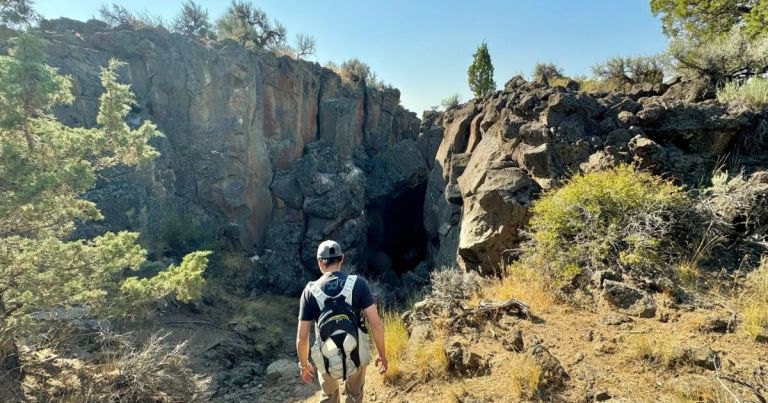

Central and Eastern Oregon show off a different version of the Pacific Northwest than most people are familiar with. While Western Oregon is best known for its moss-covered forests and coastal cliffs, the other half of the state tells a different, more seismic story. Here, sweeping lava plains, volcanic craters, and towering rock formations dominate the desert, intermixed with vast sagebrush stretches and arid grasses. It's worlds away from the lush, beachy, waterfall-filled landscapes found farther west, but even still, the natural wonders here are as majestic as they come. Travelers who make it past Bend will find plenty of evidence of ancient eruptions and incomprehensibly deep rivers still visible in larger-than-life ways. One of the coolest of these remnants is Crack-in-the-Ground, a two-mile volcanic fissure near Christmas Valley where you can descend directly into the desert floor. If a claustrophobic hike in Oregon is what you're after, this is it!

While many Oregonians are familiar with Newberry National Volcanic Monument, the canyons and lava fields farther east are perhaps some of the most overlooked spots in the state. Truth be told, the seas of black ridges, spirals, and craters formed by the lava flows from the nearby Four Craters Lava Field are easy to miss if you stick to the highway, but they're packed with prehistoric history worth exploring. This is where you'll find the otherworldly Crack-in-the-Ground Trail, hidden in this sea of solidified lava, as a part of the Four Craters Lava Bed Wilderness Study Area.
Uniquely, this isn’t a full-fledged canyon carved by water like Oneonta Gorge or the Columbia River Gorge. It’s a literal split in the earth where the surface pulled apart thousands of years ago and never closed again. Today, you can walk through it, and it's one of the coolest hikes you'll ever take, weaving between sheer walls of volcanic basalt that rise seventy feet overhead and narrow to just a few feet across.

The fissure formed as part of the Fort Rock Basin’s volcanic history, somewhere around 50,000-100,000 years ago. After ancient lava flows cooled and hardened, active faults sliced through the landscape, cracking the basalt like a sheet of glass. Most of these fissures collapsed and filled in over time, but this one stayed open, stabilized by interlocking slabs that jammed together before gravity could finish the job. The result is a natural corridor two miles long, a kind of hybrid between a slot canyon and a lava tube, that remains one of the few accessible open fissures in the country.
The Crack-in-the-Ground Trail begins at a small Bureau of Land Management parking area about eight miles south of Christmas Valley. From there, a sandy trail drops quickly from the open desert to the shadowy, slightly eerie subterranean world, nearly invisible from the sagebrush surface. Down here, with little direct sunlight and only sheer rocks surrounding you on either side, the temperature plummets by about 20 degrees, which can be a welcome respite in summer.
The first section of the fissure is wide and canyon-like, polka-dotted with trees that are growing impossibly through the rock. Farther in, the easy-to-follow trail narrows until your shoulders brush the sheer chasm sides. As you go, you'll find portions streaked with lichen and patches of moss, while in others the path rises over boulders lodged between the walls, or dips into shallow pools left after spring rain. You can scramble as much or as little as you like, but most hikers spend an hour or two exploring the length of the fissure before climbing back to the surface.

Photographers will love the way the sunlight and shadows play against the formations, so be sure to have a camera handy! Sunlight falls in narrow shafts that shift as the day moves, illuminating one wall and then the other, so even the same visit can look remarkably different hour-by-hour. At just under two miles total, the Crack-in-the-Ground Trail isn't a long or difficult hike, but it’s definitely an unforgettable one, especially if you start early and have it all to yourself.
Geologically, the entire Crack-in-the-Ground region tells a story of the PNW that spans thousands of years, all clearly visible as you go through the chasm. The pockmarked formations, layers, and sheer-cut columns can be easily read by those with geology or petrology experience. On the surface, the surrounding Fort Rock Basin was once home to a chain of volcanoes, each eruption layering the (now desert) valley in basalt and hardened ash. As the region cooled, deep fissures opened along faults. However, because it's such a stark and arid region, very little erosion or filling has occurred, meaning Crack-in-the-Ground looks nearly the same as it did when it was formed. It's literally a look into the past!

Above the fissure, the desert stretches in all directions. Fort Rock stands on the western horizon, its massive tuff ring formed when magma erupted through an ancient lakebed, likely over the same tumultuous period as Crack-in-the-Ground. To the east is the Lost Forest, which is a small stand of ponderosa pine that somehow survives far from its usual ecosystem. Those with extra time can loop these in along with other nearby geological sites, like Hole-in-the-Ground (we pride ourselves on clever naming practices here!). Together, they form a compact circuit of Oregon’s quiet and overlooked desert wonders.
The nearest town to Crack-in-the-Ground is Christmas Valley, which offers a few essential services. If you're looking for a little more than the basics, though, many visitors base themselves farther west in Bend or La Pine, where there are more lodging options and restaurants. However, since Crack-in-the-Ground is a BLM site, there are also a few camping options available in the immediate area if you feel like roughing it and enjoying some of the region's brilliant starry skies.
While slot canyons in Utah and Arizona get most of the attention, Crack-in-the-Ground is one of those true hidden gems, both literally and figuratively. And, quite honestly, the name is pretty fun too! For even more easy hikes in Oregon, lace up and check out some of our favorite short, sweet, family-friendly trails around the state. Then, use Only In Your State's AI Travel Planner to help plan the rest of your adventure-filled vacay.
Subscribe to our newsletter
Get the latest updates and news
Thank you for subscribing!