The Remote Driftwood Graveyard at Cape Blanco Might Be Oregon’s Most Haunting Beach Walk
Below the windswept bluffs of Cape Blanco State Park, a remote Oregon beach is piled with massive driftwood logs — a haunting, beautiful shoreline shaped by rivers, storms, and the wild Pacific.
There is a moment, walking down toward the beach at Cape Blanco, when the sound changes.
Up above, near the campground and bluffs, the wind is the thing you notice first. It moves through the trees, pushes against your jacket, rattles anything not tied down, and reminds you that Cape Blanco is not a gentle place. It is beautiful, yes, but it is not soft. This is Oregon’s western edge, a place shaped more by weather than by people.
Then you get lower, closer to the water, and the surf takes over.
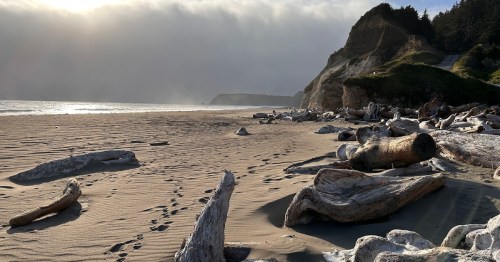
I had come to Cape Blanco State Park for the lighthouse, the campground, and the rugged coastline — all the things this remote stretch of the Southern Oregon Coast is known for. But what stopped me in my tracks was below the bluffs: a huge driftwood graveyard spread across the beach like the ocean had emptied out a forest and left it there.
Not a few pretty logs. Not the usual high-tide line of bleached sticks and smooth branches.
Whole trees. Root balls. Silver-gray trunks piled on top of each other. Cut ends, bark still clinging to some, others worn smooth by salt, sand, and time. Some logs looked freshly delivered, dark and heavy, still holding onto the smell of the forest. Others were pale and dry, the color of bone.
It was one of the most haunting beach walks I’ve ever taken in Oregon.
Why Cape Blanco Feels Different
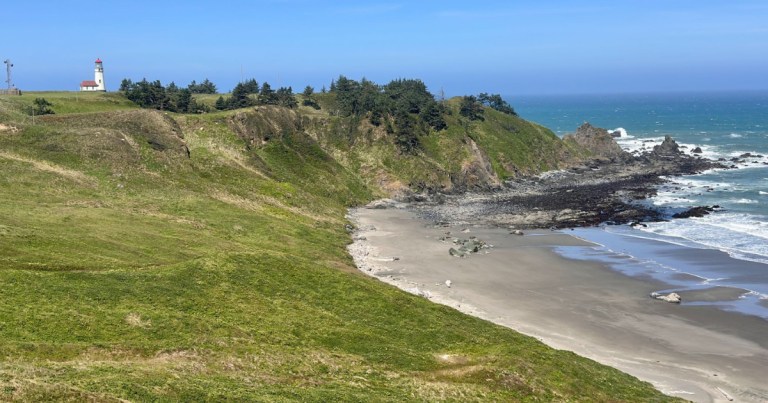
Cape Blanco State Park sits near Port Orford at Oregon’s westernmost tip, and you feel that geography almost immediately. The cape pushes out into the Pacific with a kind of stubborn confidence, taking the full force of wind, weather, and winter storms.
This is not the Oregon Coast of busy promenades or easy roadside viewpoints. Cape Blanco feels more remote, more exposed, more elemental. Even the campground has that end-of-the-road feeling, tucked into the trees but close enough to the ocean that you never forget where you are.
The park itself has plenty to explore: trails, beach access, rugged viewpoints, the historic Hughes House, and Cape Blanco Lighthouse. But the beach below the bluffs is where Cape Blanco really got under my skin.
The Driftwood Graveyard That Stops You

The first time I saw the driftwood piled along the beach, I just stood there for a minute.
It was the scale of it. Logs were stacked and tangled, some wedged into the sand, others thrown high above the active surf line as if dropped there by something much larger than ordinary waves. Walking toward it felt like approaching the remains of some enormous natural event — which, in a way, it is.
The wind was really working that day, pushing sand across the beach in little streams and making it hard to tell where the sound of the surf ended and the weather began. The ocean had that heavy Southern Oregon feel — gray-blue, cold, and completely in charge.
Up close, the logs were even stranger, the grain smooth and silver. Some worn into raised lines like a fingerprint. Others still had bark, splinters, and root balls attached, like they hadn’t been out of the forest very long. A few had clean-cut ends that made me think of old logging days. Others looked as if a storm had simply torn them loose from a riverbank and sent them out to sea.
It didn’t feel like junk washed up on the beach. It felt like the ocean had been collecting pieces of the forest for years and piling them here, one storm at a time.
How Rivers And Storms Built This Natural Archive

Part of what makes this Cape Blanco driftwood beach so fascinating is that the story is still being written.
The Sixes River drains rugged, forested country before reaching the Pacific just north of Cape Blanco. Nearby, the Elk River also carries water out of the Coast Range near Port Orford. During winter storms, these rivers can rise fast, undercutting banks, picking up downed trees, moving old timber, and carrying pieces of the forest toward the sea.
Once those logs reach the ocean, the Pacific takes over.
Tides, currents, storm surge, and big winter surf push and pull the wood along the coast. Cape Blanco’s exposed position helps make it a collector of sorts. Logs that have traveled through rivers and surf can end up stranded along the high-tide line, stacked above the beach, buried by sand, uncovered again, and shifted by the next major storm.
Some may have arrived during the most recent winter. Others look as if they have been there for years, maybe decades, bleached pale and worn soft by sun and salt air. You can see old and new wood side by side: fresh bark next to smooth silver trunks, torn root balls next to drift-polished limbs.
What It’s Like To Walk Through It

Walking through the driftwood takes some care. You can stay on the flat sand if you want the easy route, but it’s hard not to wander closer and start picking your way through the logs. One minute you’re stepping over smaller branches; the next you’re dipping into sandy gaps between huge trunks, testing your balance as something shifts slightly underfoot.
It slows you down in the best way. You have to pay attention — to where you step, to what feels solid, to which pieces are too wobbly or too tangled to cross. And in that slower pace, you start noticing the wood itself: the twisted roots, the smooth silver grain, the splintered ends, each piece with its own mysterious journey from forest to river to sea.
Slowly, I moved through the tangle, picking my way carefully through it. I’d climb over one log, step around the next, then stop because some odd shape or weathered surface pulled me in to want to touch it.
This place makes you curious. You start wondering where each piece came from, how far it traveled, and what kind of storm was strong enough to leave it here.
There is something eerie about it, but not in a frightening way. More like standing in a place where several forces have met and left evidence behind.
From the forest, down the river, in a storm, tossed into the ocean.
All of it ends up here.
What To Know Before You Go

Cape Blanco is beautiful and exposed, very wild. Check the weather, check the tide, and dress for wind, even if the day looks calm when you leave the main highway.
The beach is best explored at a lower tide, when you have more room to walk and less pressure from the surf. I would not wander too close to the water or climb carelessly on the biggest log piles. Driftwood can shift, and sneaker waves are a real danger on the Oregon Coast. No photo is worth turning your back on the ocean.
Day-use parking permits are required at Cape Blanco State Park, and if you are camping, the park makes a wonderful base for a slow exploration. One “only if you’ve been there” tip: secure anything lightweight at your campsite. Cape Blanco wind is not theoretical. It will absolutely test your camp chairs, towels, tablecloth, dog bowls, and patience.
The Beach That Stays With You

I have seen many beautiful Oregon beaches, but Cape Blanco’s driftwood graveyard stayed with me because it felt different.
It was not polished or postcard-perfect. It was rough, windblown, strange, and completely unforgettable. A place where the coast did not just look pretty — it seemed to be showing its work.
Walking among those logs beside the Pacific, with the wind in my face, I had the feeling I always hope for on a road trip: that I had stumbled into something much bigger than the thing I came looking for.
Subscribe to our newsletter
Get the latest updates and news
Thank you for subscribing!