Beaverhead Rock Is an Underrated Montana State Park That Will Pleasantly Surprise You This Fall
Montana's least-visited state park may be small, but it's actually a pretty prominent piece of history.
America's national park system has 424 units, but statistically, visitors tend to flock to only a few. The same holds true for the country's state parks, despite often boasting equally jaw-dropping scenery, awesome adventures, and way fewer crowds than their NPS counterparts. Montana is fortunate to have 55 diverse state parks to choose from (with a new addition on the horizon!), each with their own views, history, natural wonders, and glorious trails to explore. From the most-visited (Giant Springs State Park and Flathead Lake) to arguably the most unique (Makoshika State Park and Lewis and Clark Caverns), Montana's state parks run the gamut in terms of offerings, but all are well worth a visit. In terms of official numbers, though, there's one humble state park in western Montana that's surprisingly overlooked, and it just so happens to be dressed in its Sunday best come fall. This season, if you're looking for an unexpected outing, pay a visit to Beaverhead State Park near Twin Bridges for some epic photography opportunities and a whole lot of history.
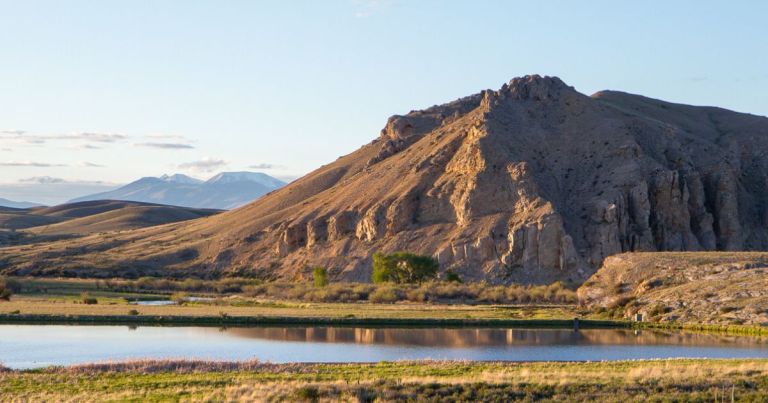
It's no secret that Montana’s western half is full of bold panoramas. From Glacier’s heavenly, sun-kissed vistas to the Beartooths’ sheer granite walls, the Treasure State definitely isn't lacking in geologic spectacle. But few of Montana’s rocks are as historically important as the monolith hiding in plain sight in the state's southwest corner. For travelers following the Lewis and Clark National Historic Trail, or for those drawn to the quieter corners of Montana’s frontier beauty, Beaverhead Rock State Park is a hidden gem that offers an unexpected combination: giant, epic rock formation meets pivotal American history.
And seriously, it's a very cool giant rock.

Known simply as Beaverhead Rock, this hard-to-miss formation near Twin Bridges and Dillon, Montana, has served as a navigational landmark for centuries. Long before modern maps or GPS coordinates, it was an important feature on the seasonal routes of the early Shoshone. It's so recognizable, in fact, that in 1805, it became a critical turning point in one of the most important journeys ever undertaken.
The origin story of Beaverhead Rock goes back to the summer of 1805, when the Lewis and Clark Expedition was traveling west along the Jefferson River. As they moved deeper into the West's challenging terrain, their progress depended more and more on the local knowledge and relationships they could build with local tribes. Their Shoshone interpreter and guide, Sacagawea, had been taken from this region as a child and recognized Beaverhead Rock from her youth.
According to Meriwether Lewis’s journal entry from August 8, 1805, she identified the rock and knew they were nearing the territory of her birth tribe, the Lemhi Shoshone, in modern-day North Idaho. Just a few days later, the Expedition ran into a group of Shoshone that reportedly led to peaceful negotiations and, just as importantly, the acquisition of horses that allowed the Corps to transport supplies over the rugged Bitterroot Mountains and continue toward the Pacific. Without Sacajawea's recognition and fortunate timing, the Expedition’s journey west might have failed before even reaching the mountains.

While Lewis only made a brief mention of “the Beavers head” in his notes, later historians and geographers marked it as one of the key physical landmarks along the expedition route. Centuries later, the rock was listed on the National Register of Historic Places in 1970, and the state of Montana was established shortly after. It's also one of dozens of official stops on the 4,900-mile Lewis and Clark National Historic Trail.
Today, Beaverhead Rock is preserved as a Montana state park, although the word “park” might seem like a misnomer to those who prefer more developed trails, tours, and accommodations, because, truthfully, there aren't any here. Beyond the rock is fenced-off private land, and the official park only consists of 71 acres to respectfully admire. Instead, perhaps consider it a scenic historical site, not unlike Tower Rock near Great Falls (same Expedition, different day, as the saying goes).

However, don't be deterred by the lack of development. There's still a dedicated parking area and interpretive signage, as well as a nifty crane statue to ogle. Plus, with so much wide-open space surrounding the rock formation, both sunrises and sunsets here are superb.
The rock towers over 200 feet above the valley floor at an elevation of nearly 5,000 feet. In true Western form, the surrounding landscapes stretch into the distance as a sea of gold and green sagebrush steppe, with some grassy flats along the Beaverhead River. All that brush is a banquet for wildlife, so the park is also a phenomenal place to go birdwatching, especially for raptors and waterfowl. And in fall, when the groundcover turns gold and the sun sets earlier, somehow the colors of the Beaverhead River Valley seem to glow from within, becoming even more saturated as the season wears on before fading into winter.


But even if you're more fascinated by the geology of giant hunks of rock like this, rather than the human history of them, Beaverhead Rock is still a pretty special place to visit. The formation is made up primarily of Madison Limestone, which is a type of gray, fine-grained sedimentary rock that was deposited in the Great Plains roughly 350 million years ago. At the time, much of what is now the western United States was submerged beneath a warm, shallow sea. Over eons, the accumulation of calcium carbonate from marine organisms formed thick layers of limestone that now form most of Montana's base.
The unique shape of Beaverhead Rock is the result of both ancient tectonic uplift and erosion. During the Laramide Orogeny, a major mountain-building event that occurred around 80 million years ago, older rock was pushed upward as the Rocky Mountains began to form. In the Beaverhead Valley, this uplift exposed portions of the underlying limestone while surrounding sediments gradually eroded away, leaving features like Beaverhead Rock as isolated formations (inselbergs) in their respective valleys.
However, for all the fascinating history and wildlife here, there's a reason why this tiny park is the least-visited in the state. Beaverhead Rock State Park isn't developed for recreation like most parks; in fact, you won't even find any picnic tables or restrooms to break up the long drive along Highway 41. But it's pretty special that this spot looks nearly identical to what Lewis and Clark would have encountered in 1805.

To complete your natural wonders-turned-history-lesson adventure through the area, just outside Dillon, Clark’s Lookout State Park serves as the perfect counterpart to Beaverhead, as it preserves the hilltop where William Clark climbed on August 13, 1805, to take compass readings and plot the surrounding terrain. About an hour’s drive southwest, Bannack State Park shows off a completely different side of Montana history with more than 60 original buildings from Montana’s first gold rush town, dating all the way back to 1862. Or, bring your pole along and try your luck for brown and rainbow trout in the Beaverhead River.
As far as hidden gems go, this rarely-visited state park definitely fits the bill. Thousands of travelers are drawn to Montana every year by the state's many jaw-dropping sights and wonders, but I definitely think historic, overlooked hikes like this one show off Montana's scenic diversity and history the way it was meant to be seen.
Looking for even more middle-of-nowhere surprises? Check out Only In Your State's official Travel Planner.
Subscribe to our newsletter
Get the latest updates and news
Thank you for subscribing!