This One Hike In Iowa Proves It’s Not as Flat as You Think
The most extreme hike in Iowa at Folsom Point has a ridgeline trail that proves Iowa is not as flat as you think.
We’ve all heard it a million times. Iowa is flat as a pancake and nothing but cornfields. But if you’ve ever wanted a verifiable, scientific comeback to overcome that generalization, jot down this ammunition: Iowa actually has more than 1,000 feet of elevation variation. Its lowest point is along the Mississippi River at around 500 feet above sea level, and its highest point is 1,670 feet, at Hawkeye Point on the northwest border with Minnesota.
And even if 1,000 feet of elevation gain still doesn’t feel that impressive, try applying that theory to a steep, uphill climb. But before you go running off to the disappointingly flat-looking Hawkeye Point, know that’s not where you’ll find the most extreme hike in Iowa. Most of our elevation variation is hidden amongst gradually sloping plains and forested ridges, barely noticeable to the naked eye.
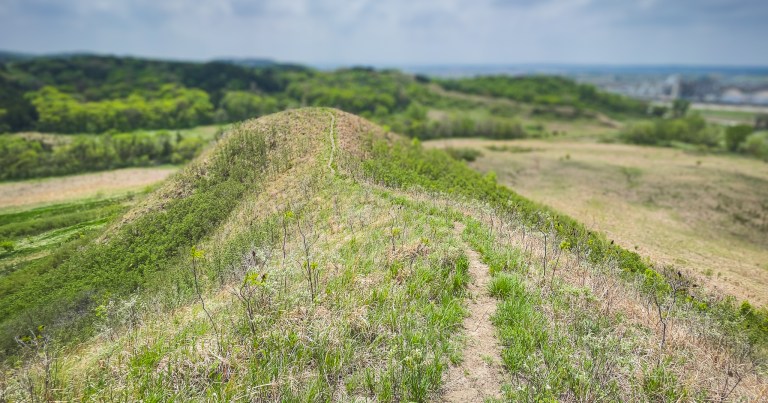
But I’ve been determined to find the best views in Iowa, so I’ve been traipsing all over the state looking for something with a little extra oomph. Perhaps I’m also looking for a little photographic proof that Iowa is not as flat as everyone thinks it is. I spend a lot of time in Iowa state parks and have found some impressive heights in the Northeast, atop the bluffs at Effigy Mounds National Monument and Pikes Peak State Park. But my favorite high-rising hike is not in the Drifless Area at all. Nor is it within a state park. In fact, it’s as far to the opposite side of the state as possible, in the Loess Hills, where the Missouri River floodplain has twice the elevation of that along the Mississippi River. And it’s quietly sleeping, unbeknownst to most, just 10 miles south of Iowa’s ninth biggest city, Council Bluffs.

It’s a truly secret paradise of startling prairie dunes, rising nearly 300 ft over a 2-mile trail in the Folsom Point Preserve. Despite almost 200 years of aggressive agricultural development across the state, somehow this little pocket of what Iowa once was has remained unscathed. Yet from the moment you stand at the base of the “point,” you will understand why no person was interested in hauling a tractor through these hills. It’s the closest thing to a mountain I’ve seen in Iowa, pointy peak and all. Even from the base, the serenity here is all-encompassing, a walk back in time to when the only sound on the prairie was the wind whistling through the grass. Fortunately, it will remain this way forever, protected by the Nature Conservancy as one of the largest remaining expanses of native prairie in the Loess Hills.

I prepared for what would likely be the most extreme hike in Iowa I’d encountered so far. And even brought my kids along for the late-May adventure, wondering if my husband would be piggybacking them up the last quarter-mile of the trail. Fortunately, despite the looming elevation, the Folsom Point Loop isn’t that difficult; it’s more of a slow-and-steady wins the race kind of deal. At first, we aimlessly picked our way up at the steepest point (just to say we did), but then found a game trail that led straight across the ridges before gently rolling us back to start again.
The views and the breeze at the top were astounding, leaving us longing for a kite to soar like eagles over the ridges and ravines. But instead, my son raced along the thin trails, arms out to the side, wind in his hair, big grin on his face. And I click, click, clicked away, trying to capture the best of our moments perched on Folsom Point, the highest I’ve ever felt in Iowa.
Looking for more Iowa hidden gems? Let Only In Your State's AI-powered itinerary planner give you a hand.
Subscribe to our newsletter
Get the latest updates and news
Thank you for subscribing!