No One Knows Why This Haunted Oregon State Park Was Abandoned
Oregon has more ghost towns than any other state in the U.S., but their populations are often far from zero. The residents just aren't from the land of the living.
Specters: they make their presence known by items falling, seemingly with no help from the living, and by eerie whispers, faint glimmers, and strange sensations. To some, they're the face that seems out of place or in an empty, misty cemetery. To others, they're the sudden cold spots in an otherwise warm room. Whatever the experience, supernatural, unexplained encounters like these have been reported across the country's spookiest abandoned places for decades—some for centuries.
Whether you personally believe in ghosts or not, Oregon has plenty of haunted places to choose from, each boasting a hefty dose of the paranormal. But of all the ghosts (and ghost towns) Oregon has hiding in its recesses, one of the coolest spooky hotspots is actually hiding in plain sight in one of Oregon's most overlooked state parks: Golden State Heritage Site near Medford, Oregon.
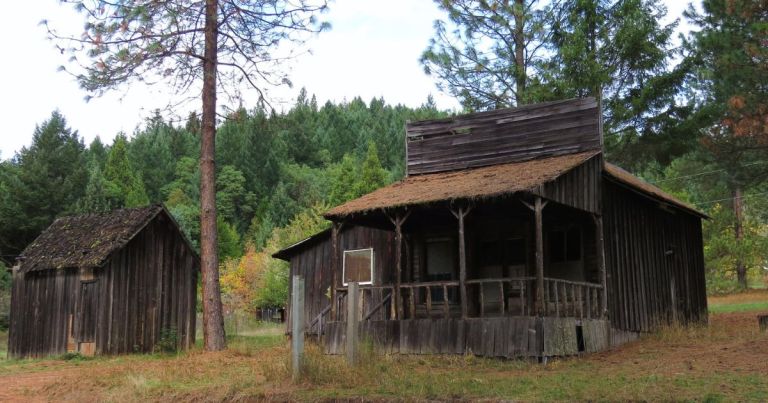
Off a quiet road in Southern Oregon, the town of Golden sits in a small clearing framed by Douglas firs. This now-eerily quiet mining town was founded in the 1890s during a short-lived, family-led gold rush along Coyote Creek, but unlike more notable ghost towns like Shaniko and Antelope, Golden never really blossomed into one of the bustling, rowdy strike-it-rich meccas found elsewhere. Instead, a small subgroup of religious settlers, led by Reverend William Ruble, built the town into a small, disciplined community, where they outlawed alcohol, gambling, and even dancing—a rare ideology for a mining town. The town had two churches, a schoolhouse, and a post office, but it never had a saloon, and it never grew to house more than around 100 people.
In the middle of this decidedly mellow community, the gold disappeared, and the people quickly followed after a short stint as a "traditional" town. Then, the post office shut down in 1920, and within a decade, nature crept in to replace the residents.
Today, Oregon Parks and Recreation manages the Golden State Heritage Site, but surprisingly few people know about it. Most visitors come by word of mouth or the occasional online mention—often because they’ve heard that Golden is haunted. And if those rumors are to be believed, it turns out there might actually be quite a few residents still holing up in this forgotten town; specifically, from the Other Side.
And that’s where things get even stranger.

Like most ghost towns, today, what’s left of Golden isn't much. Visitors to the town's remains will find little more than a preserved church, a humble general store, and a carriage shed suspended in time, even though at its peak, there wasn’t much more than there is now. But unlike other haunted spots in the West, Golden doesn’t have a clear incident to explain its spooky reputation—although the woodsy, isolated setting plays a role. Since it wasn't a typical rowdy mining camp, murders, woe-begotten maidens, and untimely demises aren't the usual culprits fueling the haunting tales. Nevertheless, the stories have prevailed because what Golden lacks in shoot-em-up drags over mining claims, it makes up for in cult rumors and restful spirits caught between worlds as a result.
In 2017, the Travel Channel’s "Ghost Adventures" filmed an episode on location in Golden. The crew focused primarily on the church, which is a small, rustic structure rebuilt in 1950 on the original foundation. Inside, they claimed to experience sudden nausea, dizziness, and physical discomfort. They described the space as oppressive, even hostile. One investigator said something unseen hit him in the stomach.
After the episode aired, more visitors began to report similar sensations: unexplained cold spots, strange sounds, and shadowy figures glimpsed through windows. Numerous visitors have mentioned hearing footsteps in the church when they were alone.
Crowd mentality? Perhaps. After all, none of these stories have been verified, and there’s no documented link to any death or mass event. Still, more keep pouring in.

The church is the focal point for many of the ghost stories, and some theories even suggest that the Reverend himself is one of the presences haunting the building—an unwilling victim of an unknown malevolence unintentionally awoken in the town orchard or perhaps dragged up from a deep mining pit—now luring travelers into the town's depths and clamoring to break free.
Across from the church, the simple, nondescript general store still stands, its porch bowed and windows cloudy with age. Some visitors say they’ve seen movement inside. Others have heard sounds from the back room, like wood shifting, maybe, or something less benign. The presence here has never been identified, although some believe it may be the shopkeeper's wife, who is said to have disappeared in 1901 without a trace.
A residence sits farther up the road. Today, it's been partially restored, but that hasn't deterred the spirits left behind. If you happen to be here after dark, you might just hear the creak of rusty door hinges or mysterious whispers from inside. Some have described a vague sense of being watched from the surrounding forest, and unsettling rustling coming from the direction of what would traditionally be the town cemetery.
It's all a part of the intrigue.

But even if ghosts, ghouls, and hauntings aren't your thing, Golden is still a unique place to visit for the history. Most old mining towns have a distinct architectural style, but the settlers here made the buildings intentionally unremarkable. They naturally blend into the forest surroundings, and were pieced together by hand by the founding families.
As an official state park, a trip to Golden has fees, rules, and hours to follow. But the historic site is open year-round, so if a ghostly ghost town encounter is on your wish list, time it carefully to take advantage of spooky fall ambiance and dark, chilly days. You'll find it about 30 minutes north of Grants Pass. The site isn’t extensively signed, so keep an eye out for a small dirt pull-off and state heritage marker. You'll also encounter spotty cell service due to the surrounding Klamath Mountains, so be sure to avoid visiting alone, especially near closing. You never quite know who (or what) you'll encounter.
Oregon actually has a few other ghost towns with even more chilling backstories. But as a photographer with a penchant for the weird, untold, and darker sides of history, I've always found that the best spots to explore are those that blend both history and lore. And when you stumble upon a ghost town riddled with more questions than answers, with only the briefest of published memoirs, you're likely to find more than you bargained for!
Looking for more abandoned places in Oregon? Check out Only In Your State’s itinerary planner.
Subscribe to our newsletter
Get the latest updates and news
Thank you for subscribing!