The Serpent-Shaped Earthwork in Ohio That Still Baffles Archaeologists to This Day
Visit Serpent Mound in Ohio, a striking prehistoric earthwork in Adams County shaped like a serpent and surrounded by natural and historical intrigue.
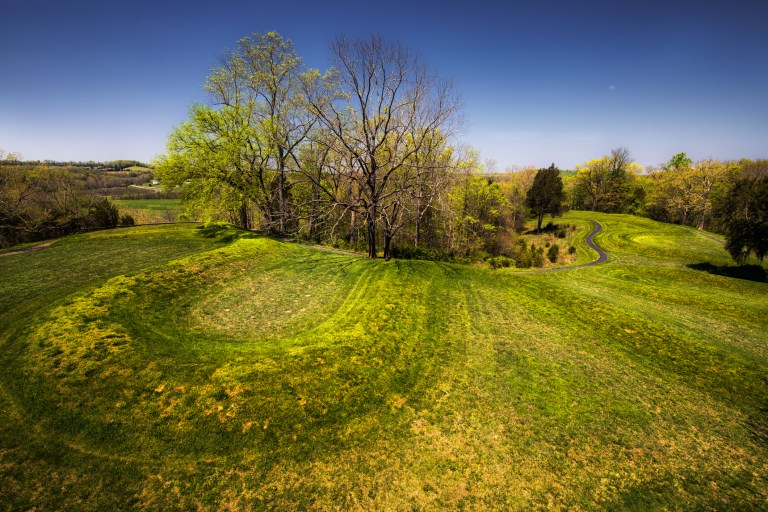
On a quiet plateau in Peebles, the Serpent Mound in Ohio winds across the landscape in sweeping, grassy curves that are easiest to recognize from above. Stretching 1,348 feet from head to tail, this massive Ohio effigy mound is one of the most remarkable prehistoric earthworks in North America, and its sheer scale continues to spark a deep debate among archaeologists and visitors alike. To see it in person is to realize that the shape feels entirely deliberate, as if the land itself was carefully arranged to hold a meaning we are still trying to decode.
There is a quiet stillness here that feels almost out of place, as if the hills are holding onto a story they haven’t fully given up yet.
What Is the Serpent Mound in Ohio

This prehistoric effigy resembles a giant snake with seven coils, an open mouth, and an oval feature near its head, often viewed as an egg. It is one of the most iconic ancient earthworks in Ohio and stands apart for its incredible design and placement in the countryside.
Unlike many nearby sites, Serpent Mound is not a burial mound. No human remains or grave goods have been found within the structure itself, deepening the ongoing Serpent Mound mystery and leaving its purpose open to speculation.
The oval feature near the head remains one of the most debated elements. Some researchers see it as an egg, while others suggest it may represent a frog or a symbolic marker tied to seasonal or ceremonial meaning.
Why This Effigy Mound Remains a Mystery

Part of what makes the site so compelling is its unusual setting. The coils sit within the Serpent Mound impact structure, a rare geological formation created by an ancient meteor strike. This unique topography makes it unlike nearly any other prehistoric mound sites in Ohio.
The mound also shows a sophisticated link to the stars. The serpent’s head is widely believed to align with the summer solstice sunset, suggesting a connection to seasonal observation. Some researchers also propose additional alignments tied to winter solstice events, though these theories remain a point of healthy debate.
These ideas lead back to a simple but still unanswered question: what did the serpent mean to the people who built it? Across the region, ancient earthworks reveal the extent of mound-building traditions, each one offering a different glimpse into how early Native peoples interacted with the land.
The History Behind Serpent Mound

For many years, the monument was attributed to the Adena culture, an early society known for ceremonial and burial earthworks. This conclusion was based on comparisons to nearby Adena culture mound sites, where similar engineering was found.
However, radiocarbon testing in the 1990s suggested a later connection to the Fort Ancient culture site, dating to around 1070 CE. Today, the Ohio History Connection notes that the site may have a more complex history than a single origin, possibly involving reuse or modification over time. This layered timeline is part of what keeps the Serpent Mound mystery so compelling.
What To Expect When You Visit

Visiting Serpent Mound offers a rare opportunity to walk alongside one of the most significant prehistoric mound sites in Ohio. A paved walking path follows the serpent’s curves at ground level, giving a sense of scale that photographs rarely capture.
For the full perspective, the observation tower reveals the complete serpentine shape of Serpent Mound in Ohio, clearly showing how it interacts with the surrounding valley. Interpretive signage throughout the park explains both Adena and Fort Ancient perspectives, along with the geological impact structure beneath the mound, helping connect natural and cultural history in one place.
Spring and fall are especially striking, when the rolling hills of Adams County feel most alive.
A Lasting Sense of Wonder

Serpent Mound in Ohio remains one of the most intriguing ancient earthworks in Ohio, not just because of its size, but because of what it still doesn’t fully explain. Its shape, setting, and uncertain origins create a place that feels both grounded in the earth and open-ended in meaning.
From the ground or from above, the serpent holds its form quietly across the ridge, unchanged, unanswered, and still inviting a sense of wonder.
Before you go, visit the official website for Serpent Mound Historical Site for current hours, admission details, events, and more information about this remarkable landmark.
Interested in more of Ohio's ancient secrets? If you want to dig even deeper into the region's history, check out this fascinating archaeological discovery that put a small town near Cleveland on the map by revealing some of the oldest human structures in North America.
Subscribe to our newsletter
Get the latest updates and news
Thank you for subscribing!