Welcome to Rumor Has It, a series investigating some of the most compelling lore and legend across the U.S. These articles invite readers to dig deeper, ask questions, and be curious.
Rumors, Restless Souls, and the Real Columbia: Exploring the Haunted Heart of South Carolina
A firsthand journey into Columbia’s haunted history—where ghost stories, unsolved mysteries, and Southern gothic legacies come to life after dark.
By the time our guide lit the lantern, the sun was just beginning to dip behind the skyline, casting a blue-gray wash over Columbia’s wide streets and old brick facades. There’s something about this Southern capital after dark that chilled me. It doesn’t try to be spooky. It just is.
I love a good walking tour, especially after the sun sets and the real stories come to light. I recently went to Philadelphia to enjoy a haunted history tour that showed me a completely different side to the city, and wanted to do the same with my trip to Columbia, South Carolina. I stumbled upon a company called US Ghost Adventures and decided to sign myself up. While I had an idea of what to expect on this nighttime adventure (hello, local folklore and legends!), I was unprepared for just how much I would learn about Soda City's past, including one of the most infamous murders the South has ever seen in broad daylight.
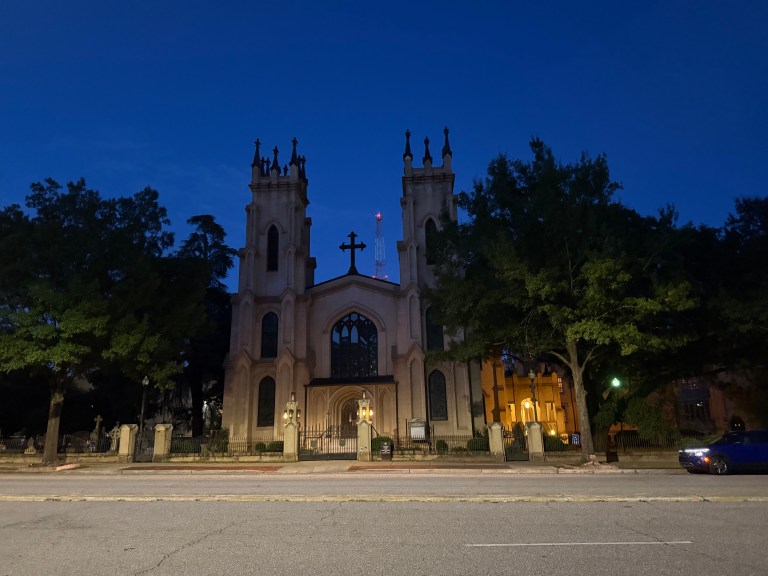
By the time our guide lit the lantern, the sun was just beginning to dip behind the skyline, casting a blue-gray wash over Columbia’s wide streets and old brick facades. There’s something about this Southern capital after dark that chilled me. It doesn’t try to be spooky. It just is. Quiet, very humid, and a little too still, this was the perfect stage for US Ghost Adventures’ walking tour, which promises a walk through Columbia’s haunted heart without veering into the campy.
We began at the Trinity Episcopal Cathedral graveyard, where quite a few notable families and politicians are buried. Our tour guide, Hayden, was dressed in old timey clothes, complete with a vest, dress shoes, a wide brimmed hat, and of course, a lantern. As we wandered through the cemetery, Hayden pointed out, the cemetery walls were different than most. Why? Because the plans to build the cemetery walls were not proportioned properly to the size of the lot. So, he explained, "the gravestones were simply built into the walls."

As we walked through downtown, the city revealed its layers, not just its ghosts, but its historic scars. Columbia has been burned to the ground, rebuilt, divided, and reimagined, but some things still cling to its streets. On the University of South Carolina campus, we stopped at the horseshoe in the center. Hayden got up on a cement planter and asked, "Can any of you find the only cemetery plot still remaining within this courtyard?" While nobody could accurately pinpoint, he pointed to a stone grave just outside of a campus building door. "Seems pretty strange to still have someone buried right in a courtyard of college campus, no?"
I shivered.
At one point in the evening, as Hayden's shoes clacked along the sidewalk, he turned to us and said, "now let's go find the spot where the most gruesome murder in Columbia took place."
We stopped in front of the State House, not to enjoy the bronze Washington sculpture or gaze up at the beauty of the lights illuminating the columns, but instead for a story that took place across the street where an old dive bar once stood and now a Moxy hotel.

In 1903, journalist Narciso Gonzales, co-founder of The State newspaper, was shot in broad daylight on Main Street in Columbia, South Carolina, by Lieutenant Governor James H. Tillman. Gonzales had publicly criticized Tillman in scathing editorials, calling him unfit for office. Despite Gonzales being unarmed, Tillman claimed self-defense and was shockingly acquitted. The killing, just steps from the State House, exposed deep political corruption and remains one of South Carolina’s most infamous injustices. Gonzales is remembered as a fearless voice for truth—murdered for holding the powerful accountable in a city still haunted by its past.

What struck me about the Columbia haunted tour wasn’t just the stories, though those were rich, complicated, and rooted in place, but the way the city itself seemed to shift the longer we walked. Shadows deepened. Buildings whispered. History wasn’t just something you read in plaques, it pulsed, quietly, around us, in the spots on the capitol building's walls where canon shots were marked with stars, or in the hidden gravestone our tour guide brought us too right on a main thoroughfare.

There’s no jump scares or hokey theatrics here. Just a slow, steady immersion into the parts of Columbia that don’t make it into travel brochures. The tour felt less like a ghost hunt and more like a history lesson with a heartbeat, a reminder that every city has its share of spirits—some seen, others simply felt.
What struck me about the Columbia haunted tour wasn’t just the stories, though those were rich, complicated, and rooted in place, but the way the city itself seemed to shift the longer we walked.
By the time we circled back to our starting point, I didn’t need to be convinced that Columbia was haunted. Haunted not just by ghosts, but by the weight of its own past. You don’t need to believe in spirits to feel them brushing against your shoulder here. You just need to listen.
Subscribe to our newsletter
Get the latest updates and news
Thank you for subscribing!