16 Oldest Towns in New Jersey That Are Full of History
You'll journey back in time at these Garden State landmarks.

New Jersey was one of the first established colonies and states in the U.S., so it's no wonder it's full of historical lore. Before then, the coast of New Jersey was first explored by Giovanni de Verrazzano, an Italian explorer, in 1524, and was first settled by Europeans in the early 1600s.
When it comes to American history, the Garden State was the third to ratify the U.S. Constitution, and its capital city, Trenton, houses the building once used as the U.S. Capitol. Fast forward to the present day, and Jersey is home to some of the coolest, oldest towns in the country—some of which we know you'll love to explore! Check out our list of favorites below.
1. Jersey City
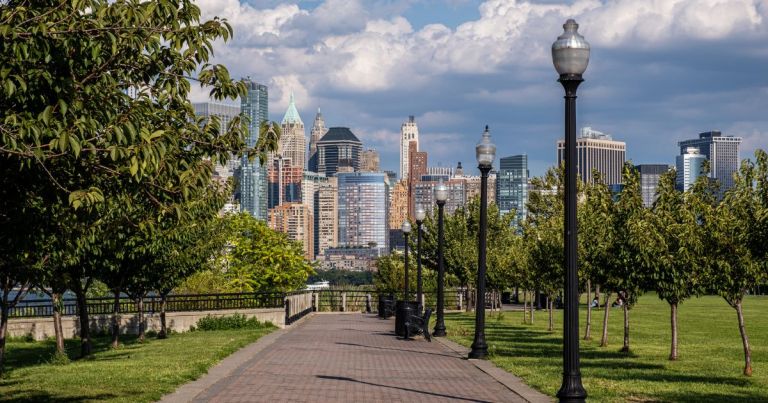
One of our favorite towns for a weekend getaway is Jersey City. It was inhabited in the 1600s by affluent business owners like Michael Reyniersz Pauw and Cornelius Van Horst. The latter built his home in Harsimus Cove in the 1630s, though it no longer remains. The oldest surviving building in the town is the Newkirk House, aka Summit House, which was built in 1690.
Now, Jersey City is the second most populous city in the state, often referred to as "Wall Street West" thanks to its economic trade centers. When you visit, you'll see all sorts of historical and preserved architecture.
2. Greenwich Township

This Gloucester County town and Philadelphia suburb is home to the oldest surviving log cabin in the U.S.: the C.A. Nothnagle Log House, built in 1638. Located in the community of Gibbstown, the home is privately owned and was recently sold in 2023. The house predates the town, which was formed in 1695 and officially incorporated in 1798. The current population sits at around 5,000 residents, making it a quaint yet charming town to visit. It's well-known for its beautiful parks and outdoor recreation.
3. Burlington

Beautiful Burlington, New Jersey, was established in 1677 as part of William Penn's "West Jersey" Quaker settlement. Once the county seat of Burlington County, it is home to the oldest surviving church in New Jersey—St. Mary's Episcopal, built in 1703. The town's library system was organized in 1757, making it the oldest continually operating library in New Jersey and the seventh oldest in the U.S. It's truly a sight worth visiting on your next trip to this cute town.
4. Newark

Newark was founded in 1666 by Puritans from Connecticut, and originally became a town in 1693. It is believed that the town's name was derived from Newark-On-Trent, England, though others say the name has biblical roots: New Ark of the Covenant, bringing new hope. As Jersey's most populous town, Newark is a hub of industry; it's home to businesses like Anheuser-Busch, PSE&G, Prudential Financial, IDT, and Panasonic. It's also home to Branch Brook Park, the oldest county park in the U.S., where you can see the largest collection of cherry blossoms in the U.S., too.
5. Piscataway

First established in 1666, the town of Piscataway is over 350 years old! The land was granted to Massachusetts natives by New Jersey's first Governor, Philip Carteret. Additional settlers soon arrived, including Quakers and Baptists fleeing a Puritan colony along the Piscataqua River in New Hampshire. Now, it's home to around 60,000 residents and hosts part of Rutgers University's main campus. Stroll along River Road to discover the town's oldest buildings, part of the Road Up Raritan Historic District. Homes here date from 1720 to 1865.
6. Freehold Township

Freehold Township was first settled on All Hallows Eve, 1693, and was incorporated by the state of New Jersey in 1798. The historic Battle of Monmouth was fought here, and in neighboring Manalapan, in June of 1778. Led by George Washington, the legend of Molly Pitcher (a woman who secretly fought in the Revolutionary War) originates from this battle. Less than a century later, Freehold Raceway opened. Built in 1854, it is the oldest harness racetrack in the U.S. It's no longer open, but its legacy lives on through the town's lore.
7. Chatham Borough

The Borough of Chatham was first settled by European immigrants in 1710. Originally called John Day's Bridge, the name was changed to Chatham in 1773. Chatham was chosen in honor of William Pitt, Earl of Chatham, a member of the British Parliament who advocated for the colonists. One of the state's first printing presses was established here in 1779. Now, you can visit several museums in the town, including the Atwood Museum, to learn all about the small town's origins.
8. Ridgewood

Though Ridgewood wasn't officially established until 1894, the area was settled in 1700 by Johannes Van Emburgh, a prominent doctor who purchased 500 acres of land to start the town. Now, there are a dozen different buildings in the neighborhood listed on the National Register of Historic Places, including the stately Ackerman House and Rathbone-Zabriskie House, both built in the late 1700s. There's also the original Paramus Reformed Church, which was used by the Continental Army during the Revolutionary War. You can spot many of these landmarks today.
9. Morristown

Morristown, considered the "Military Capital of the American Revolution," was first settled in 1715 by Presbyterian migrants from Long Island, New York, and New Haven, Connecticut. The town was named for Lewis Morris, a Royal Governor of New Jersey. By the mid-1700s, the town was thriving, and in 1773, George Washington made his first visit. In the winter of 1777, he and his troops camped here, in the Ford Mansion and Jockey Hollow (which you can visit today).
The town's role in the Revolutionary War isn't its only claim to fame: Samuel Morse and Alfred Vail constructed the first telegraph at the Speedwell Ironworks in 1838, and the Bethel African Methodist Episcopal Church was incorporated in 1843. This was one of the first black congregations in Morris County, which opened one of the first schools for black children in the area.
10. Cape May

The charming waterfront town of Cape May was officially established in 1848 as Cape Island, but it was settled decades before. The area was discovered by explorer Cornelius Jacobsen Mey in 1611, and became the nation's first beach resort in the mid-1700s. Vacationers from Philadelphia flocked to the area, and now tourists from around the world do the same.
Famous for its stunning Victorian homes, Cape May also has a military past. During WWII, the town was essential in protecting the coast of New Jersey and preventing lost ships at sea. A Naval Air Station, Naval Annex, Frontier Base, and Anti-Submarine Attack Teacher Training Unit were all located in the area. Cape May is currently home to the nation's only Coast Guard Recruit Training Center. Also, it's one of the top bird-watching destinations in the world, home to over 400 species of migrating birds.
11. Princeton

Henry Greenland was the first European to settle in Princeton, building a home and tavern in 1683. The town began to expand in 1709 when Quaker and landowner Richard Stockton gave the land to his sons. Princeton University was established in 1746 (in Elizabeth) as The College of New Jersey and has been located in Princeton since 1756. In fact, the school's Nassau Hall originally housed the New Jersey Legislature and briefly served as the U.S. Capitol Building.
Another fun fact? F. Scott Fitzgerald's first novel, "This Side of Paradise," was based on his time spent in Princeton as a student. Wandering the campus still feels like a time capsule of years past.
12. Toms River

Toms River was first established by Royal Charter as Dover Township in 1767. Vital to the Revolutionary War, the town was home to salt works that supplied Colonial troops and harbored privateers who attacked the British. Fast forward a few hundred years, and the town's little league team made headlines in 1998 for winning the Little League World Series. The town's youth football and cheerleading squads have also taken home several national titles. You'll find many historic sites and stunning murals in Downtown Toms River. The peaceful waterfront docks are a must-visit, too.
13. Cranbury

Incorporated in 1872, the town of Cranbury dates back much further. A land deed noting homes and improvements from 1698 serves as evidence that the area was settled over three centuries ago. Alexander Hamilton and Marquis de Lafayette used a home in the town as their headquarters during the Revolutionary War, and paperwork from their stay details the presence of a church, a mill, and over two dozen other buildings in 1778. The entire downtown is listed on the National Register of Historic Places. When you visit, stroll to the picturesque town hall, stop to gaze upon the cherry blossoms, and take in the charm of this small town.
14. Trenton

Our state's capital city was founded in 1719 and was named for William Trent, a prominent merchant in the area. The Battle of Trenton was George Washington's first military victory, and the U.S. Army had a strong presence in the town during the War of 1812. Trenton is also home to the Old Barracks, a vital piece of New Jersey history. Now, you can tour the historical barracks along with several other prominent landmarks like the NJ State House and State Museum.
15. Greenwich

Named after Greenwich, England, this New Jersey river town was officially incorporated in 1798, though the area was inhabited well before then. Citizens participated in their own Greenwich Tea Party on the Cohansey River, one year after the famous Boston Tea Party, to protest taxation and overbearing rule from the British monarchy. Pictured is a monument dedicated to the event, which you can visit to this day in the town center. Be sure to also stop by Ye Greate Street, the town's main historic district, when you visit.
16. Elizabeth

First founded as Elizabethtown in 1664, the town was not named after Queen Elizabeth. A common fallacy, it was actually named after Elizabeth Carteret, wife of Sir George Carteret, one of the founders of New Jersey. The city of Elizabeth served as New Jersey's first capital and played a vital role in the Revolutionary War. Singer Sewing Machines' first major factory was built in Elizabeth in 1872, and one of the first car companies, Electric Carriage and Wagon Company, also got its start here. Elizabeth has also been named one of "America's 50 Greenest Cities," due to its plethora of parks and outdoor recreational spaces.
New Jersey has so many towns dating back hundreds of years (think: Swedesboro, South Orange, etc.), it would be impossible to include them all on this list. What other New Jersey towns would you be interested in learning the history of? Discover them yourself on a once-in-a-lifetime roadtrip through the Garden State—Only In Your State's itinerary planner can help guide the way.
Subscribe to our newsletter
Get the latest updates and news
Thank you for subscribing!