Witch’s Butter & Golden Chanterelles: Mushroom Foraging in Sonoma County
A rain-soaked, wonder-filled mushroom hunt with expert forager Steve Conwell reveals the hidden magic, edible treasures, and wild forest stories of the Sonoma Coast.
The rain was coming down in silver sheets when the first car in our caravan screeched to a stop on a winding Sonoma County road. Before I could pull over behind him, our guide, Steve Conwell, wild-food educator and resident forest storyteller, had already launched himself out of his truck and plunged into the dripping roadside brush.
"There it is!" he shouted, holding up a brilliant red-and-orange mushroom as rain poured off his jacket. “Amanita muscaria, Alice in Wonderland shroom! I had to show you this one."
His grin, bright and boyish, cut through the storm. And just like that, before we'd even reached the trailhead, the forest delivered her first secret.
Magic doesn't wait for perfect weather, he seemed to say. Sometimes it appears soaking wet and luminous beside the road—if you're willing to look.
A few minutes later, we parked along a lonely stretch of gravel, slamming doors and popping umbrellas like forest-colored flowers. The hunt had started early. And with Steve as our guide, it was clear the forest wasn't going to wait for us.
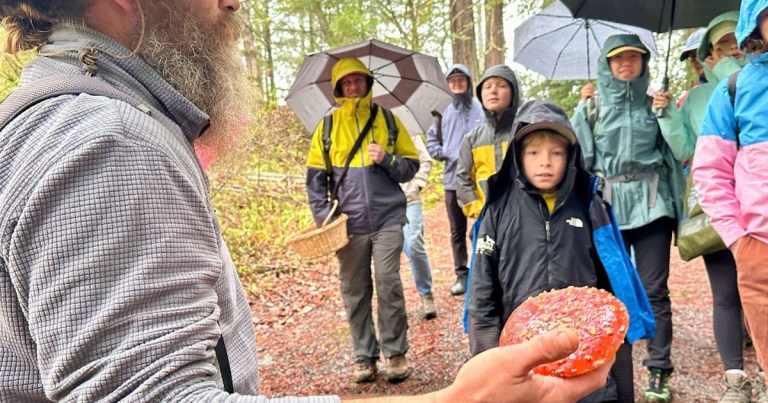
The Forest Opens Up
Earlier that morning, we'd gathered beneath a tiny porch as rain hammered the metal roof like a drumline. Steve passed around waivers, his energy crackling despite the drenching storm.
"Where do you think you find mushrooms?" he asked the group.
"Under trees!" someone offered.
"Yes," he said, "but also, wherever you look."
He had a way of saying things that made the forest feel like an eager companion, just waiting for us to tune in.
Before we left the shelter, Steve made sure we were prepared. He pointed out his three essential mushroom-hunting apps:
- OnX Backcountry — offline maps and property boundaries for navigating land safely
- Picture Mushroom — his go-to for building a photo library of finds
- iNaturalist — “where we all become citizen scientists.”
Then he added a fun aside: "Banana slugs have unique slime trails—just like fingerprints."
We were already laughing, already learning, loosening into the day.

Into the Rain-Drenched Woods
By the time we reached the trailhead, water rushed in rivulets down the fire road. Steve told us he once lived up the hill and volunteered for Sonoma County's fawn rescue. Then he casually mentioned he had live-trapped a 160-pound mountain lion on his property.
"But don't worry," he deadpanned, "I brought bear spray." Then, bursting into song: "Lions and tigers and bears—oh my!"
His humor wasn't a gimmick—it was his way of easing us into the woods, dissolving fear, helping us see wonder instead of wet. He began with safety: zigzag down slippery hills, don't follow him into danger spots, and always return mushroom stems to the soil so the forest can regenerate.
"And don't be a Gnome Wesley," he added, referencing the Belgian cartoon character who stomps through forests kicking mushrooms. "Respect the living world."
With that, we stepped into the soaked, breathing forest.

The First Finds of the Day
The rain intensified, making my notepad run with ink. But the woods felt alive—each droplet awakening color, scent, and possibility.
Steve darted ahead, calling back: "Gather up! Come look!"
We crowded around discovery after discovery:
- Witch’s Butter, glowing yellow and slick as jelly.
- Warlock Butter, its dark counterpart.
- White Coral Fingers, like tiny ghost hands rising from the soil.
- Shrimp Russula is unmistakable by its fishy smell.
- Lactarius delicious, commonly known as the delightful milk cap.
The rain soaked us, but it also unveiled things we wouldn’t have seen on a dry day. Mushrooms plumped by moisture glistened like polished jewels. The ground, newly awakened, breathed out its earthy perfume.
He reminded us to look up, down, far, and close—all at once. “Mushrooms hide in plain sight,” he said. “The forest gives clues. Patterns. Balance. Look, and you start seeing differently.”
The truth of that would reveal itself slowly, like a mushroom pushing up through the duff.
But somehow, the woods didn’t feel gloomy—they felt alive.
Breathing. Generous. Welcoming.

Golden Treasure: The Chanterelle Moment
Then came the moment. Steve froze mid-stride, eyes locked on a patch of forest between tall redwoods. “Don’t follow me!” he yelled as he skidded down the embankment. “But look at this!”
He brushed aside leaves and duff with a practiced hand.
“Chanterelles. California Pacific Golden Chanterelles!” Their golden ridges glowed like captured sunlight.
"These," he said softly, "we'll cook later."
He placed them carefully in my basket. I felt like I had been entrusted with some precious jewels.

A Forest That Teaches
Steve moved with uncanny instinct, spotting mushrooms we'd walked past without noticing:
- A Hairy Curtain Crust on a dead log
- A massive moss throne he called Mountain Lion Rock
- Logs bursting with oyster mushrooms (“Too waterlogged today”)
Then he knelt beside a dark crevice, scooped soil into his hand, and shone a blacklight on it.
A deep red glow bloomed. "Algae," he said. "Phosphorescent. Sometimes it feels like snorkeling a coral reef in the forest."
A few minutes later, he guided us up a slippery slope—switchbacking, as taught—to see an Artist’s Conk, its underside a delicate blush of pink.
"Don't pick it," he said. "It could live here for fifty years."
That's when I truly felt it: Steve wasn't just teaching us mushrooms—he was teaching us relationships. This forest wasn't a resource. It was a presence. A teacher. A companion.

More Gifts From the Woods
Even as the storm grew wilder, the forest kept offering more:
- Honey Mushrooms (Armillaria spp) are edible but too “buggy” today.
- Turkey Tail, a medicinal treasure.
- Bears Head Tooth, in the Lions Mane family—“Yes, edible!”
A startled Giant Pacific Salamander was shepherded safely away by Steve. Steve gathered us to allow everyone a safe look, then shepherded the salamander back into hiding.
"There are more wonders out here than mushrooms," he said.
He also reminded us: 6,000 mushroom varieties in California, 1,000 edible. Fewer than 100 truly good to eat.
"Mushrooms teach patience," he said. "And humility."

Back to Camp: The Alchemy of Wild Foods
At the end of the trail, he gathers us up. “Now is the time to explore on your own. Stay on this road and meander back to camp. I’ve got to get ready to cook.”
When we reached the clearing, he had transformed a rain-lashed woodland into a bustling outdoor kitchen: a huge tarp overhead, a gas burner roaring, tables laid with tools, bowls, spices, and wild-food gear.
He taught us how to make shiitake logs, scrape moss, drill holes, insert spore plugs, and seal with wax. Kids crowded in, wide-eyed and muddy. Then the real feast began.
"Let's fry that Lion's Mane," he said. He dry-sautéed it first, "Always release the moisture"—then dipped the pieces in an egg wash, panko, and a gluten-free flour developed by Thomas Keller.
"Did I mention I've been on TV?" he joked as the mushrooms hit the hot oil. When we tasted them, the rain, the cold, the mud—all of it disappeared. The lion's mane tasted like wild crab cakes kissed by the forest.
But he wasn't done.
He sautéed chanterelles with dates, butter, cream, and salt, reducing everything to a golden, velvety consistency. Then he spooned it over crostini layered with rice pudding and crisp, sweet rice noodles.
It was the most unexpected, deeply comforting wild dessert I've ever tasted.

A Day That Changes You
As we packed up to leave—drenched, tired, a little chilled—Steve wrapped up the day with the same gentle wisdom that had guided us through the storm.
"The real goal," he said, "isn't to fill your basket. It's to feel confident carving your own path in the forest."
And it struck me how true that was. This wasn't just a mushroom class. It was a lesson in belonging. In paying attention. In honoring the forest as a partner, not a pantry.
I left that rainy Sonoma County woods feeling changed—as if the mushrooms had opened a door, the forest had whispered a secret, and Steve had handed us the keys.
Feeling inspired? Try planning your own trip using Only In Your State’s itinerary planner.
Subscribe to our newsletter
Get the latest updates and news
Thank you for subscribing!