Low Tide Lessons: Seaweed Foraging Adventure on California’s Sonoma Coast
Join a small group of curious foragers on Sonoma’s rugged shoreline, where seaweed expert Heidi Herrmann teaches how to harvest the ocean’s bounty—and gratitude—with care and respect.
It's late afternoon on the Sonoma Coast, fog drifting in from the Pacific, and though I can't see it yet, a Super moon is rising somewhere above the mist. Our small group gathers on a gritty beach, boots and buckets in hand, waiting for the tide to pull back.
"This is my schedule book," says our guide, Heidi Herrmann, holding up a tattered tide chart. "We harvest when the new and full moons bring minus tides—when the ocean pulls away and reveals her secrets."
We nod, scanning the glistening rocks and pools that will soon be our classroom. Heidi, who has owned Strong Arm Farm in Santa Rosa for 17 years, is one of California's commercial seaweed harvesters.
The Rhythm of the Tides
Heidi explains that June and July—especially around the summer solstice—are prime harvest months. "The best seaweed grows then, but you have to get up at dawn to harvest it," she laughs.
With a small team of helpers, she can collect up to 200 pounds of seaweed in just a few hours. But she says the most challenging part isn't the foraging—it's the drying. "We rinse everything and lay it out on wire screens in the summer sun. Timing is everything."
As we descend toward the tide line, Heidi reminds us that there are over 640 varieties of seaweed in the U.S., all edible, though only a handful are genuinely delicious. "None are invasive," she notes. "They're all part of the ocean's living fabric."
Our main goal today is to harvest kombu, the prized sea vegetable that adds umami depth to broths and stews. "Chefs love this one," Heidi says. "It's meaty, savory, and full of nutrients and minerals."
Learning the Ocean's Language

We gather around, and Heidi kneels beside a tangle of washed-up seaweed. "If it's already on the beach, it's already dying," she explains. "Good for compost or the deer, but not for dinner."
She holds up a live Kombu specimen. "See this long stem? That's the stipe. Never cut it—that kills the plant. We harvest from the blades, which are a fan-like series of thick, flat, slimy, dark green fronds. She shows us exactly where to cut the plant, taking only 20–50% so it can regrow and recover itself. Our destination is out there past the tide line, where the best Kombu grows on submerged rocks, securely attached by their robust root base.
She moves on to a look-alike, the "fake" Kombu, with a scarab-like handle attaching its fronds. "Edible, just not as tasty."
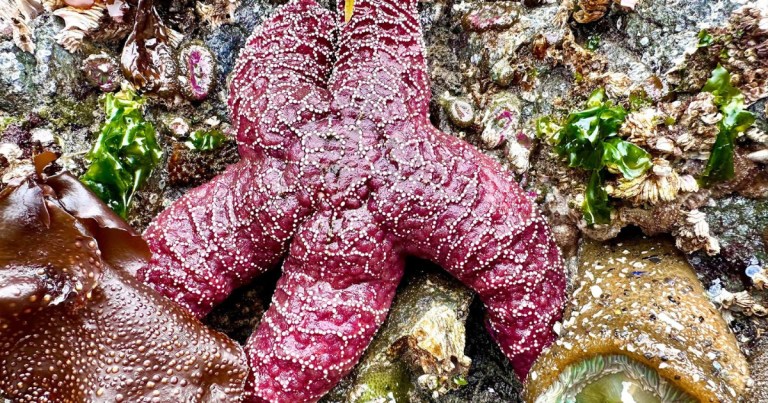
Someone asks about the kelp forests that once lined this coast. Heidi's expression darkens. "Most of our kelp was wiped out by sea urchins after the sea star die-off. Kelp is a keystone species—it shelters marine life and even buffers wave erosion. What you find here now likely drifted from Mendocino or Monterey."
A Living Pantry Beneath the Waves

As the tide recedes, Heidi shows us other ocean offerings. Nori, she says, is one of the few annual seaweeds, delicate and paper-thin. "You can harvest the whole plant. It's the one you see in sushi rolls, but that's usually farm-grown in Japan."
Nearby, she points out bladderwrack, its stalks dotted with air bladders that give it buoyancy. "It's high in iodine and iron—great for thyroid health. When dried, it tastes like blood," she adds with a grin. "It's usually medicinal, not culinary."
The "wrack" in its name means high-tide zone. This zone is important for coastal ecosystems as it provides food and habitat for various organisms. We spot it clustered along the rocks, already beginning to "spore," its texture turning fleshy and slick. "It's a good snack," Heidi says, popping a piece into her mouth.
She gestures to the mussel-encrusted boulders ahead. "Mussels are another story, harvest only in winter, when the cool water keeps them safe from bacteria. In summer, they can practically cook in the sun." For that reason, she always harvests the mussels on the dark, shady side of the rocks. Interspersed within the mussels are clusters of Percebes (gooseneck barnacles), which are a delicious, hard-to-eat global delicacy, especially in Portugal.
Between Worlds

We start our trek across the slippery boulder field, watching our steps among anemones and sea lettuce. The air is thick with salt and kelp, the tide murmuring against the rocks. The oyster catchers cawing overhead. They are easy to spot with their bright orange-red bill. Heidi reminds us not to step on the sea anemones, those bright green "mouths" that close when tickled.
Someone holds up a long brown strand—Egregia, or feather boa kelp. Heidi drapes it around her neck like a scarf. "You can pickle the bladders—they pop like olives, or you can use them as finger puppets," she laughs. "And for gardeners, they make fantastic mulch. Lay them around your plants—they'll feed the soil for months."
Nearby lies a sea palm, a miniature tree swaying in the shallows. "Delicious in salads," Heidi says wistfully, "but protected here due to overharvesting." She points to the crashing waves. "It grows only on the wave-battered side of rocks." It is one of the few algae that can survive and remain erect out of the water.
From Ocean to Earth

Heidi shows us more ocean treasures:
- Turkish Towel (Chondracanthus exasperatus): a rough, exfoliating seaweed used as a natural bath cloth. "I give them to my nieces," she laughs. "They're over it now."
- Asmundi Seaweed: small and spicy, tasting faintly of bacon.
- Sea Lettuce: neon green and edible, though "not much flavor—more garnish than meal."
She tells us that most seaweed lasts about 24 hours once picked and then must be rinsed and dried quickly. Properly dried, it can easily last up to 10 years.
Merroir: The Taste of Place

At last, Heidi raises her voice above the surf. "It's kombu time!" The ocean has peeled back, revealing a field of long, waving fronds. She points. "See the elbows sticking out of the surf? That's what we're after."
Trying not to get too wet, we step into the shallow pools with small waves still surging in. I find some kombu fans and start cutting a few of the broad green ribbons from the plants. Using my own hands to gather our food feels energizing, and I feel a strange pride in the act—an ancient rhythm between ocean and human.
Heidi tastes a piece of kombu and says. "You've heard of terroir for wine? This is merroir—the taste of the sea, of place." In wine, terroir is the flavor born of soil and sun. In seaweed, merroir is shaped by tides, temperature, minerals, and the living pulse of the coast. Each beach has its own distinct flavor.
A Lesson in Reciprocity

As the tide begins to return, we gather our bags—heavy now with slick, shining fronds. Someone laughs, "I'm soaked!" Another adds, "I've got battle wounds!"
Heidi smiles. "That just means it was a good harvest."
Before we leave, she reminds us to give thanks to the sea, the land, and the people who came before us. "This is Pomo land," she says softly. "It's free, yes, but it's also an energetic exchange. Take only what you need—and give thanks in return."
Indigenous elder Robin Wall Kimmerer summed it up nicely in Braiding Sweetgrass, saying, "Never take the first. Never take the last. Take only what you need. Take only that which is given. Never take more than half. Leave some for others. Give thanks for what you have been given."
We each pause for a quiet moment, feet in the sand, the horizon dimming into dusk. The fog is rolling back in, but there's a strange, luminous light across the waves. Somewhere above it all, the full moon has risen.
As I walk back up the beach, my bag filled with the ocean's gifts, I realize the real treasure isn't what I'm carrying—it's what I've learned: that nature gives freely, but only when we listen and move in rhythm with her tides.
And that the first step toward sustainability is as simple as gratitude for the bounty plants give to us.
Feeling inspired? Try planning your own trip using Only In Your State’s itinerary planner.
Subscribe to our newsletter
Get the latest updates and news
Thank you for subscribing!