Tuolumne Meadows Reopens: Explore Yosemite’s Stunning Alpine Basecamp
Yosemite National Park's best campground got a $26 million upgrade and it's now the coolest place to spend the night in the park.
As I rolled up to the ranger kiosk at Tuolumne Meadows Campground in Yosemite National Park, I was greeted by the man who simply introduced himself as the "Bear Guy." Handing me a bright yellow flyer, he leaned in and asked, "You know we have bears here, right?"
"Yes, I did know," I replied, "but please tell me more."
He launched into his well-rehearsed but passionate reminder: everything with a scent—food (even unopened cans and bottles), toiletries like toothpaste and sunscreen, and all trash or recycling—must be stored in the metal bear boxes at each campsite. With a sense of urgency, he explained that a bear's sense of smell is several times stronger than that of a bloodhound. Pair that with claws capable of ripping open car doors, and it's easy to see why food left in vehicles rarely stays there for long.
I know this all too well. Years ago, a black bear shredded the canvas top of my convertible just to get at an apple I'd foolishly left in a cooler. Since then, I've learned a lot about black bears in the Sierras—and how much their behavior depends on ours.
He hands me the flyer, and I check the box that informs me I could have my food impounded and have my camping permit revoked, and I may be fined up to $5,000.
Harsh? Maybe. But as the Bear Guy made clear, so-called "bad bear" behavior almost always starts with careless humans. These rules are designed to protect both bears and humans.

A Short History of Tuolumne Valley
Tuolumne Meadows has long been considered the spiritual heart of Yosemite's high country, a gathering place for naturalists, hikers, and conservationists alike. In the late 19th and early 20th centuries, figures like John Muir and the Sierra Club championed this alpine region as both a sanctuary and a proving ground for the wilderness preservation movement. Parsons Memorial Lodge, built in 1915 as the Sierra Club's summer meeting house, remains a testament to those early conservation battles.
The meadows are also a critical junction for long-distance hikers: both the John Muir Trail and the Pacific Crest Trail pass through here, linking generations of trekkers to the granite domes, wildflower-strewn valleys, and rushing rivers that define Yosemite's upper reaches. Tuolumne's history is inextricably linked to the broader story of America's national parks — a place where recreation, preservation, and advocacy have intersected for over a century.

What's New: $26 Million Renovation of Tuolumne Meadows Campground
This year marks my first time camping at the newly reopened and improved Tuolumne Meadows Campground, which has just undergone a $26 million, 3-year overhaul, funded by the Great American Outdoors Act. I was eager to see the changes firsthand and hear how fellow campers were experiencing them.
At the ranger station check-in, National Park Service Ranger Brad Jorgensen unfolded a campground map and walked me through the upgrades. The most dramatic improvement was underground: a complete replacement of the sewer infrastructure, allowing for modern flush toilets to replace restrooms that, in some cases, were nearly 90 years old. With 304 individual sites, plus group and backpacker areas, this was no small task. Accessibility also got attention, with paved and upgraded ADA sites ensuring a more inclusive camping experience.

Equally important was the restoration of the habitat. Many of the coveted riverfront campsites were relocated farther back from the banks of the Tuolumne River, thereby reducing erosion and protecting fragile riparian ecosystems. As Brad noted, it's a balance between giving campers access to the beauty they came for and preserving it for the future.
Some traditions remain unchanged: The river edge campsites are still the most sought after. Brad laughed as he told me that "old timers" once lined up at dawn for first-come, first-served sites before online reservations existed. They miss that ritual, he admitted, but most campers now appreciate the certainty of securing a site before arriving.
Campground Sections at “Glance"
Tuolumne Meadows is now divided into eight sections (A–H), each with its own character. Section A is situated close to the river and the Backpackers' Camp, making it a natural choice for long-distance hikers. B includes group sites, while C and D offer areas for families and smaller RVs.
The new sections E and H expand capacity with shaded, spacious sites that provide more privacy. Every section now features bear boxes and flush toilets, so choosing your campsite is really about deciding whether you prefer easy access to trails, extra seclusion, or a family-friendly getaway.
Backpackers' Camp at Tuolumne Meadows
At the far end of Section A lies the new Backpackers' Camp, designed for thru-hikers wrapping up or launching into adventures on the John Muir and Pacific Crest Trails. That's where I met Joe and Dave, backpackers who had just finished a two-week trek ending here in Tuolumne Meadows. They were relieved to find campsites so close to the trailheads, complete with restrooms and individual bear boxes.
When I asked for advice, they'd offer it to other backpackers; they didn't hesitate: "Know your carrying capacity." Both admitted they had started with packs weighing over 65 pounds, most of which was food. Dave laughed, "Too much weight." They explained that investing in ultralight gear and freeze-dried food would have saved them a lot of pain.
Starting in Yosemite Valley, they'd covered 56 rugged miles, carrying lightweight plastic bear canisters required for all food storage. These canisters, although bulky, save the hassle of hanging food from trees and keep meals safe from curious bears. And yes, they'd encountered one black bear, but it simply ambled off as they approached, more interested in foraging than hikers.

Flora & Fauna of Tuolumne Meadows
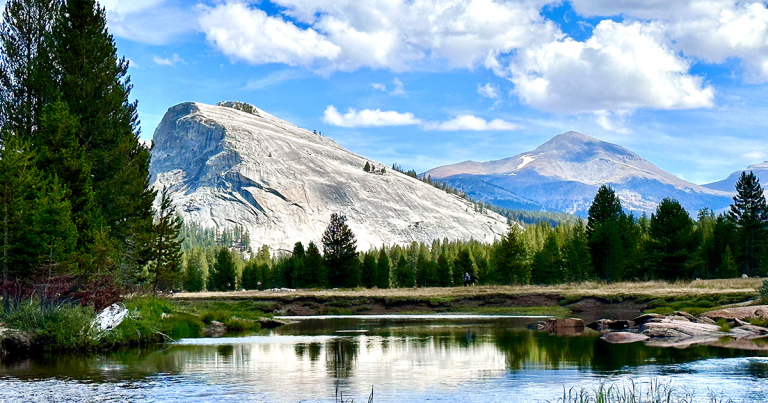
The next day, I ventured into Tuolumne Meadows. It was an early fall day, and I gazed out at a wide-open landscape along the river, carpeted with the remnants of once colorful wildflowers. Purple lupine, scarlet paintbrush, and white shooting stars are all present here in the early summer blooms. The massive granite rock of Lembert Dome looms over the meadow like an ancient sentinel.
On the 7.5-mile trail around the meadow, I follow the Lyell Fork of the Tuolumne River; its clear waters meander lazily through the grassy plains, reflecting the sky and peak in equal measure. Mule deer often graze at the river's edge, while marmots sun themselves on warm granite slabs. Pausing to listen, I hear the air hum with the buzz of bees, the trickle of the waters, and the distant calls of Clark's nutcrackers echoing across the meadow.
It's a reminder that Tuolumne Meadows is not just a campground, but a fragile alpine ecosystem, vibrant and alive.
Where to Hike Near Tuolumne Meadows Campground
One of the joys of staying at Tuolumne Meadows is that trailheads begin just steps from your campsite. Families and casual hikers can enjoy short meadow walks along the Lyell Canyon Trail, where the Tuolumne River meanders through wildflowers and granite peaks rise in the distance. For history buffs, Parsons Lodge—once the Sierra Club's high-country meeting hall—sits near the bubbling Soda Springs, a natural carbonated spring that continues to fascinate visitors.
For a more adventurous outing, the Cathedral Lakes Trail rewards hikers with some of Yosemite's most iconic high-country scenery: dramatic granite spires mirrored in pristine alpine lakes. Whether you're seeking a peaceful stroll or a day-long trek, Tuolumne offers trails that connect you directly to the heart of Yosemite's wilderness.

Walking through the meadows at dusk, as the air is turning crisp, I felt the quieter side of Yosemite revealing itself. Away from the crowds of the Valley, Tuolumne moves at a gentler rhythm, with a slight breeze, the rivers gently flowing, and the stars twinkling in an inky, darkening sky. Here, in this restored high-country haven, you're reminded why California's public lands matter: because they are places where Nature is still protected for all of us to enjoy. That might be the real magic of Tuolumne Meadows, a stunning place to coexist with the wilderness.
Feeling inspired? Try planning your own trip using Only In Your State’s itinerary planner.
Subscribe to our newsletter
Get the latest updates and news
Thank you for subscribing!