Come for the Soak, Stay for the Spirits: The Lodge at Hot Lake is Oregon’s Steamiest Ghost Story
Tucked away in a remote part of Oregon, Hot Lake Lodge is equal parts haunted house and hot springs retreat.
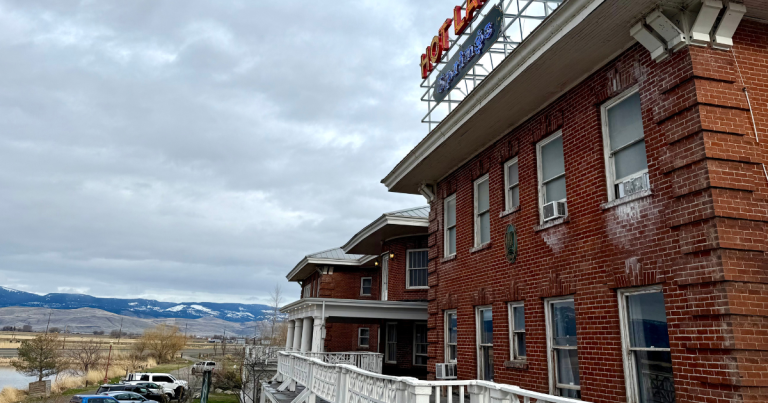
It’s an overcast afternoon when I arrive, low-hanging clouds stage a most dramatic welcome. The lake seems to be in on the plan: clocking in at 200 degrees, a veil of sulfurous steam rises from its surface and slithers around a red brick, colonial-style building. On the roof there’s an honest-to-goodness neon sign. The letters buzz faintly: “Hot Lake Springs.”
This is the Lodge at Hot Lake Springs in La Grande, Oregon. Originally constructed in 1864, its current iteration is as a hotel and wellness destination, fueled by the steamy geothermal area it overlooks.
A property this old is bound to come with stories. In 2001, it was featured on the ABC series The Scariest Places on Earth, and at first glance, sure, it’s plausible. The lodge sits just off the highway in remote Eastern Oregon, about nine miles from La Grande, the kind of place you’d miss if you weren’t looking for it. Deer roam the grounds, adding a touch of feral wild; in the distance, you can hear the low rumble of passing freight trains on the Union Pacific Railroad.
But even with the isolation, The Lodge at Hot Lake Springs is anything but forgotten. During the day it bustles with energy as locals and out-of-towners alike flock to the geothermal pools of the oldest resort in Oregon. There’s an odd vitality here, woven through the steam, the sulfur, and the layers of history. For a place this old, it’s remarkably alive.
Hot Lake, Cold Chills
The allure of the lake stretches deep, beginning with the semi-nomadic Nez Perce Tribe, who named it Ea-Kesh-Pa. Later it was a welcome refuge for weary travelers along the Oregon Trail. Construction of the original Hot Lake Resort began in 1864 with a simple wooden structure offering soothing warm mineral baths.
The arrival of the Union Pacific Railroad helped highlight the region. When Dr. William Thomas Phy, a flamboyant and well-known physician in the Pacific Northwest, began working with the hotel in 1904, the resort was reimagined as a “sanitarium,” not just for relaxation, but for natural healing. A sprawling brick addition followed, and in 1917 Dr. Phy purchased the property outright, renaming it the Hot Lake Sanitarium. He added a state-of-the-art hospital on the third floor, complete with a surgical theater and x-ray facilities. Soon after, the resort’s iconic neon sign was installed, casting its glowing promise.
Thanks to Dr. Phy not only was financing secured from people like Walter Pierce, Oregon’s governor from 1923 to 1927, but Hot Lake attracted both the wealthy and ill from all around the world; there’s no record of anyone being turned away because of their inability to pay. The Mayo Brothers became frequent visitors to the hotel for its medical innovation, which also reportedly earned it the nickname “The Mayo Clinic of the West.” Wild Bill Hickok was drawn by the springs advertised as “70 degrees hotter than the famous hot springs of Arkansas” (Posters inside from that time still compare the two).
With 300 guest rooms, Hot Lake could host up to 1,000 people a day. It operated like a self-contained city, complete with medical wards, a post office, barber, tailor, bank, restaurant, bathhouses, entertainment halls, and more. But tragedy struck in 1934 when Dr. Phy unexpectedly died after falling into the water during a hunting trip near Ontario. Just three years later, a fire swept through the resort, destroying the original wooden structure. Although the brick building survived, Hot Lake was never the same.
The Great Depression only sped up the resort’s decline. In the decades that followed, Hot Lake cycled through a series of owners. “Nobody could keep it open,” says Michael Rysavy, who now owns the hotel with his wife, Tamarah. “I think there was a restaurant that tried to operate. A bathhouse gave it a go. I even read there was a cowboy disco nightclub.”
At one point, a black bear was reportedly kept in a cage out front to attract visitors. Over the years, the property was repurposed again and again: as a nurse’s training center, a World War II flight school, and later, a mental health asylum. During a particularly brutal winter typhoid epidemic, part of a wider pattern of early 20th-century public health crises in Oregon, the building even served as a temporary morgue.
In other words, plenty of fodder for ghosts.
The building was finally abandoned in 1991, but it continued to draw urban explorers and the curious, wandering through its decaying halls in search of thrills. Soon, rumors of hauntings began to spread. Among the reported spirits were former vacationers, a nurse said to have been scalded to death in the lake, a gardener with a spade who took his own life on the grounds, and patients from the building’s time as a mental asylum, staring out the windows.
Visitors claimed to hear screams echoing from the old surgery room. Others spoke of a piano playing by itself on the third floor. It was allegedly the same instrument once owned by the wife of Robert E. Lee, which was later acquired by the hotel. A website called Hot Lake Hauntings was dedicated to abnormal encounters. It hasn’t been updated since 2011. Spooky.
Even Spirits Like to Soak

Rysavy isn’t at Hot Lake because he’s drawn to remote places, haunted histories, or unexplained phenomena. Despite being from Portland, he had no prior connection to the place.
He’s here for one simple reason: he’s a die-hard hot springs enthusiast. In fact, he may be the most devoted one in the country. He even met his wife, Tamarah, while soaking at Bagby Hot Springs in Oregon’s Mount Hood National Forest. “When we met, she’d been to about 30 hot springs; I’d been to about 20,” he says. “We were a match made in heaven.”
The couple purchased the Grande Hot Springs RV Resort, adjacent to Hot Lake Hotel, in 2013. When the hotel later went up for sale, they bought that too. While it remains their only hot springs property, they also own the publishing company behind the hot springs guidebook that inspired much of their exploration. And in a full-circle moment, they now operate Bagby Hot Springs under a long-term agreement with the Forest Service that extends through 2043.
Nevertheless, Rysavy does his best to appease my curiosity about the so-called haunted happenings. He tells me they were so pervasive the previous owners—who bought the lodge in 2003, restored much of it, and also had a fondness for playing Christian music—went so far as to have it blessed by multiple denominations, as well as Native American groups.
“When they bought the hotel, the place was a disaster,” he says. “All 300 rooms were blown out. There were holes in the floors, holes in the roof—steam was rising everywhere.”
Everyone expected the new owners to tear the place down, but instead, they began rebuilding, basically starting from scratch. After the Rysavys took it over in 2020, they continued the restoration of the 64,000-square-foot resort. Today, 13 of an eventual 18 suites have been fully restored. Each room is unique: mine featured a soaking tub in the living room, fed by the hot springs and overlooking the front lawn, where deer wandered by. An unusual setup, to be sure, but oddly idyllic.
The Rysavys have ambitious plans for the future. The interiors have been modernized with light blonde wood, and a cozy pub now sits beside the 2nd run movie theater. The new, round outdoor tubs have a distinctly Scandinavian feel. By next year, they hope to open a full bathhouse offering spa treatments. A concert venue is even in the works.
Day passes can be purchased for $20 to $25; currently, they can accommodate 120 soakers a day. When the current expansion is done and more tubs are added, that number will double.
While plenty of new things are happening, there's still a deep commitment to honoring the past. Historic posters line the walls, and one upper floor is devoted to a display of old medical equipment, some of which resemble torture devices. But it’s all part of preserving the building’s layered history.
“During the ’90s, when the place was completely abandoned, everything was stolen. It was wiped out,” says Rysavy. “When the previous owners started restoring it, people began coming forward, saying, ‘Hey, my family has this item—can we return it?’ Eastern Oregon University even talked about putting out a call for people to bring things back, no questions asked.”
And he’ll admit, there’s some spook factor.
Like the time he heard loud banging on the third floor. When he went up to investigate, a white bird suddenly flew at him. “Then it turns around and slams right into a window—bang. I realized, that’s the noise I’d been hearing. It was terrifying in the moment. If I were up here in the middle of the night with no power and that thing came at me, I probably would've crapped myself.”
Then there was the time he was the ghost.
“I was here alone, painting a hallway at one or two in the morning, because, you know, when you’re painting, you’ve got to finish. Once I caught a glimpse of someone at the end of the hall and jumped. Took me a second to realize: it was just my reflection.”
Soaking Up the Sunrise

I had no ghostly encounters that night; in fact, I slept like the dead. Just after sunrise the next morning I stepped out into the brisk air for a soak in the outdoor tubs. That’s one advantage of staying in the hotel: the tubs are accessible to the public from 8 a.m. to 8 p.m., but for hotel guests it’s 24 hours.
A few tubs were already occupied, hotel robes draped on nearby hooks, swaying in the breeze. Above us the Hot Lake Springs sign buzzed faintly against the moody morning sky. One letter is burned out, but it’s better that way.
Each tub is set to a slightly different temperature, with a cold plunge pool tucked at the far end. The taps flow with strong, steaming water. In the distance, the mountains are a grounding presence. And despite the lake’s intense heat, wildlife thrives: birds dart through the steam, fish leap, and turtles and muskrats occasionally break the surface, seemingly unbothered.
And it is perfect. If we have to share the space with a few spirits, so be it.
Subscribe to our newsletter
Get the latest updates and news
Thank you for subscribing!