These 6 Strangest Buildings in Iowa Are Unlike Anything Else Around
Discover the strangest buildings in Iowa, from a spinning jail to a city built on cosmic laws. Explore six architectural marvels you won't find anywhere else.
The Hawkeye State is often thought of as a landscape of unyielding pragmatism: grids of cornfields, farms, and small towns stretching out toward the horizon. Yet, tucked within this quiet geography you'll find architectural anomalies that feel almost like glitches in the matrix. From a historic jail designed to spin like a bingo cage to a community built entirely on cosmic alignment, some of the strangest buildings in Iowa challenge our perceptions of the state. These structures are more than roadside attractions—they're monuments to eccentricity, obsession, and aesthetic risk, proving that if you know where to look, the Iowa landscape is anything but ordinary.
1. Visual Arts Building - Iowa City
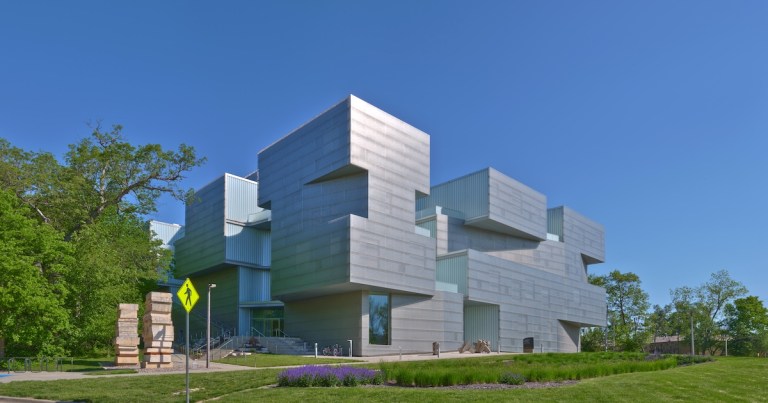
Perched on a bluff overlooking the Iowa River, Steven Holl’s University of Iowa Visual Arts Building in Iowa City is a study in porosity. Unlike the heavy brick structures that dominate much of the campus, this 2016 masterpiece incorporates cutting-edge techniques into a breathable, light-filled monolith that replaced the beloved 1936 facility, which was lost to the 2008 flood. The architecture is defined by seven vertical "centers of light"—massive cutouts that slice through the floor plates, channeling natural light deep into the building’s core.
For a creative, the space feels less like a school and more like a collaborative tool. The shifted floor plates create balconies and visual connections between disciplines, allowing a painter to look down and see a sculptor at work. Its zinc skin and punched concrete frame provide a stark, industrial contrast to the surrounding greenery, making it a modern cathedral for the arts that demands you look up, around, and through.
2. Maharishi Vedic City - Fairfield

This isn't a single building—rather, it's a collection of them. Driving into Maharishi Vedic City feels like crossing a border into a distinct spiritual jurisdiction. Incorporated in 2001, this is the first all-Vastu municipality in North America, meaning every structure adheres strictly to ancient Vedic architectural laws. You’ll notice immediately that every single home and building faces due east to align with the rising sun—an orientation believed to promote order and happiness.
The aesthetic is unmistakably uniform: pastel colors, symmetry, and golden roof ornaments called kalash topping the buildings. Perhaps most striking is the silence; many homes are built around a central "silent core" or brahmasthan, which remains empty to anchor the structure’s cosmic energy. It's a planned utopia where, by law, even the food sold must be organic. It’s a fascinating, serene, and slightly surreal detour that challenges Western concepts of urban planning and curb appeal.
3. Grotto of the Redemption - West Bend

On the quiet streets of West Bend, you'll find an architectural fever dream that's been called the "Eighth Wonder of the World" and is, without a doubt, one of the strangest buildings in Iowa. The Grotto of the Redemption is not just a shrine; it's the physical manifestation of a priest’s desperation. Father Paul Dobberstein began construction in 1912 to fulfill a vow made while fighting pneumonia, promising to build a shrine to the Virgin Mary if he survived.
He did, and for 42 years, he worked obsessively, setting petrified wood, malachite, jasper, and quartz into concrete by hand. The result is a sprawling, nine-grotto labyrinth—the largest such grotto in the world—that covers a city block. It feels less like just another piece of weird architecture in Iowa and more like a crystallized coral reef rising from ground. The sheer density of the semi-precious stones is overwhelming, creating a dazzling, tactile mosaic that tells the story of the Fall of Man and the Redemption in a way that feels both pious and profoundly eccentric.
4. Squirrel Cage Jail - Council Bluffs

The brick Victorian structure of the historic Pottawattamie County Jail in Council Bluffs hides a mechanical nightmare inside: a three-story, 90,000-pound rotating drum. Built in 1885, the "squirrel cage" is one of the few remaining rotary jails. The concept was chillingly efficient—cells were wedge-shaped slices of a pie that spun inside a stationary cage. There were no doors on the cells themselves; the jailer simply hand-cranked the entire drum until a prisoner aligned with the single opening on the floor.
Standing in the center, you can almost hear the grinding gears that once crushed the limbs of inmates foolish enough to stick an arm through the bars during rotation. It was a "human lazy Susan" designed for maximum control with minimum staffing. Today, the drum is locked in place, but the eerie silence of the pie-shaped wedges offers a grim look at Victorian-era innovations in incarceration.
5. St. Anthony of Padua Chapel - Festina

Tucked away near the tiny community of Festina (just south of Calmar) is a structure that challenges the definition of a cathedral. The St. Anthony of Padua Chapel, the self-described "World’s Smallest Church," seats only eight people. Like the Grotto, its existence is owed to a promise. It was built in 1885 by the mother of Johann Gaertner, who vowed to construct a chapel if her son returned safely from Napoleon’s disastrous Russian campaign.
The chapel measures just 12 by 16 feet, yet it possesses a disproportionately tall 40-foot steeple that seems to stretch hopefully toward the heavens. Inside, it's impossibly intimate, with a miniature altar and just enough room for a single family to pray. It sits near the Old Mission Cemetery, a quiet, stone testament to faith, survival, and the immense power of a mother’s relief packed into a tiny footprint.
6. University of Iowa Advanced Technology Lab - Iowa City

On the east bank of the Iowa River in Iowa City, Frank Gehry’s Iowa Advanced Technology Laboratories (IATL) looks like an explosion arrested in mid-air. Completed in 1992, this was Gehry’s deconstructivist playground before he built the Guggenheim in Bilbao. The building is a collision of forms—stainless steel curves that mimic fish scales, copper cladding, and limestone blocks that seem to tumble into one another.
It's a building that refuses to settle. The light plays off the metal skin, changing the structure's mood from dawn to dusk. While it famously suffered from leaks in its early years—a common trait of Gehry’s ambitious designs—it remains a pivotal piece of architectural history. It represents the moment the university decided to break from tradition and embrace the chaotic, fragmented beauty of the future, anchoring a science facility in a work of art that's just as experimental as the research happening inside.
Taken together, these six sites offer a rugged counter-narrative to Iowa's pastoral reputation. They prove that innovation and oddity have always found fertile ground here, whether through the hand-cranked gears of a Victorian jail or the deconstructivist angles of a Frank Gehry lab. These strange buildings in Iowa compel us to stop and stare, reminding us that the most memorable landmarks are often the ones that refuse to fit in.
Looking for more unique architecture in Iowa? Check out the Danish-style town of Elk Horn or Pella's full lean into its Dutch heritage. For more inspiration, check out Only In Your State’s itinerary planner before you set out on your next Hawkeye State adventure.
Subscribe to our newsletter
Get the latest updates and news
Thank you for subscribing!