There’s a Secret Inn in Marin You Can Only Reach by Trail — and It’s Pure Magic
Above the Clouds: A Night at California’s Hidden Mountaintop Inn Photo by Deborah Dennis for Only In Your State
David, the innkeeper, starts his safety talk with a grin and a warning — no open flames, not even on my birthday cake, which we’re here to celebrate. “There are 36 fire extinguishers on the property,” he says proudly. The last fire? A metal kettle was left on the gas stove. If anything happens on Mount Tam, we’ll either hike up to the East Peak or wait for a helicopter rescue. “I told that to a scout troop once,” he adds. “Their eyes lit up. I had to tell them not to get any ideas.”
Hike-In, Unplug, and Step Back in Time
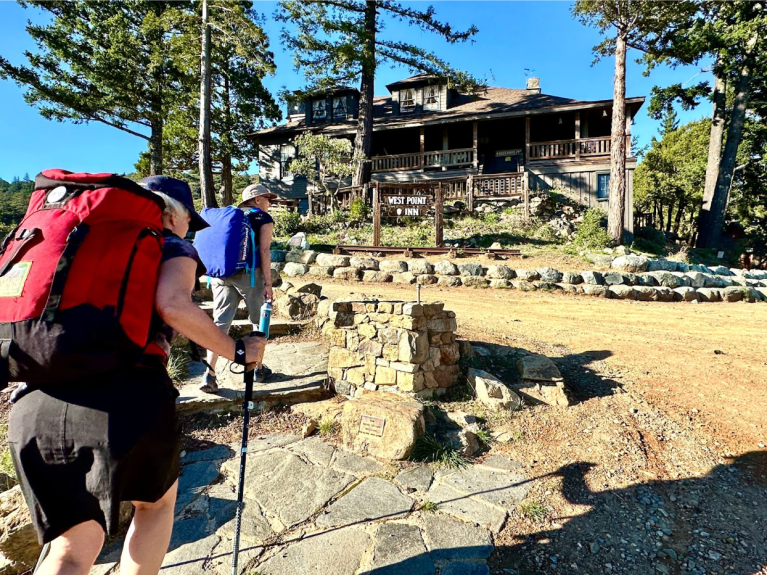
It’s a fitting start to our adventure at the West Point Inn, a century-old mountaintop refuge perched high above the clouds on Mount Tamalpais, where time slows and Wi-Fi disappears. There’s no electricity, no road access, and no distractions — just a veranda overlooking the entire Bay Area and the distant shimmer of the Pacific Ocean.
We’ve parked at the Pantoll lot off the Panoramic Highway and shouldered our packs — filled with bedding, food, and a bottle of wine for the occasion. The hike along the old Stage Coach Road is nearly two miles of redwood shade and ocean mist. Each bend opens a new view through madrone branches, sunlight flickering on the dusty trail.
By the time we reach the inn, the air feels thinner, fresher — that high-mountain stillness you only find above the fog line. Dozens of hummingbirds swarm around feeders on the wide porch, their wings whirring like a low electric hum. Then the view hits us: the entire Bay stretched beneath our feet — San Francisco gleaming like a mirage, Mount Diablo rising in the east, the dark blue line of the Pacific to the west.
A Historic Inn from the “Crookedest Railroad in the World”

The West Point Inn was built in 1904 as part of the Mill Valley & Mount Tamalpais Scenic Railway — the so-called "Crookedest Railroad in the World" with 281 turns from Mill Valley to the mountain’s East Peak. The line carried weekenders, poets, and socialites eager to ride the steam train through redwoods and mist. When the train stopped, visitors transferred to a horse-drawn stagecoach that wound down to Stinson Beach — the same trail we just walked.
Inside the lodge, the air smells faintly of pine and the lingering scent of old smoke.
Black-and-white photos line the walls: train passengers in long skirts and suits, a locomotive perched on a narrow curve of track, and the inn itself a century younger but instantly recognizable. Leather chairs surround a large stone fireplace, and the floorboards creak in that comforting, old-house way — every sound a whisper of memory.
Life Without Electricity — and Why It Feels So Right

David returns at dusk to light the gas lamps and start the fire. He hands us each a lantern for our cabins, and by the time the last light fades from the Bay below, the room glows in amber warmth. My friends and I prepare dinner in the communal kitchen, where travelers from around the world chop vegetables and share stories. A woman from Sweden named Steena joins us after hiking up alone from San Francisco. “I took three buses to get here,” she laughs. We offer her a glass of wine and some appetizers. She tells us she’s never stayed anywhere like this—that it feels like stepping into another century.
As we cook, I wander out back to the kitchen garden. A handmade "cloud catcher"—a contraption of mesh stretched between poles—collects moisture from the fog, dripping into a barrel that waters the herbs and lettuces. Guests are welcome to harvest what they need, so I pluck a few strawberries and a handful of lettuce. Sustainability here isn’t a buzzword; it’s a quiet rhythm of life.
Later, we gather in the lodge’s common room. Someone finds a guitar, another drifts to the piano. Soon we’re singing ,old rock-and-roll classics echoing against the wooden walls. It’s spontaneous and imperfect, the kind of joy you can’t manufacture. The room feels alive with gratitude, strangers who have become companions for a night.
Sunrise on the Dawn Patrol
In the morning, we’re awakened by laughter and the faint whoosh of mountain bikes hurtling downhill — the “dawn patrol,” David explains later. They ride up in darkness to catch sunrise at the East Peak, then glide down the switchbacks while the world still sleeps.
We pull on jackets and step outside just as the first light crests the horizon. The entire Bay is wrapped in gold — clouds like a living sea, the city faintly visible below. For a few long moments, no one speaks.
Standing there, I think about how few places like this remain — where the world’s noise falls away and we’re left with the simple essentials: warmth, conversation, and awe.
The Spirit of Stewardship

The West Point Inn has survived fires, abandonment, and decades of change, kept alive by volunteers who dedicate their time to preserving its quiet magic. When the railroad shut down in the 1930s, a handful of locals refused to let the inn fade into history. They rebuilt it by hand, maintained it through storms, and opened it to hikers again.
Today, six innkeepers rotate shifts, each staying for a week at a time. Visitors who fall in love with the place often return to volunteer, repainting cabins, tending the gardens, and repairing lamps.
Before leaving, I talked with one of them, a former mountain biker who started volunteering after her first visit. “People fall in love with this place,” she says. “Then they come back to take care of it.”
That sentiment captures the soul of this place — and maybe, of travel itself.
Why We Need Places Like This
As we pack up our things and shoulder our backpacks for the hike out, the morning sun glints off the veranda railings, the hummingbirds are already back at their feeders, and the scent of coffee drifts from the kitchen. I take one last look at the lodge — this improbable little outpost above the clouds — and feel a wave of gratitude.
Places like the West Point Inn remind us what simplicity feels like. There are no notifications, no screens, no electricity — only the rhythm of light, laughter, and conversation. You carry in what you need, share what you have, and leave a little of yourself behind.
The world below keeps spinning, but up here, something quieter endures — a sense of belonging that has nothing to do with Wi-Fi or walls. Maybe that’s why so many of us return. Not just to see the view again, but to reconnect with what’s essential: friendship, stillness, and the grounding truth that joy doesn’t require much.
The trail winds back through the trees, the air still cool and scented with pine. As the inn disappears from view, I realize this is exactly why I travel — to rediscover wonder in small, hidden places, and to be reminded that sometimes the most meaningful journeys are the ones that take you inward, not far away.
Feeling inspired? Try planning your own trip using Only In Your State’s itinerary planner.
Subscribe to our newsletter
Get the latest updates and news
Thank you for subscribing!