How Much Each Airline Charges You for Checked Bags (And Why You Should Know)
This ultimate guide breaks down each major airline's baggage fees, carry-on size requirements, plus a few tips and tricks for travel.
Between the REAL ID flight requirements, Southwest's infamous new baggage fees, and flight delays from the government shutdown, navigating flight requirements feels like an Olympic sport. Traveling is expensive enough without having to incur any surprise baggage fees at the airport, so we've put together an ultimate guide for how much each airline will charge for your bags.
Carry-On Sizes for Major U.S. Airlines
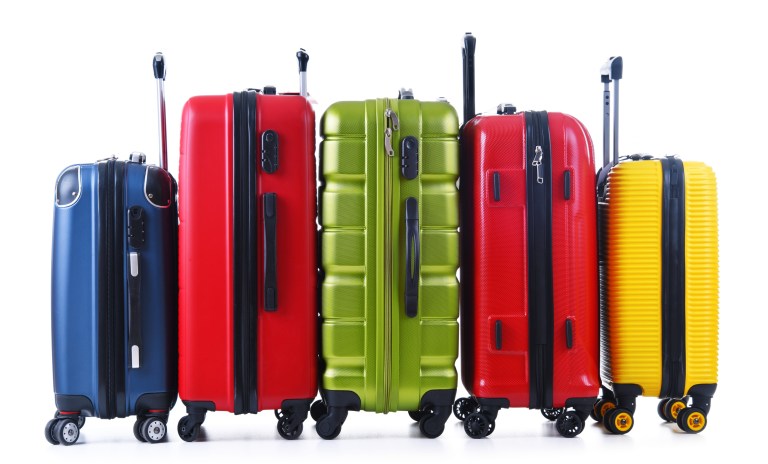
The four major airlines in the United States are American Airlines, Delta, United, and Southwest. These four airlines control 80 percent of the market, so we will focus most of our attention on them. We’ve also included JetBlue and Frontier because they offer popular flight routes that may be offered from your home airport. All of the carry-on sizes are measured in inches.
- Carry on: 9 x 14 x 22 inches
- Personal Item: 9 x 10 x 17 inches
- Carry on: 9 x 14 x 22 inches
- Personal Item: Delta does not have specific dimensions listed on its website. (8 x 14 x 18 inches is generally considered to be within an acceptable range to fit under the seat.)
- Carry on: 9 x 14 x 22
- Personal Item: 8 x 14 x 18 inches
- Carry on: 10 x 16 x 24 inches
- Personal Item: Southwest does not have specific dimensions listed on its website. (8 x 14 x 18 inches is generally considered to be within an acceptable range to fit under the seat.)
- Carry on: 9 x 14 x 22 inches
- Personal Item: 8 x 13 x 17 inches
- Carry on: 10 x 16 x 24 inches
- Personal Item: 8 x 18 x 14 inches
All of these measurements include handles, straps, and wheels. Keep in mind that your ticket may not include a carry-on item. For example, the Basic Economy ticket on United only includes a personal item. Frontier tickets usually include a personal item, and baggage fees are charged separately. On the flip side, JetBlue, Delta, and American Airlines flights include a personal item and a carry-on.
Historically, Southwest advertised that the first checked bag flew free. This policy was recently reversed, and any ticket purchased after May 27, 2025, incurs baggage fees. You're grandfathered in if you booked your ticket before this date. Southwest travelers still get one free carry-on and one personal item.
Even if you meet these requirements, you may still be forced to check your carry-on at the gate. I wish I knew a foolproof way around this, but the only method that works for me is picking a seat toward the front of the plane, or making sure I'm one of the first groups to board. There are so many variables as to why flight crews need to do this (weight distribution, full flight, type of plane, etc.) that there's really no one-stop shop answer here.
Baggage Fees for Each Airline

Baggage fees can vary for each airline depending on your class, where you're flying, and when you book the ticket. The following list is by no means comprehensive, but it gives you a good start. For checked bags, most airlines hover around 50 pounds or less. Anything heavier will incur oversized/overweight fees. Always check with your airline once you've booked the ticket! To keep things as simple as possible, here are the baggage fees for first checked bags (not oversized or overweight) for a standard class ticket:
- United Airlines: Typically start at $35 to $40, use its calculator to find out your exact fees
- Delta: Start at $35
- American Airlines: Start at $35 to $40
- Southwest: Start at $35
- JetBlue: Start at $35 to $40 depending on travel dates (JetBlue denotes certain periods as off-peak/peak and charges higher fees during peak travel times i.e. holiday weekends)
- Frontier: Varies based on flight dates and type of ticket purchased
These fares can change if you fly to Hawaii, U.S. territories, fly internationally, or exceed the weight and/or size limits. It’s nearly always cheaper to add baggage when purchasing your ticket, and it's always cheaper to add baggage online before the flight. If you wait until you get to the airport, the baggage fees will be more expensive.
Tips for Going Carry-On Only

I haven’t checked a bag in over a decade. I’m a proud member of the “carry-on only” club, and if you’re considering traveling this way, I have picked up some tips along the way:
- You don’t need it: You don’t need four pairs of shoes. You don’t need three pairs of jeans. Learn the benefits of a capsule wardrobe and free yourself (and your luggage). Seriously, can you even remember what shoes other travelers were wearing when you went to XYZ attraction? Exactly.
- Wear the bulkiest on the plane: This is a tried-and-true method. Wear your boots, sweatshirts, jackets, etc., on the plane so they don’t take up space in your suitcase.
- Pack smarter: There are a few different routes you can take here. I prefer the rolling method, where I roll all of my clothes into tight bundles to fit nicely in my suitcase. Some people swear by packing cubes. I tried them, and I am not a fan. They offer more organization than space-saving, and if I’m being honest, I’m a pretty organized person to begin with.
Picking the Right Suitcase
Not all suitcases are created equal. I’ve gone through my fair share of suitcases on the hunt to find the best carry-on, and here’s where I landed on:
- Duffel: I love my duffel. I don’t have to deal with cobblestones, puddles, or snow; I can just throw it over my shoulder and go. However, it gets negative points for practicality. Having to take everything out to reach the one thing you need at the bottom can be a challenge, and there’s a learning curve to packing a duffel bag that I wasn’t prepared for. My traps are also not a muscle I work out often (ok…ever), and they thoroughly hate my duffel bag.
- Hard-shell carry-on: I wanted to like this. I really did! Just about every hard-shell carry-on suitcase on the market is butterfly-open, so you have nearly equal space on either side. This gives you less space. I need every inch I can get, and I’m not throwing my suitcase around where I need a heavy-duty hardshell to protect my things.
- Soft-shell carry on: There are a few reasons this became my go-to carry-on: The traditional opening with one large compartment gives me more space and the canvas shell has some give in case I buy some souvenirs and need a little extra room.
Share this article with someone who has a flight coming up! If you're inspired to go on a vacation, read my article on how to find cheap flights. I've also created an extensive guide on how to book a trip from start to finish.
Subscribe to our newsletter
Get the latest updates and news
Thank you for subscribing!