13 Places in the U.S. That Feel Like a Caribbean Paradise
You don't need a passport for turquoise water and warm, clear swimming holes. These spots across the country deliver the Caribbean experience without leaving the U.S.
Not everyone can hop on a plane and fly to the Caribbean for a vacation. But what if you didn't have to cross any international lines in order to get that tropical experience?
If you've seen OIYS's state-by-state Caribbean paradise guides, you already know this country has a quietly impressive collection of teal-water lakes, spring-fed swimming holes, and glacier-carved shorelines that rival international destinations. We pulled the 13 strongest spots from our existing coverage across the country, spanning everything from South Carolina's limestone-filtered lake to Washington's glacier-flour-tinted reservoir. The flight savings don't hurt either.
1. Lake Jocassee: Salem, South Carolina
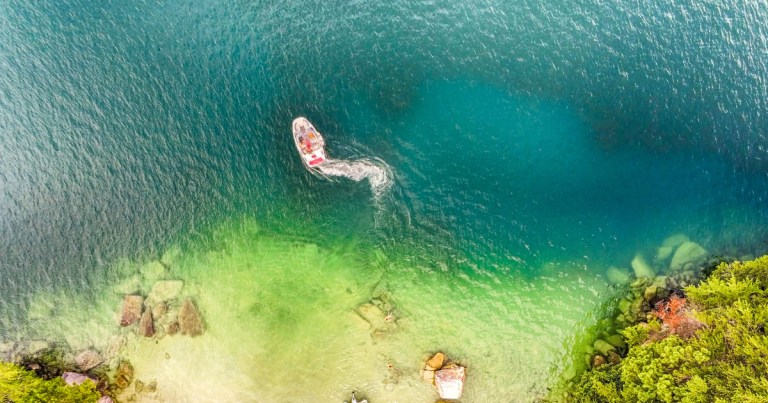
Bet you didn't think we'd start off this article with South Carolina, huh? But here's the thing: Lake Jocassee doesn't look like it belongs in South Carolina. Tucked into the Blue Ridge foothills of Oconee County, its water is so clear and so deeply turquoise that visitors routinely mistake photos for the Caribbean or the Maldives.
The lake sits at the base of several waterfalls that feed straight into its cold, gin-clear surface. You can kayak up to them, swim beneath them, or simply float out on the water and watch the Blue Ridge ridgeline do its thing overhead.
The lack of development around the shoreline is a big part of why it looks this way. Jocassee is protected on nearly every side by the Jocassee Gorges, keeping the water clean and the banks wild.
2. Treasure Island Beach: Laguna Beach, California

Laguna Beach has long had a reputation as Southern California's most scenic stretch of coast, and Treasure Island Beach is a big reason why. It's a cove-style beach tucked beneath oceanfront bluffs, with water that runs from deep teal in the shallows to rich cobalt further out.
The clarity here comes partly from the rocky bottom and partly from the protected cove shape that keeps wave churn to a minimum. On a calm morning, you can see straight through to the sand.
It earned a spot in OIYS's look at places in Southern California that feel like a Caribbean paradise in summer, and it's easy to see why. The surrounding sandstone cliffs and kelp-filtered light do most of the work.
3. Looking Glass Falls: Brevard, North Carolina

The Pisgah National Forest around Brevard is known for waterfalls, but what makes Looking Glass Falls stand out is what happens at the base of it. A wide, shallow plunge pool collects water filtered through old-growth forest and granite, emerging clear and cold enough to make you gasp.
The falls themselves drop 60 feet directly from a roadside overlook, which means almost no hiking is required. But the reward at the bottom, that pool of mountain-filtered water against the mossy rock face, rivals anything you'd see on a Caribbean island.
Brevard's location in Transylvania County means you're deep in the Blue Ridge. The humidity, the green, the sound of moving water everywhere: it's the American tropics, minus the flight.
4. Pictured Rocks National Lakeshore: Munising, Michigan

Lake Superior is cold, often gray, and not especially tropical by reputation. But Pictured Rocks challenges all of that. The sandstone cliffs that line the shoreline near Munising reflect into the water below in shades of green and turquoise that look genuinely tropical in full summer sun.
The color comes from mineral seepage in the rock, streaking the cliffs in copper greens, iron reds, and manganese blacks. Combined with Superior's famously clear water and the sheer scale of the formations, it produces landscapes that serious photographers drive days to reach.
Kayaking along the base of the cliffs puts you right at water level, which is where the Caribbean comparison really clicks. The water clarity is startling. You can see the lakebed in 15 feet of water.
5. Ichetucknee Springs: Fort White, Florida

Florida has dozens of natural springs, but Ichetucknee runs for six miles through limestone and hardwood forest before spilling into the Santa Fe River, where it stays a constant 68 degrees year-round. The water is so clear it looks fake in photographs.
Tubing the Ichetucknee is one of Florida's oldest summer rituals, and it earns its reputation every time. The spring-fed current is gentle, the water is the color of Bahamian shallows, and the canopy overhead keeps the whole run in green-dappled shade.
It's one of nine springs protected inside Ichetucknee Springs State Park, and the whole area has a distinct, prehistoric magic that proves Florida's beauty goes way deeper than just its coastlines.
6. Redfish Lake: Stanley, Idaho

Redfish Lake sits in the Sawtooth Valley at around 6,500 feet, ringed by jagged granite peaks on three sides and fed by snowmelt that keeps it cold and clear well into August. The Caribbean-esque water reads vivid teal from above and shifts to deep blue near the center of the lake.
The name comes from the sockeye salmon that historically turned the inlet red during their spawning run. Today the lake is protected within the Sawtooth National Recreation Area, which is why it still looks the way it does: no private development, no motorboat churn disturbing the bottom.
Stanley is already on people's lists as one of Idaho's most underrated destinations. Redfish is the reason most of them made the trip.
7. Pennyrile Forest State Resort Park: Dawson Springs, Kentucky

Western Kentucky isn't the first place most people picture when they think turquoise water, but Pennyrile Forest has quietly built a reputation among people who know. The swimming lake inside the resort park has the kind of sandy bottom and clear, green-tinted water that belongs in a travel magazine.
The state resort park format means lodges and a golf course share the same grounds as the lake, which gives it a slightly throwback resort feeling. But the water itself is the main draw, and it holds up.
OIYS covered it as a beachfront attraction in Kentucky you'll want to visit over and over again, which probably surprised everyone who didn't know this part of the state existed.
8. Diablo Lake: North Cascades National Park, Washington

The Caribbean color of Diablo Lake is so intense and so specific that it reads as artificially dyed in almost every photograph taken of it. The turquoise is real, and it comes from glacial rock flour suspended in the water, catching light differently depending on cloud cover and time of day.
It's inside North Cascades National Park, which is one of the least-visited national parks in the lower 48 despite being two and a half hours from Seattle. That relative obscurity is part of what keeps it looking pristine.
The overlook off Highway 20 gives you the most dramatic view, but hiking down to the shoreline changes the experience entirely. From water level, the color reads even more saturated.
9. Rutledge Falls: Tullahoma, Tennessee

Rutledge Falls is one of those places that circulates on Tennessee outdoor forums and never quite breaks into mainstream awareness, which is exactly what makes it worth knowing about. A wide sheet of water spills over a mossy limestone ledge into a tropical swimming hole, the water reading unmistakably teal in late summer.
The falls drop about 25 feet, wide enough that you can stand directly underneath them in the shallower edges of the pool. The surrounding forest keeps the whole scene in cool shade through most of the afternoon.
It's on private land with public access, which means low crowds and no amenities. You bring what you need and pack out what you bring.
10. Hocking Hills Swimming Hole: Logan, Ohio

Hocking Hills is one of Ohio's most visited natural areas, known for its sandstone gorges and waterfalls. What gets less attention is how the water behaves at the base of some of those formations: pooling into clear, green-tinted swimming holes with a distinctly un-Ohio quality.
Old Man's Cave and Cedar Falls both have pools worth noting, but the lower gorge area is where the water gets that Appalachian swimming-hole clarity that surprised OIYS readers when it appeared on a Caribbean lookalike list.
The surrounding hemlock canopy, the sandstone walls, the sound of moving water in all directions: it doesn't look like the Midwest, and it doesn't have to.
11. Big Blue Spring: Wacissa, Florida

Big Blue Spring sits along the Wacissa River in Jefferson County, where a deep limestone basin pushes cold, clear water up through the riverbed and into one of North Florida's quietest natural swimming holes. The color is what stops people: an intense blue-green that reads almost artificially vivid against the surrounding cypress and hardwood forest.
Getting there requires a kayak or canoe, which is the main reason it still looks the way it does. The river route winds through old-growth forest before the spring opens up, and the lack of road access keeps the kind of crowds that follow easier destinations from ever finding it. Most days it's paddlers, locals, and not much else.
Florida has no shortage of spring-fed swimming holes, but Big Blue has a combination of depth, color, and remoteness that puts it in a different category.
12. South Padre Island, Texas

South Padre Island has picked up the nickname "Caribbean of Texas" somewhere along the way, and unlike most travel nicknames, it's not entirely unearned. The island sits at the southern tip of the state, far enough from the Mississippi River's reach that the water doesn't carry the murky brown tint that plagues Galveston and most of the upper Texas coast. On a calm day in late summer, it reads as a genuine blue-green.
The 34-mile barrier island is bordered by the Gulf on one side, and the hypersaline Laguna Madre on the other, and the subtropical latitude means warm water well into October. That's the window when South Padre really delivers: after spring break, after the summer crowds, when the water clears, and the beach mostly belongs to people who actually live near it.
13. North Avenue Beach: Chicago, Illinois

Most people don't expect to feel like they're somewhere tropical in the middle of Chicago, which is exactly what makes North Avenue Beach worth knowing about. Lake Michigan runs clear and blue-green here in summer, the sand is clean and wide, and the horizon stretches far enough that the water looks genuinely oceanic from shore level.
The backdrop is what sets it apart from every other entry on this list. Behind you, the Lincoln Park skyline rises along Lake Shore Drive in a way that doesn't look like any other beach city in the country. In front of you, the lake disappears into blue. It's a combination that's genuinely hard to find anywhere else in the world, let alone within city limits.
Want to keep the fun in the water going? Check out the best swimming holes across America to really get your feet wet.
Subscribe to our newsletter
Get the latest updates and news
Thank you for subscribing!