15 Legendary American Road Trip Stops From Coast to Coast
Discover 15 legendary American road trip stops, from Route 66 icons and scenic byways to unforgettable roadside attractions.
Some of America's most memorable moments have happened behind the wheel. For generations, the road trip has been more than just a way to get from one place to another—it has become part of the nation's identity. Families have piled into cars for summer vacations, friends have set out in search of adventure, and countless travelers have discovered small towns, natural wonders, and quirky roadside attractions they never would have found otherwise. Along the way, a handful of places became destinations in their own right, welcoming millions of visitors and earning their place among the country's most legendary stops on American road trips. From a half-buried row of Cadillacs in the Texas Panhandle to the roaring edge of Niagara Falls, these landmarks have become woven into the story of American travel.
As the United States celebrates its 250th anniversary, there's no better time to hit the open road and rediscover them. These 15 unforgettable drivable destinations, scattered from coast to coast, deserve a place on every American road trip bucket list.
1. Route 66 — Illinois to California
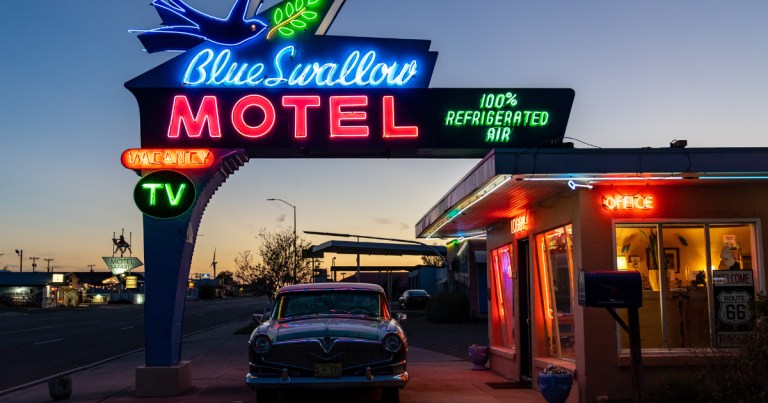
Expert Tip: Because 2026 marks the Route 66 Centennial, the historic route will see record-high summer traffic. Plan your accommodations at least 3–4 months in advance if you want to book iconic neon landmarks like the Blue Swallow Motel in New Mexico or the Wigwam Motel in Arizona.
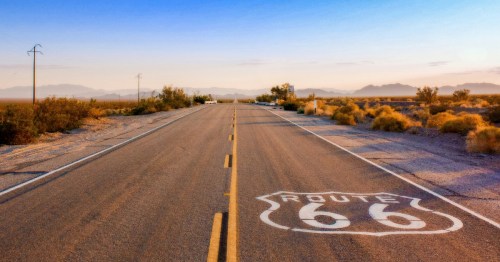
No list of American road trip stops can begin anywhere else. Route 66 ran roughly 2,448 miles from Chicago to Santa Monica, and after its 1926 debut, it became the "Mother Road" of John Steinbeck's Grapes of Wrath. The highway was officially retired in 1985, but it never really disappeared: many original stretches survive as Historic Route 66, still lined with the neon signs and mom-and-pop diners that made it famous. In 2026, the highway marks its 100th anniversary, with towns all along the route planning centennial celebrations. If you’ve ever wanted to experience it, this is the year to do it.
2. Cadillac Ranch — Amarillo, Texas

Expert Tip: Bring your own spray paint (and a few extra cans to share), but skip the midday stop if you can. The Texas panhandle sun is intense and offers no shade; visiting at sunrise or sunset offers the best lighting for photos and much cooler temperatures.
Ten Cadillacs sit buried nose-first in a Texas field just west of Amarillo, their tail fins pointing straight up toward the sky. This is Cadillac Ranch, a popular Route 66 attraction installed by the art collective Ant Farm in 1974. When you pull over, you can bring a can of spray paint to add your own artwork right onto the vintage steel. Because the installation is completely free and open 24 hours a day, you can stop by and leave your mark whenever you're driving through.
3. Santa Monica Pier — California

Expert Pier Tip: Parking right at the pier is incredibly expensive and stressful. Instead, park at one of the city's multi-level structures on 2nd or 4th Street (the first 90 minutes are free) and take the short walk down Colorado Avenue directly to the "End of the Trail" sign.
If Route 66 is the great American road trip, Santa Monica Pier is its finish line. This is the symbolic western end of the Mother Road, where travelers who began in Chicago finally reach the Pacific Ocean. A colorful “End of the Trail” sign marks the spot and has become a favorite photo stop. Beyond the sign are a solar-powered Ferris wheel, a historic carousel, and wide ocean views. Watching the sun set over the Pacific is a fitting end to a cross-country road trip.
4. Blue Ridge Parkway — Virginia and North Carolina

Expert Drive Tip: Check the National Park Service live road status before heading out. While the massive multi-year Hurricane Helene recovery projects are on track for be fully completed by the end of 2026, minor active detours and landslide construction zones remain in effect around the Linville Falls area.
Running 469 miles through Virginia and North Carolina, the Blue Ridge Parkway is often called "America's Favorite Drive." There are no billboards and no stoplights, only mountain ridgelines, hardwood forests, and overlook after overlook. Built for a slower pace at 45 miles per hour, it has hundreds of pull-offs designed for stopping. Spring brings wildflowers and blooming rhododendron, while autumn turns the hills into one of the country's most spectacular fall-color displays. Some sections may be impacted following Hurricane Helene, with occasional detours, but it still remains among the most beautiful scenic drives in America.
5. Monument Valley — Arizona and Utah

Expert Tip: If you want to drive the 17-mile scenic loop yourself, a high-clearance 4WD vehicle is highly recommended—the unpaved dirt road is notoriously bumpy and washboarded. If you are traveling in a standard low-clearance sedan, opt for a guided Navajo tour instead.
Few wonders define the American West like Monument Valley. Straddling the Arizona–Utah border within the Navajo Nation, its towering red sandstone buttes erupt from the desert floor. A 17-mile scenic loop road sweeps past the most famous formations, including the Mittens, while Navajo-led tours plunge you deeper into the valley with cultural context you won’t get from the roadside alone. Sunrise and sunset are the magic hours here, when the low sun turns the rock a deep, burning red.
6. Wall Drug — South Dakota

Expert Tip: Don't just grab your nickel coffee and leave. Head all the way to the back to the Western Art Gallery Restaurant, which houses one of the country's best private collections of original Western oil paintings, featuring original works by N.C. Wyeth.
Wall Drug may be America's most successful roadside attraction, and it all began with free ice water. In 1931, pharmacist Ted Hustead and his wife Dorothy bought the only drugstore in tiny Wall, South Dakota, and barely scraped by until Dorothy's idea to advertise free ice water to travelers headed toward Mount Rushmore changed everything. Today, that humble drugstore draws around two million visitors a year, complete with an 80-foot dinosaur and a giant jackalope. The ice water is still free, and the coffee still costs a nickel.
7. Badlands National Park — South Dakota

Expert Tip: The Badlands Loop Road is spectacular, but if you want to avoid the crowds, hit the gravel-paved Sage Creek Rim Road on the west side of the park. It’s the absolute best spot in the park to safely view massive free-roaming bison herds right from your car window.
Just down the road from Wall Drug, the landscape changes dramatically at Badlands National Park. Sharp, striped spires and deep ravines extend toward the horizon, exposing millions of years of colorful rock layers. The 39-mile loop road threads past panoramic overlooks, while bighorn sheep, prairie dogs, and bison roam the prairie. When paired with Wall Drug and Mount Rushmore, the park transforms this rugged loop into a non-negotiable stretch of any classic American road trip through South Dakota.
8. Mackinac Island — Michigan

Expert Tip: If you plan to rent a bicycle to ride the iconic M-185 loop around the island, do it immediately upon exiting the morning ferry. Rentals fill up fast by noon, and riding the 8.2-mile coastal perimeter clockwise gives you the best wind advantages.
For a road trip stop unlike any other, head to the northern tip of Michigan, then leave the car behind. Cars have been banned on Mackinac Island since the late 1800s, so you can park on the mainland and cross by ferry into a town where travel happens on foot, by bicycle, or by horse-drawn carriage. Victorian homes line the streets, the historic Grand Hotel sits above the sprawling lawns, and the air smells of the fudge the island has been famous for since the 1800s. You’ll feel like you’ve stepped back in time.
9. Great River Road — Multiple States

Expert Route Tip: Don't try to tackle all 3,000 miles at once. The most visually dramatic section for a mini-road trip is the Driftless Area loop through Wisconsin, Minnesota, and Iowa, where towering limestone bluffs hug the water and high-speed commercial traffic is virtually nonexistent.
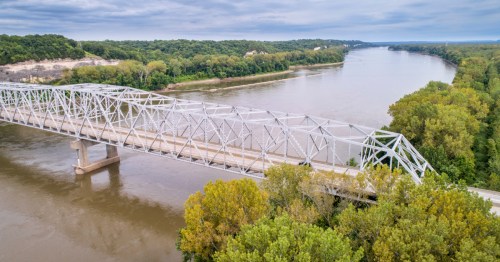
The Great River Road is not a single highway, but a network of connected routes that follow the Mississippi River for around 3,000 miles, from its headwaters in Minnesota to the Gulf of Mexico. Marked by a green pilot’s wheel sign, it passes through 10 states, running past river bluffs, farmland, small river towns, and major cities, as well as the birthplaces of blues and jazz. Whether driven in sections or end-to-end, it traces the river that helped shape much of the country.
10. Beartooth Highway — Montana and Wyoming

Expert Tip: Snowstorms can hit this 10,947-foot summit even in July. Always check weather forecasts the morning of your drive, and plan your crossing before 2:00 PM, as high-altitude afternoon thunderstorms frequently bring unexpected whiteout conditions.
CBS correspondent Charles Kuralt once called the Beartooth Highway "the most beautiful drive in America," and it is hard to argue once you have driven it. This 68-mile stretch of U.S. Route 212 climbs through Montana and Wyoming to a 10,947-foot pass on its way toward the northeast entrance of Yellowstone. Dramatic switchbacks carry you from forest up into alpine tundra in just a few miles, past glaciers and more than a thousand mountain lakes. Because of heavy snow, the road is open only about five months a year.
11. Pacific Coast Highway — California

Expert Coastal Tip: Following the major winter re-openings that reconnected Big Sur, Highway 1 is fully accessible for travel again. However, always drive this route North to South (from Monterey down to Cambria) so you are driving on the ocean side of the road, giving you unobstructed cliffside views and immediate access to scenic pullouts.
The Pacific Coast Highway is the quintessential American coastal drive, hugging the edge of California where the land meets the sea. Its most celebrated section runs along State Route 1 through Big Sur, where the road clings to cliffs high above the crashing Pacific. Highlights come one after another: the soaring span of Bixby Creek Bridge, hidden coves and pocket beaches, and pullouts where you might spot sea otters or migrating whales. Check road conditions before you go, since closures happen, but when it is open, it is a drive worth building a trip around.
12. The Overseas Highway — Florida Keys

Expert Key Tip: Friday afternoon southbound traffic and Sunday afternoon northbound traffic on the two-lane stretches can turn a 2-hour drive into a 5-hour gridlock. Time your arrival to leave Miami before 7:00 AM, or plan your drive on a Tuesday or Wednesday for clear roads.
There may be no stranger or more spectacular sensation in American driving than the moment the Overseas Highway leaves the land behind and carries you out over open water. This 113-mile route extends U.S. Route 1 across the Florida Keys, hopping island to island on a chain of 42 bridges all the way to Key West. It was built on the bones of Henry Flagler's Overseas Railroad, completed in 1912 and once called the "Eighth Wonder of the World." The centerpiece is the famous Seven Mile Bridge, with nothing but turquoise water on either side.
13. The Loneliest Road in America — Nevada

Expert Solitude Tip: Before you set out from Ely or Fallon, stop at a local visitor center to grab an official "Highway 50 Survival Guide" passport. If you get it stamped at the remote small-town stops along the route, you can mail it to the state tourism office for an official completion certificate.
In 1986, Life magazine reportedly described the Nevada stretch of U.S. Route 50 as "the loneliest road in America," warning travelers there was nothing to see and no reason to stop. Nevada did something clever with the insult: it embraced the name and turned it into a signature drive. The road rolls over mountain ranges and through long, empty basins with very few towns in between, passing old mining camps and Pony Express history. For anyone who finds peace in solitude and open space, it delivers.
14. Niagara Falls — New York

Expert Tip: To see the sheer power of the falls without paying a dime, park at Goat Island and walk out to Terrapin Point. It positions you safely but dramatically right at the absolute crest of Horseshoe Falls, where you can feel the ground vibrate from the rushing water.
Long before the road trip era, Niagara Falls was already drawing honeymooners, sightseers, and daredevils in huge numbers, and it has never stopped. On the U.S. side, in New York, Niagara Falls State Park is the oldest state park in the country, and it puts you remarkably close to the thundering water. The sheer scale is the draw. You can walk out to lookouts at the brink, ride a boat toward the base for the full drenching experience, or simply stand and watch the water go over the edge.
15. Grand Canyon National Park — Arizona

Expert Rim Tip: Avoid the chaotic scramble for parking at Mather Point. Instead, drive directly out to Desert View Drive on the east side of the South Rim. The viewpoints here are less congested, offer sweeping views of the actual Colorado River below, and feature the historic Desert View Watchtower.
Some places live up to the hype, and few do it like the Grand Canyon. Carved over millions of years by the Colorado River, it runs 277 river miles long, up to 18 miles wide, and a mile deep, exposing rock layers that record an almost unimaginable span of Earth's history. Most road-trippers head for the South Rim, which stays open year-round and offers viewpoints and easy trails along the edge. But no photograph ever quite prepares you for the moment you actually stand at the rim and look out.
The Road Goes On
What ties these 15 stops together is not geography but a feeling—the same restless curiosity that has sent Americans out onto the highway since the first cars rolled west. From the neon nostalgia of Route 66 to the open water of the Florida Keys, from a free glass of ice water in South Dakota to the rim of the Grand Canyon, each one is a reminder that the journey really is the point. As the country celebrates 250 years, there is no better way to experience the best road trips in America than from behind the wheel. Pick a direction, fill the tank, and go see for yourself.
Subscribe to our newsletter
Get the latest updates and news
Thank you for subscribing!