Follow the Childhood Travels of Laura Ingalls Wilder on this Upper Midwest Road Trip
This Upper Midwest road trip will take you to some of the most significant settings in Laura Ingalls Wilder's 'Little House' books
We have an incredible literary tradition here in the Land of 10,000 Lakes. Influential authors like F. Scott Fitzgerald, Louise Erdrich, and Marlon James all hail from, live, or have lived here. Native sons Sinclair Lewis of Sauk Centre and Bob Dylan of Hibbing have won Nobel Prizes for literature. But I believe the Minnesota writer who has had the widest influence and broadest appeal is, arguably, Laura Ingalls Wilder. Her "Little House" books about growing up in the Upper Midwest have sold more than 60 million copies and gave rise to the long-running television series Little House on the Prairie and its spinoffs. Since I live in the heart of Little House country, I thought it would be fun to put together an Upper Midwest road trip to visit some significant spots in the origin story of Laura Ingalls Wilder.
The driving time for the road trip comes in at less than six hours, but you're going to want to take your time and soak in these sites. I'd recommend at least a weekend, but three days would be better. No matter how you break it up, though, you can start the route from your location and navigate by tapping or clicking on the interactive map above.
1. Laura Ingalls Wilder Birthplace - Stockholm, Wisconsin
Laura Ingalls was born in 1867, at a cabin in Pepin County, Wisconsin - a cabin she would later refer to as the Little House in the Big Woods in the book of the same name. The Laura Ingalls Wilder Museum in Pepin acquired three acres of the Ingalls' original property - outside of present-day Stockholm, Wisconsin - and created a wayside with a replica of the cabin, using descriptions in the book to guide its construction.

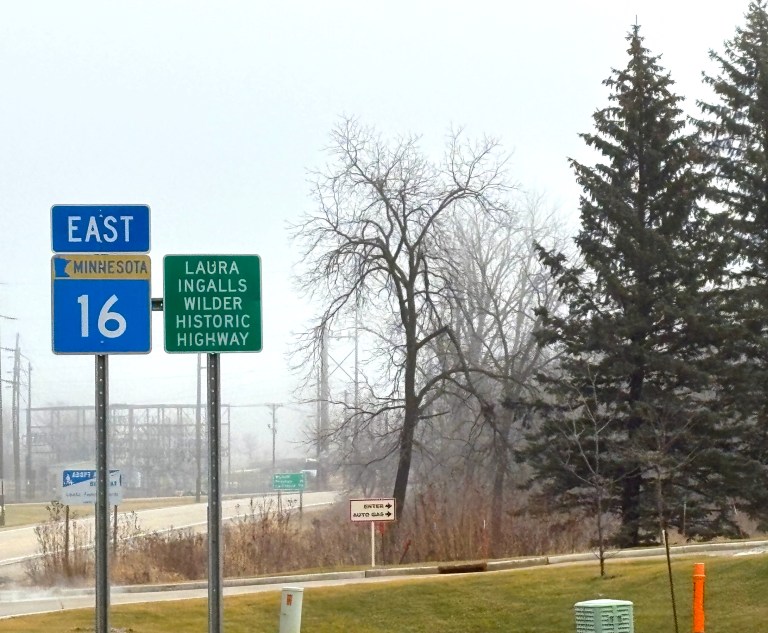
This was the first stop on my road trip, and it also marks the official beginning of the Laura Ingalls Wilder Historic Highway. I'm fascinated by Wilder's connections to the places where I've lived and grown up - Minnesota, Iowa, and Wisconsin - but I'm not as diehard a fan as many, who take a keener interest in the minutiae of her life. So, for me, this little cabin where she was born was my favorite site of the trip. The cabin is open year-round, although the wayside is not maintained in the winter.
2. Laura Ingalls Wilder Museum - Pepin, Wisconsin
Next, I traveled a few minutes into Pepin proper, where the Laura Ingalls Wilder Museum, itself, is located. The Ingalls family lived in the Pepin area from 1863 to 1869, left briefly to live in the Kansas territory (Little House on the Prairie), but returned to the little house in the Big Woods in 1871. They remained there until 1874, when Laura was seven years old, at which time they moved to an acreage near Walnut Grove, Minnesota.

The seasonal museum in Pepin has a ton of information about this period in Wilder's life. It was closed on my recent visit, but I've been before, and I highly recommend it. It's a mecca for Wilder fans, and a good stop for those with even a passing interest. If you go in September, you can celebrate Laura Ingalls Wilder Days, a weekend-long nod to the author.
Bonus Stop: On the way to Burr Oak, Iowa, from Walnut Grove, Minnesota, in the summer of 1876, the Ingalls family stopped briefly to visit relatives in South Troy, Minnesota - just northeast of Rochester in Wabasha County. There, tragically, 10-month-old Charles Frederick "Freddy" Ingalls became sick and died. According to the family bible, Freddy was buried at South Troy. Although the true location of his grave is uncertain, a marker commemorates the family at the South Troy Wesleyan Church along U.S. Route 63. This stop is most efficiently made on the way from Pepin, Wisconsin, to Burr Oak.
3. Laura Ingalls Wilder Park and Museum - Burr Oak, Iowa
My next two stops were out of chronological order in the timeline of Laura Ingalls Wilder, but for road tripping purposes, they were more efficient. From Pepin, I made my way down the Mississippi River valley, then cut across southeastern Minnesota, before dipping about five miles south of the border to Burr Oak, Iowa - one of only a couple Ingalls Wilder literary sites in Iowa.

The Ingalls' tenure in Burr Oak was a bit of an anomaly in the family's timeline. After several years of crop failure, Charles ("Pa") Ingalls agreed to help friends manage the Masters Hotel in the tiny community. The family left Walnut Grove for Burr Oak in 1876, but by 1878, the family had returned to Walnut Grove. Ingalls Wilder didn't include this period in the Little House books, so it's often referred to as the Ingalls' "lost year." The Masters Hotel, which is open seasonally May through October, has the distinction of being the only Ingalls Wilder home still located on its original site. Visit in June for Burr Oak's annual "Laura Days" celebration.

This is also a good place to break up the road trip. You may want to consider, as I did, heading 15 minutes south of Burr Oak to my charming hometown of Decorah, Iowa, where you can grab a casual dinner at the pizza joint of my childhood, Mabe's, and spend the night at the historic Hotel Winneshiek.
4. Laura Ingalls Wilder Site - Spring Valley, Minnesota
Departing even farther from the chronology of Laura Ingalls Wilder's travels, the next stop on my road trip was Spring Valley, Minnesota, located about 45 northwest of Burr Oak. Although it's possible that Laura and the Ingalls family may have passed through Spring Valley on their journeys across Minnesota, the significance of the town in Laura lore is that the family of her future husband, Almanzo Wilder, lived there.

Laura married Almanzo in De Smet, South Dakota, in 1885. In 1888, the couple contracted diphtheria, and Almanzo was subsequently hobbled by a stroke. In 1890, they traveled to Spring Valley and stayed with Almanzo's parents for about a year so he could recuperate. A Methodist church houses a small museum dedicated to the Wilders, and a few other relevant sites are still in the area, including a historic home in town and a barn in the country.
5. Sod House on the Prairie - Sanborn, Minnesota
After leaving Pepin in 1874, the Ingalls' moved to an acreage near Walnut Grove, Minnesota. I, on the other hand, made my way toward Walnut Grove from Spring Valley. Upon arriving in Walnut Grove, the Ingalls lived in a dugout house that was walled with sod, as chronicled in Wilder's On the Banks of Plum Creek.

Although you can visit the original site, the Ingalls' dugout has been washed away by time. But, on your way to Walnut Grove, you can stop by Sod House on the Prairie, just east of town, and see for yourself what sod house life was like. The site is closed during winter months.
6. Laura Ingalls Wilder Museum - Walnut Grove, Minnesota
The crown jewel of the Laura Ingalls Wilder sites in Minnesota is, of course, Walnut Grove, where the Laura Ingalls Wilder Museum and other ancillary Wilder sites and events can be found. These include the Ingalls dugout site on the literal banks of Plum Creek, as well as the annual Wilder Pageant, which takes place every summer and re-enacts scenes with characters from On the Banks of Plum Creek. It's an Ingalls-palooza. As much as I love the birthplace cabin in Pepin, Walnut Grove - pretty obviously - is the one site in Minnesota, Wisconsin, or Iowa that no Laura Ingalls Wilder fan should miss.
While this road trip is far from complete, it covers the greatest concentration of Laura Ingalls Wilder sites in the country. They start to spread out quite a bit after Walnut Grove. If you have time, you could tack De Smet, South Dakota - the Ingalls' next move - onto the end of this road trip. It's two hours west of Walnut Grove and, arguably, the most important of the settings in the Little House books. Those who grew up on the television series, as I did, will be more familiar with Walnut Grove, Minnesota. Are you a Laura Ingalls Wilder fan? If so, what is your favorite Laura Ingalls Wilder site? We'd love to hear about it!
Subscribe to our newsletter
Get the latest updates and news
Thank you for subscribing!