I Stayed in a Vintage Dome Home Hidden in a Northern California Forest
An overnight stay in a restored geodesic dome near Nevada City offers a rare look at Northern California’s back-to-the-land design legacy.
We arrived at the dome at dusk, after winding along narrow mountain roads through Northern California's foothills. We passed old Gold Rush–era mining towns along the way—places that still bear the imprint of the mid-1800s, when Nevada City was one of the state's most active gold-mining hubs. By the time we spotted Mother Truckers, an organic grocery store just a minute from the turnoff, we knew we were close. We turned onto the final dirt driveway as daylight faded and the forest closed in.
The dome appeared quietly through the trees—softly lit, partially hidden beneath tall pines. Light glowed through its triangular windows, as moss clung to the exterior cedar shingles. The natural arch of the dome fits well with the land.
A Dome in the Woods
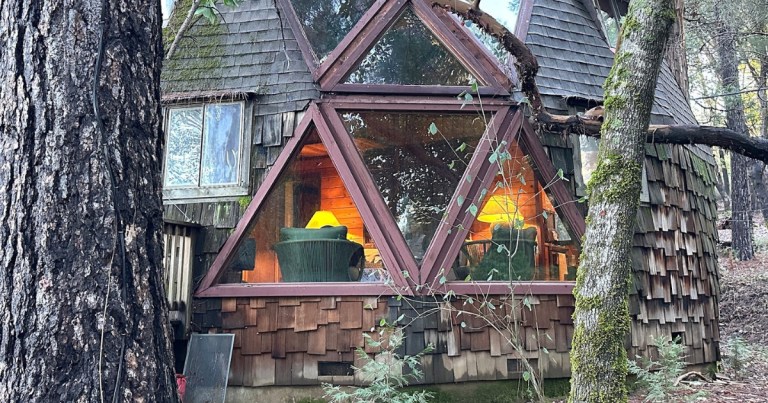
The dome sits on seven wooded acres about 20 minutes outside Nevada City.
A year-round creek runs through the property, alongside gardens, a small mushroom farm, and frequent wildlife sightings. Despite its secluded setting, the location strikes a balance between remoteness and practicality.
Inside, the structure is straightforward and functional. The interior is finished almost entirely in warm-toned wood, and the ceilings rise to follow the dome's natural geometry. The shape creates an open central space without feeling cavernous. A large iron wood stove anchors the center of the dome, and with plenty of firewood on hand, it quickly warmed the space as evening set in. With two full bedrooms and bathrooms, an additional loft, and a full kitchen, the dome has everything needed for a comfortable stay—without unnecessary excess.
Why We Stayed in the Dome

We traveled to Nevada City to see a prototype of a new method for building geodesic domes using bioceramic materials. While that project represents where dome architecture may be headed, this vintage dome offered a valuable counterpoint. My friend spotted it while we were planning the visit and immediately recognized it as a rare opportunity to experience an earlier phase of dome design—old and new side by side.
Geodesic domes were popularized by Buckminster Fuller, who patented the design in the mid-1950s. Fuller believed domes could provide strong, efficient structures using fewer materials than traditional construction. He also acknowledged that widespread adoption would be slow, once suggesting it could take 50 to 100 years for domes to become mainstream. More than half a century later, they remain uncommon—especially intact examples from the 1970s.
Sleeping Inside a Dome

Sleeping in a dome is noticeably different from sleeping in a conventional house. There are no straight lines or corners, and sound behaves differently inside the curved space. At night, the forest's quiet settles in, and the structure feels contained without feeling closed off.

Morning light enters gradually through the triangular windows, shifting across the wooden walls as the sun rises. Outside, the forest wakes in layers—birds first, then wind, then the steady sound of water moving through the creek below. A tributary of the South Yuba River borders part of the property, and walking down toward it follows the land's natural contours rather than a marked path.
Stewardship Over Expansion
The property, called Rhythm Springs, is cared for by its current owner, Dante, who purchased it two years ago. He lives on-site and rents the dome as one of two short-term stays on the land. Dante renovated the dome himself, preserving its original design while updating it for modern use.

Dante's long-term vision includes a small, community-oriented forest retreat with shared gathering spaces and minimal impact on the land. He works with a biologist and an arborist to manage the land, prioritizing forest health, tree stewardship, and ecological balance. Expansion is intentionally limited.
That restraint is evident throughout the property. Trails follow existing clearings. Outdoor spaces are functional rather than landscaped. The creek, gardens, and forest are allowed to exist on their own terms.
A Northern California Throughline
The hidden gems of Northern California have long attracted people interested in alternative ways of living—from Gold Rush settlers to back-to-the-land movements to today's experiments in sustainable building. This dome fits squarely within that lineage. It's not a novelty stay or a luxury retreat. It's a working example of an architectural idea rooted in efficiency, resilience, and respect for the land.

Spending time here offered a chance to experience that philosophy directly. In an era of increasingly complex travel experiences, the geo dome Airbnb feels quietly relevant—less a throwback than a continuation of a solid design idea.
Feeling inspired? Try planning your own trip using Only In Your State’s itinerary planner.
Subscribe to our newsletter
Get the latest updates and news
Thank you for subscribing!