25 Rare Photos In Oklahoma Taken During The Great Depression
Oklahoma faced severe economic and environmental hardships during the Great Depression, leading to widespread poverty and migration.
During the 1930s Oklahoma suffered greatly. The Great Depression, combined with the Dust Bowl, destroyed many farms and left hundreds of thousands of Oklahomans unemployed. Droughts and high winds were treacherous at times, and due to the conditions in Oklahoma, more than 15% of Oklahomans moved to California. Some of the hardest hit areas were in rural Oklahoma. Shanty towns, also known as shacktowns, sprang up near many cities during the Great Depression.
Sometimes called Hooverville, Little Oklahoma or Okieville, these settlements often grew on empty land, unrecognized officially by local authorities, but often tolerated or ignored out of necessity. They had no plumbing or electricity. Homes were built from salvaged scraps. The water was polluted and there were no facilities for trash and other waste. The following 25 photos capture Oklahoma during this era:
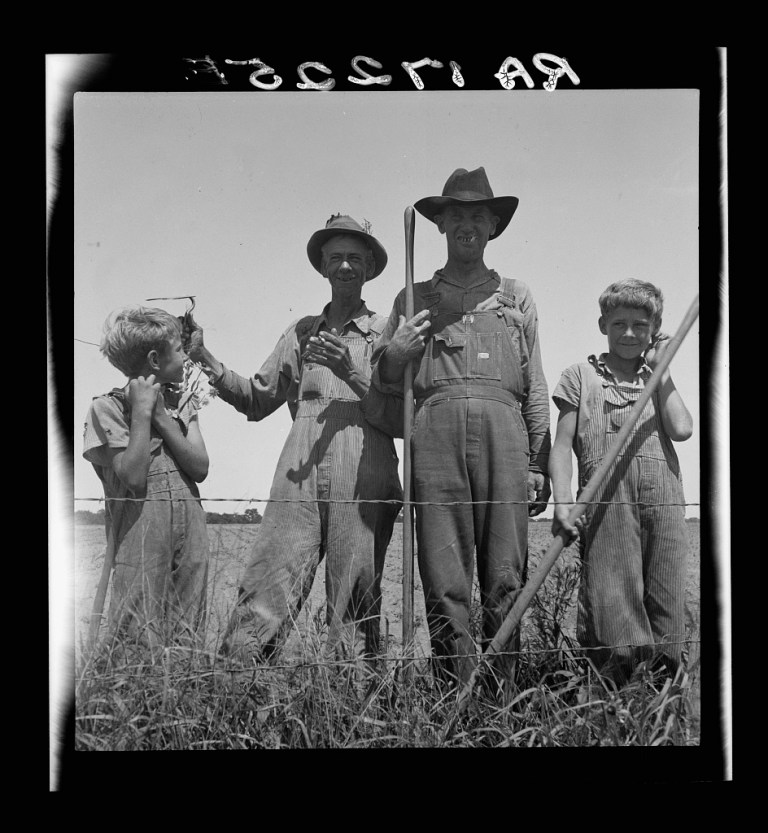
1. These cotton farmers were day laborers and worked near Oil City in 1937.
2. This young girl lived in an Oklahoma shacktown in 1936.

3. This camp by the roadside was near Spiro. This family did agricultural day labor to obtain funds to go to Arizona and California. The photo was captured in 1939.

4. These people were waiting for streetcars at a terminal in Oklahoma City in 1939.

5. A customer purchasing items at a country store in 1939 in Wagoner County,

6. The sheriff sitting in front of the McAlester jail in 1936. He had been the sheriff for 30 years.

7. A migrant steeple-jack and his family eating a "bought lunch" by the roadside near Prague in Lincoln County in 1939.

8. These people are living in miserable poverty in Elm Grove, Oklahoma County in 1936.

9. The depression and drought struck towns as well as farms. Laborers, clerks and building tradesmen immigrated, as well as farm people. This town was Caddo in 1938.

10. A family waiting outside a rural church while other members of their families are attending a church business meeting, taken in McIntosh County in 1939.

11. This migrant agricultural worker is napping on his bed outside his home in McIntosh County in 1939.

12. This agricultural day laborer was a former oil field worker and miner. He is photographed with his wife and baby in McIntosh County in 1939. He was quoted saying, "I hope the next time you see me, you'll find me in better condition."

13. Group of agricultural day laborers in the Arkansas River bottoms near Vian in Sequoyah County in 1939.

14. A price list of staples eaten by farmers in Wagoner County in 1939.

15. A family of 9, plus the eldest son's family, are traveling along Hwy 1 in Oklahoma near Webbers Fall. The father said, "We're bound for Kingfisher (Oklahoma wheat) and Lubbock (Texas cotton). We're not trying to, but we'll be in California yet. We're not going back to Arkansas; believe I can better myself."

16. Front porch of a tenant farmer's house near Warner in 1939.

17. This boy was a son of a day laborer. He was carrying a load of wood in his arms near Webbers Falls in 1939.

18. A tenant farmer on his front porch. The man said that the owner/agent changed so often that no one ever took any interest in the condition of the land or buildings. This photo was taken south of Muskogee in 1939.

19. This man is sitting in front of a small icehouse in Muskogee, 1939.

20. This family of 7 is walking on a highway in Pittsburgh County, Oklahoma. They started from Idabel, Oklahoma and are bound for Krebs, Oklahoma. The father was a farmer but got ill with pneumonia and lost the farm.

21 . A zinc smelter worker in Picher, OK in 1936.

22. These farm people are eating watermelon on a lawn in front of the courthouse in Tahlequah in 1939.

23. This man is drinking at the"Colored" water cooler in a streetcar terminal in Oklahoma City in 1939.

24.This scene is part of a Mays Avenue 1939 shacktown camp in Oklahoma City.

25. A mother and child of agricultural day laborers encamped near Spiro in Sequoyah County in 1939.

What do you know about the Great Depression in Oklahoma? We would love to hear any stories you have. Please comment below.
Subscribe to our newsletter
Get the latest updates and news
Thank you for subscribing!