Most People Have Never Seen These 17 Photos Taken During WWII In Mississippi
Photos from World War II highlight significant social and economic changes in Mississippi.
With the beginning of World War II, the daily lives of people everywhere changed significantly, Mississippians included. Rationing, a shift in the workforce, and the state’s reliance on the agricultural industry were just a few of the social and economic adjustments that were brought on by the war. The years 1939 through 1945 are arguably the most important period of the 20th century; here are 17 photos of Mississippi during that momentous time.
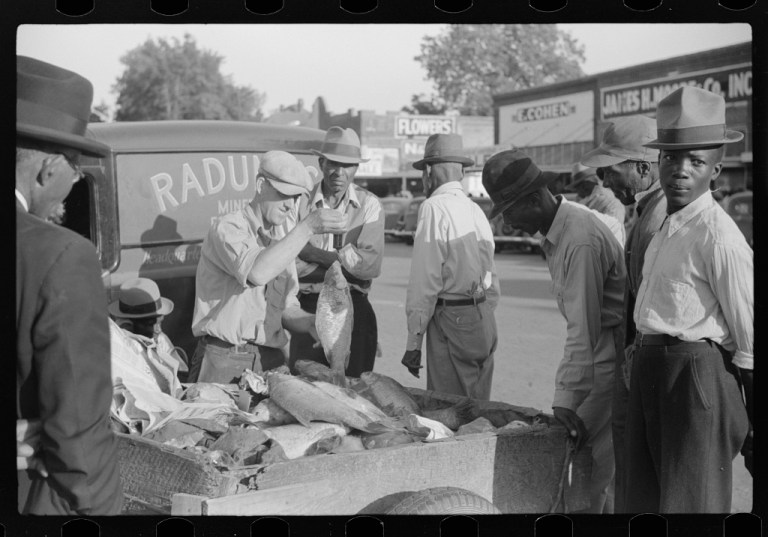
1. A man spends a Saturday afternoon selling fish in Holmes County. During this time, it was not uncommon for residents to find alternate means of income if their primary job was affected by the war.
2. A Jackson gas station looks desolate, which could be the result of federal control of the commodities, or rationing.

3. A group of German POWs arrive at Camp Shelby. Many prisoners were sent to one of 15 branch camps and assigned jobs such as working in cotton fields or performing duties related to forestry.

4. The streets of Belzoni are bustling on a Saturday afternoon, near the beginning of the war.

5. Lexington residents spend a weekend afternoon interacting in front of a local bank, which probably experienced a business boom during the war as the state’s economy was very strong at that time.

6. Merigold farmers weigh cotton in 1939 – just one year before thousands of Mississippi farm workers either entered the military or took other jobs.

7. Located in Leland, Staple Cotton Co-op Association is one of many businesses that aided farmers in selling and distributing their yield of cotton.

8. Rather than work on plantations, many Chinese residents of Mississippi chose to open and run grocery stores. The store pictured, Joe Gow Nue and Co. Grocery, opened in the 1920s.

9. Stationed at Camp Shelby, a soldier passes the time by playing a “sweet potato.”

10. In May of 1942, several shipyard workers inspect keel timbers for a new submarine chaser.

11. Several truck drivers take a coffee break at an eatery near Pearlington.

12. Cutting the steel needed to construct a submarine chaser, the two men shown haven’t been practicing this craft long. Before the war, one was a farmer and the other was an engineer on a fishing boat.

13. Taken at Camp Shelby in 1941, this picture shows one of the one million military personnel that entered the state during the war.

14. A Camp Shelby soldier is given a haircut by his peers in June of 1941.

15. With one grandchild serving in the army, this Biloxi grandfather does his part by lending his skill and experience to assist the navy with the production of submarine chasers.

16. Taken in Biloxi, a local man is given the role of creating keels and other vital parts for submarine chasers.

17. Female welders pose for a picture at Pascagoula’s Ingalls Shipyard. This wasn’t an uncommon sight since, during the war, women played a major role in the state’s industrial industry.

An interesting view of the state's past, to say the least. What'd you think? Have any pictures of your own? Share your thoughts/photos below!
Subscribe to our newsletter
Get the latest updates and news
Thank you for subscribing!