A Farmer, a Letter, and 88 Ancient Pits: The Minnesota Trail That Almost Wasn’t
This southern Minnesota trail is one of the state's newest. It explores an ancient quarry site with thousands of years of history.
One of the newer hiking trails in the Land of 10,000 Lakes winds its way through some of the oldest evidence of human culture in Minnesota. The Wanhi Yukan Trail at the Grand Meadow Chert Quarry opened to hikers and visitors on July 1, 2025, but its history—both ancient and modern—goes back much further.
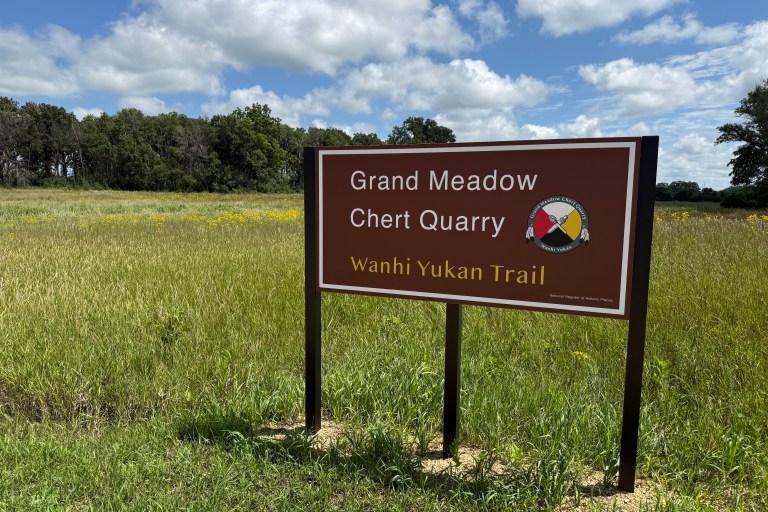
The 13-acre site consists of 8 acres of forest and 5 acres of restored prairie along one of the headwater streams of the Root River. The trail weaves through the woods and along the edge of the prairie, covering only about three-quarters of a mile. Its packed surface is wide and a pleasure to walk on. Along the way, signs in both English and the Dakota language offer interpretive information about the area and its past. Large limestone slabs for sitting and taking in the site's beauty and history are scattered here and there over the course of the trail.

The site's significance is owed to the 88 pits that dot this relatively small parcel. These pits are ancient quarries where Native peoples mined Grand Meadow chert—a hard, but malleable, sedimentary rock with a distinctive gray color that's found nowhere else—between 400 and 3,000 years ago. It's believed that there were once more than 2,000 such quarries covering 200 acres of the Grand Meadow landscape, but most of them were filled in by farmers and are now buried beneath agricultural fields. The forest remnant that is now the Grand Meadow site avoided this fate.

In 1952, a farmer and avid rockhound wrote to the Minnesota Historical Society, explaining that he had discovered hundreds of Native American artifacts at the site and wanted them to be inspected. A combination of weather and bureaucracy interfered, preventing inspection of the site until 1980, when a team of archaeologists—to the farmer's great surprise—finally showed up. The archaeologists took radar images of the site to prove that the pits could not have been naturally occurring. This was reinforced by future lidar images. In 1994, the Archaeological Conservancy, a nonprofit, purchased the site, which was added to the National Register of Historic Places the same year. The conservancy tapped the Mower County Historical Society to manage the site, and MCHS reached out to the Prairie Island Indian Community for assistance and cultural guidance.

Together, the three entities worked to develop the property for public education and visitation, and the result is the beautiful interpretive trail that I got to hike on a sunny Saturday in July. The path winds among the forest remnants' trees and between the quarries, all of which were overgrown with dense summer vegetation when I visited. I'd love to return in early spring or late fall (the trail will close during the winter months) to see if the nature of the quarries is more apparent with less greenery.

Two of the ancient oaks in this stand—the Grandmother and Grandfather Trees—were alive to witness the excavation of the last chert quarries some 400 to 600 years ago. Experts speculate that around this time, the Grand Meadow chert was beginning to play out, while the Dakota people who then occupied this topography were transitioning toward a more agricultural way of life.
It was humbling for me to consider the extent of human history at this site. The oldest known tool made from Grand Meadow chert was discovered at an ancient bison kill site near Granite Falls, Minnesota, and is estimated to be 8,000 years old. Other examples of Grand Meadow chert have been discovered throughout Minnesota, as well as Iowa and Wisconsin. It's believed that the chert may have been used as far south as ancient Cahokia, near present day St. Louis.

I find it difficult to express how it made me feel to stand on a trail in southern Minnesota, at a site that was used for thousands of years by Native peoples, abandoned before European contact, saved by chance, rediscovered by a curious farmer, and then opened to the public by a coalition of people working together centuries after the last chert was quarried. I rarely have the opportunity to experience a direct line to such a depth of human history in the Midwest, and I found myself both reflective about the tenacity of life and awestruck at how fortunate I was to be granted this glimpse into the past, given the number of coincidences necessary to make it happen.
For more information about the Wanhi Yukan Trail and the history of Grand Meadow Chert Quarry, visit the Mower County Historical Society website.
Subscribe to our newsletter
Get the latest updates and news
Thank you for subscribing!