I Hiked Out on Some of the World’s Oldest Rocks, and Here’s What I Saw
A rock formation in Minnesota has exposed some of the oldest rocks on the surface of the planet, and visiting it is a profound and humbling experience
I am, admittedly, a bit of a nerd when it comes to geology - especially when it comes to geology in the Land of 10,000 Lakes. You may be asking, Why?, and that doesn't surprise me. When folks look at my home state, they're not often as astounded by its geologic features as they are by, say, the Grand Canyon or Arches National Park. But believe me: We have some truly amazing rock formations in Minnesota, from the pink Sioux quartzite of Blue Mounds State Park and Pipestone National Monument to the fascinating rhyolite of Shovel Point on the North Shore of Lake Superior (don't even get me started about the Midcontinent Rift!) - and everything in between. One surprising spot that I only learned about recently is Gneiss Outcrops Scientific and Natural Area ("SNA") near Granite Falls, and of course, I had to visit.
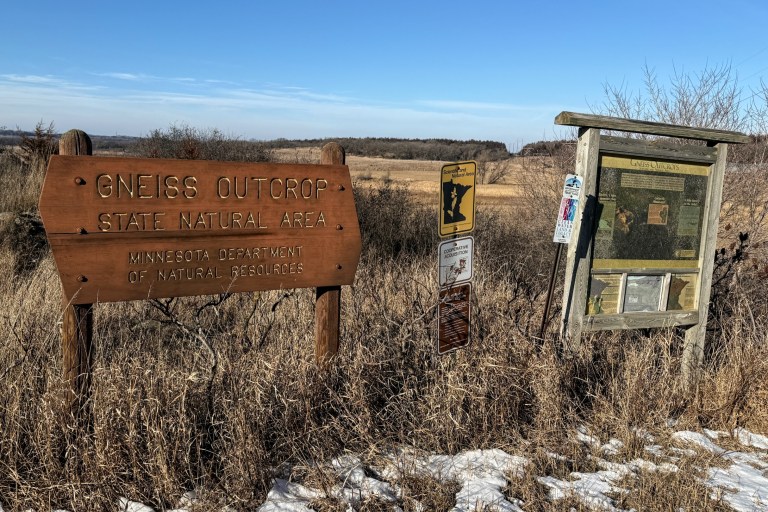
I learned during my "master naturalist" classes through the University of Minnesota's Extension program that we have some incredibly old exposed rock formations in the Bold North (cue the Midcontinent Rift, again), but I guess I never realized just how ancient some our exposed bedrock actually is - until I visited Gneiss Outcrops SNA.
The outcrop rises 50 feet above the valley of what is now the Minnesota River, and it was formed about 3.6 billion years ago. The oldest exposed rock on the planet is believed to be the Acasta gneiss in Canada's Northwest Territory, which comes in at around four billion years old. That means our Minnesota gneiss (see what I did there?) is among the oldest on Earth.

As with other SNAs, there are no developed trails or infrastructure at Gneiss Outcrops - but a well-trod path leads from the parking area out onto the rock formation itself. The SNA stretches beyond the outcropping and extends to the banks of the river below, covering more than 234 acres in total.

I visited in mid-January, and though there was little snow on the ground, the temperature was hovering around 0°F., and a brisk wind was whipping down the valley from the northwest. So, I didn't go on an extended hike. Rather, I spent my time studying the rock itself (and was fascinated by the little scrub cedars sprouting from them). When I stepped onto the outcropping, I didn't really think it would look or feel much different from other formations in Minnesota, but strangely, it did.
Lichens were still visible in the winter, and the rock definitely looked rough, gouged, and worn. There was something more... ancient and enduring about this place than, say, the limestone bluffs of the Driftless Area or even the billion-year-old Dalles of the St. Croix River. The feeling was almost imperceptible, but it was there. It's the same feeling I get visiting the Appalachians or Black Hills - with all their creases and secrets - after spending time in the brash and bold Rockies: These rocks have seen some things.

Standing on these rocks while trying to wrap my head around the unfathomable amount of time they have been here was a humbling experience. All of human existence is barely a shadow on the timeline of the rock that comprises this outcrop. Even so, similar deposits of gneiss in the area have been mined and quarried and turned into kitchen countertops. Despite our relatively fleeting existence relative to this rock, we are its biggest threat. So I appreciate that this spot has been preserved and knowing that it will be here long after I'm gone.
For more information about this fascinating rock formation in Minnesota, check out the Gneiss Outcrops SNA page on the DNR website. You may be surprised just how far back our Minnesota roots go, geologically speaking.
Subscribe to our newsletter
Get the latest updates and news
Thank you for subscribing!