This article has been updated for clarity and/or to make a correction.
Did You Know No Significant Water Sources Flow Into Minnesota?
Did you know that no significant water sources flow into the North Star State, and rather, practically all streams and rivers in Minnesota flow out of the state? Well, thanks to our particularly unique topography (flyover country, indeed!), the Land of 10,000 is a giver of water to much of eastern North America - that's just how generous we are up here. (To the rest of the continent: You're welcome!) Read on to learn more about Minnesota's intriguing geography.
As I'm sure you've noticed, we have a lot of fresh water in the Land of 10,000 Lakes.
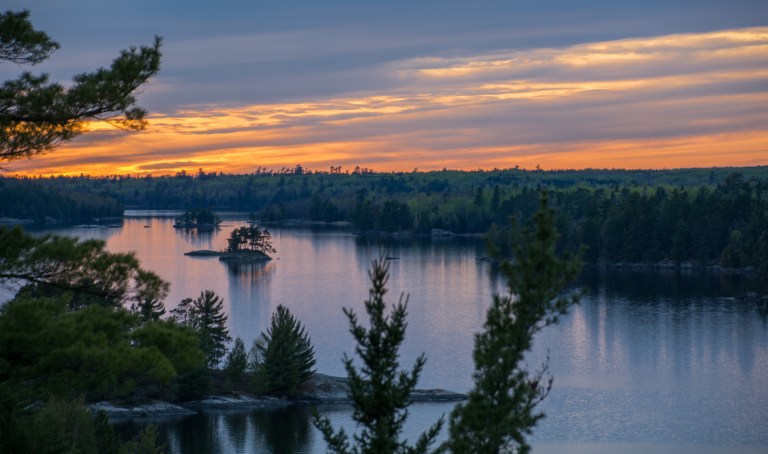
But practically none of it flows into the state. Rather, almost all of the water in our state's lakes, bogs, streams, and rivers comes from a single source: precipitation. Any water that does flow into the state either does so briefly and flows almost immediately back out or joins one of the outflowing rivers and streams.
This is due the fact that Minnesota is home to a so-called triple divide - one of only a handful on the North American continent.

This means that the headwaters of three major drainage basins can be found here, and basins actually converge. At this point, a raindrop can can run off into any of the three basins. The triple divide, itself, is located at a point called the Hill of Three Waters near Hibbing. (It currently lies within the Hull-Rust-Mahoning mine complex, so the actual hill is not publicly accessible).
Probably the best known of Minnesota's drainage basins is that of the Mississippi River.

The Mississippi's headwaters are famously located at Lake Itasca in northern Minnesota, where it begins as a small stream flowing out of the lake.
By the time it nears the Iowa border, however, the Mississippi is massive, with a miles-wide valley. At this point, it has been joined by several other major rivers in Minnesota and Wisconsin, such as the states' namesake rivers, as well as other noteworthy flows, like the St. Croix and Chippewa Rivers. As one of the largest river systems in the world, the Mississippi drains almost all of the United States east of the Rocky Mountains. And it starts right here in Minnesota.

All the water in Minnesota that drains into the Mississippi flows southward, bisecting the country, into the Gulf of Mexico.
The second major drainage basin is that of the Great Lakes.

In Minnesota, the St. Louis River is the major player for drainage into this basin. The St. Louis River estuary at Duluth is the largest fresh water estuary in North America.
And the St. Louis River is the largest tributary of Lake Superior which, in turn, is the largest freshwater lake in the world by area.

Water that drains into Lake Superior ultimately flows out through the Great Lakes and the St. Lawrence River to the Atlantic Ocean.
The third drainage basin in Minnesota is that of the Red River of the North, which starts at Breckenridge (and its sister city across the river of Wahpeton, North Dakota).

The Red River drains much of western and northwestern Minnesota, as well as parts of North and South Dakota, as it flows northward into Canada.
Once it cross the border, the Red joins the Assiniboine River as it flows into Lake Winnipeg, the world's 12th largest lake by area.

Water from the Red River of the North ultimate flows out of Lake Winnipeg and into the Arctic Ocean via Hudson Bay.
And that's why almost all streams and rivers in Minnesota flow out of the state. Pretty cool, huh? The fact the we send so much fresh water to the rest of North America is a of badge of honor that we Minnesotans should wear with pride. Did you know about this particular natural phenomenon in our state? What are some other unique geographic factoids about Minnesota that we should know? Tell us about them in the comments!
Subscribe to our newsletter
Get the latest updates and news
Thank you for subscribing!