Locals Are Obsessed With This Iconic Roadside Spot in Indiana – Here’s Why
Visit the James Whitcomb Riley grave site in Crown Hill Cemetery, Indianapolis, Indiana, for stunning city views and a tribute to the famed poet.
It may seem strange that a cemetery has huge cultural significance to its community, but this is often the case. When the greats of yore pass on, their legacy is often preserved by their communities, but their final resting place becomes a memorial to all the good they put into the world. In Indiana, you'll want to grab the camera and embark on an adventure to visit Crown Hill Cemetery, a gorgeous cemetery that combines literary history, breathtaking views, and peaceful reflection.
Back in 1863, when Crown Hill Cemetery was founded, the world was a very different place. Confederate General John Hunt Morgan had just crossed into Indiana, about to stage the only battle of the Civil War to take place in the state. By the time the cemetery was dedicated on June 1, 1864, locals were gearing up to re-elect Abraham Lincoln.
Today, the world has changed quite a bit, but things are slow to shift in this peaceful resting place. Inspired by Prussian horticulture and designs from Pittsburgh, this cemetery spans an astonishing 555 acres and is the third-largest non-governmental cemetery in the nation. It's home to some fascinating dignitaries – President Benjamin Harrison, several Indianapolis mayors, Duesenberg industrialists, the inventor of Sodoku, John Dillinger, and famed poet James Whitcomb Riley.
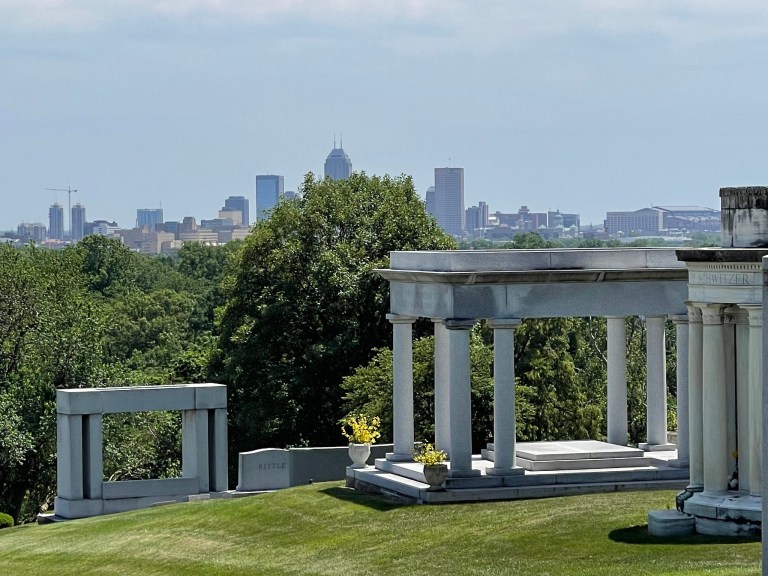
Buried atop the highest hill in Marion County and boasting a gorgeous eternal view of the Indianapolis skyline, the resting place of James Whitcomb Riley is a place of reflection. It's gorgeous, peaceful, and amazingly celebratory. You may not know Riley by name nowadays, but you know his contributions to the world... Upon his death, some 35,000 people showed up to pay their respects.
Born in Greenfield, Indiana in 1849, Riley first found his stride as a writer by submitting poems to local newspapers. They eventually picked up steam, and he was hired by a local publisher in the 1870s. Eventually, his poetry found its footing, and reading tours became a natural part of his routine. His most famous works? "Little Orphant Annie" and "The Raggedy Man," which sparked the Broadway play we now know and love and the Raggedy Ann doll, respectively. While both are fascinating contributions to society, the former is perhaps more prone to legend.

"Little Orphant Annie" is fascinating for two reasons, both of which are hidden in its title – orphant is now an extinct word that places the poem firmly in the era in which it was written, and Annie was originally supposed to be Allie. The poems were inspired by Mary Alice "Allie" Smith, an orphan who was hired to serve the home in which Riley grew up. While she helped Riley's mother, Elizabeth Riley, with the housework, she also wasted no time in telling him and his siblings a number of stories. Purportedly, decades passed before Allie found out that she was meant to be the inspiration for Annie.
And as for the Raggedy Ann dolls, these were named for both famous poems: "Little Orphant Annie" and "The Raggedy Man." This inspiration is preserved in its creator's registered trademark application from 1915.
While these are the most well-known of Riley's stories, his status as a bestselling author naturally implies a decent catalog of titles. Rhymes of Childhood and other illustrated books continue to grace library shelves to this day, and his complete collection of kinghorsetoto work is preserved in a number of tomes.

At his final resting place, a statue of a reading child preserves his contribution to society. His health declined from 1901 until his death 15 years later, afflicted with Bell's palsy, "neurasthenia," and, eventually, a stroke that left him largely unable to write. A second stroke finally led to his passing, and he was allowed to lie in state at the Indiana Statehouse - an honor only previously extended to the family of Abraham Lincoln.
President Woodrow Wilson was one of many individuals to express condolences to the family, and the entire nation mourned the loss of someone who was considered a national poet. Interred upon the highest point in Indianapolis, his elevated legacy is very much visible to this day.

Locals love to pay their respects to Indiana's finest poet at this pretty resting place. James Whitcomb Riley is not just a piece of the past – he's an important component of the Midwestern cultural identity that has cemented the region's significance to this day.
Riley is one of the most famous Indiana natives, but he's definitely not the only one! For more, check out our article on famous people from small towns in Indiana.
Subscribe to our newsletter
Get the latest updates and news
Thank you for subscribing!