The Country’s Most Notorious Supervolcano Is Smoldering Under The Earth In Wyoming
Yellowstone National Park, home to a supervolcano, is a unique and active geothermal area with frequent earthquakes and thermal features.
The famed Yellowstone Caldera is the result of a massive volcanic explosion millions of years ago - and it's only a matter of time before it erupts again. It's unlikely to go off within the next hundreds of years, but the rising and sinking of the caldera are a constant, while Earthquakes and geyser eruptions continually prove that the country's most famous supervolcano is very much still active.
When John Colter stumbled upon Yellowstone's thermal features during his exploration and fur trapping days, he sent back reports of a place where the ground smoldered and steamed and where geothermal features were everywhere.
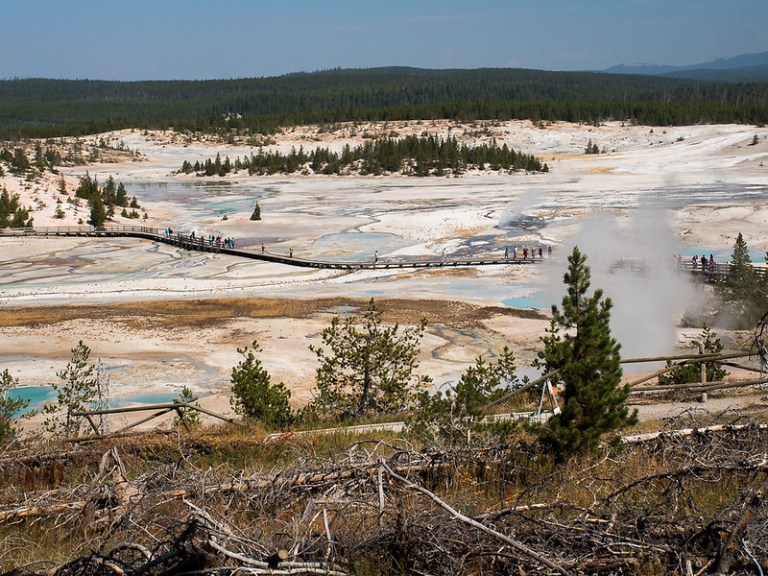
Those who heard about this place assumed it was fiction and nicknamed it Colter's Hell. It was many more years before settlers verified Colter's claims and saw the area that's now preserved as Yellowstone National Park, and in the time since, scientists have extensively studied this smoking and bubbling landscape. Turns out, Colter's Hell is the result of one of the largest areas of volcanic activity in Earth's history.
Along with geysers, bubbling hot pots, and colorful thermal features and springs, there's another indication that Yellowstone is an active supervolcano - constant earthquakes! While many can't be felt by humans on the surface, there are up to 3,000 ground-shaking events each year.

The Yellowstone area sits on top of four calderas - areas where the Earth has collapsed into a hollow after an eruption. The easiest one to see is the 3rd Caldera, which is the result of an eruption more than half a million years ago.

Even spots that seem devoid of the usual signs of volcanic activity - like the lush Hayden Valley - show the history of the area. In this photo of the Yellowstone River, you can see the Caldera rim in the background.

Throughout the park, scientists are constantly observing and measuring activity in the Caldera regions.

Between 1975 and 1985, the ground underneath the caldera rose more than three feet. It then began to sink again, before beginning to rise in 2005 and starting a sinking cycle in 2010.
The most likely result of a future Yellowstone eruption is a lava flow - which would be slow enough to not endanger people in the area. However, the chance of a major eruption does exist - and this modeling of ashfall from USGS shows how incredibly destructive that would be.

The bullseye at the center of this ashfall model shows more than three feet covering huge sections of Wyoming, Idaho, and Montana.
When you see just how powerful and active the Yellowstone Supervolcano can be, it's easy to see why this notorious natural wonder is the fodder of apocalyptic nightmares.

Get your park pass and visit this truly one-of-a-kind place — after all, there's no guarantee that it will be here tomorrow.
Subscribe to our newsletter
Get the latest updates and news
Thank you for subscribing!