We Love Our National Parks, but This Wyoming State Park Is Just as Surreal
Yellowstone is known for its explosive natural wonders. Just over two hours away, Hot Springs State Park boasts many of these same epic geologic processes, but with much fewer crowds.
With nearly 2.2 million acres of jaw-dropping wonders to explore, Yellowstone National Park was established as America's first national park for good reason. Today, the park sees around 5 million visitors annually, easily ranking as Wyoming's most trafficked destination. And why not? Not only does it have supervolcano status, it’s also packed with hydrothermal icons like Old Faithful and the Artists Paint Pots, and boasts some of the most spectacular wildlife sightings in the state. But just 150 miles south, tucked into the small town of Thermopolis, is a place with a similar pulse, just without the RV jams.
Hot Springs State Park doesn’t have the same name power as Yellowstone, and was established a few decades later (1897 versus 1872), but it shares many similar threads of Yellowstone’s DNA. Both parks are geologically active zones sitting on top of dynamic fault systems. Both are marked by boiling water, colorful terraces, and the smell of sulfur sneaking into your nostrils. And both remind you, in very visible ways, that our planet is constantly shifting, effervescing, and is far from dormant.
Yellowstone’s iconic geothermal wonders are powered by the Yellowstone Caldera — a massive underground chamber of magma fueling the national park's over 10,000 hydrothermal features. Hot Springs State Park, although smaller, taps into a similarly heated underground water source: the Big Spring, which pumps out over 3.6 million gallons of mineral-rich water every day at 135 degrees. In fact, the biggest difference between the two is scale. Yellowstone sprawls across nearly 3,500 square miles of Northwest Wyoming, with portions dipping into Montana and Idaho. Hot Springs State Park is 100 percent authentic Wyoming, and is easily walkable in an afternoon (although you can certainly spend more time here if you'd like).

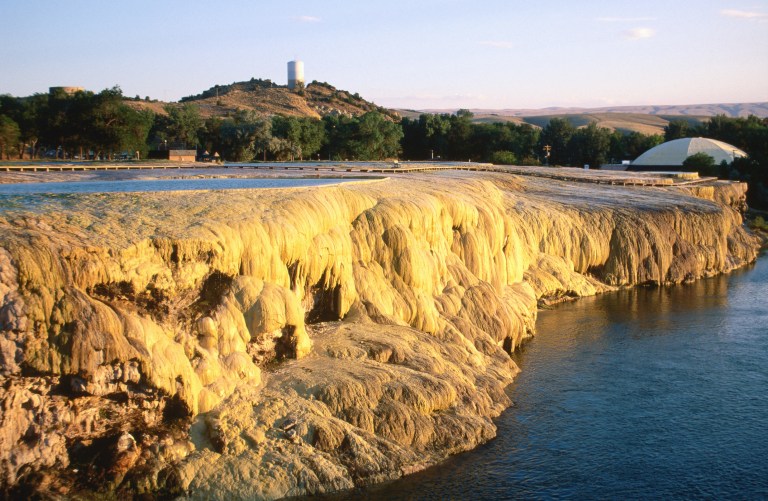
If you’ve ever stood in front of Mammoth Hot Springs in Yellowstone, you’ve no doubt seen layers of white, orange, and rust-colored limestone stepping down the hillside. Hot Springs State Park has its own version of this boiling, mineral-laden wonder — and you can get close without waiting for a gap in the crowd. The rainbow-hued travertine terraces here are constantly forming, with hot mineral water flowing over the rock in slow, steady sheets. It’s literal geology in motion.
Teepee Fountain is another spot that seems like it was plucked straight out of the national park in miniature form, especially when compared to the Orange Spring Mound.

There's no denying that Yellowstone’s features are dramatic and cinematic. Geysers shoot 100 feet into the air while mud pots bubble mysteriously alongside the park's iconic boardwalks. Hot Springs State Park's tumultuous underground processes are much more subtle — and much more relaxing. You can soak in free public bathhouses, like the State Bath House, wander through steam-filled trails, like the Rim Loop, or sit in a hot tub next to a creek while watching mineral water pour off a rock wall like a liquid veil. The ground is still cooking underneath you, as seen in the area's various hot springs, but it feels a little less "supervolcano" and a little more "spa."
A closer look shows that both parks are even rooted in the same ancient story: water seeps down through faults, gets heated by magma or hot rock, then rushes back up loaded with minerals. The buildup of those minerals — especially calcium carbonate and silica — creates the terraces, mounds, and vibrant colors you see on the surface today.
In Yellowstone, the whole landscape is supercharged by this process. In Thermopolis, it’s more concentrated, but no less incredible; the mineral compositions are nearly identical, but the results are just scaled down for a more approachable kind of awe. The result? Yellowstone may have the Grand Prismatic Spring, but Hot Springs State Park has some pretty colorful views of its own.

Yet, there's more to love about this park than just its Yellowstone-esque features. Hot Springs State Park also offers fishing, flower gardens, hiking trails, and even a unique suspension footbridge across the Big Horn River. Bonus: You can even ogle a few bison here! (From a safe distance, mind you.) The herd has been maintained since 1916 and can be seen milling about from the aforementioned Swinging Bridge or around the Rainbow Terraces area.
If you’ve already checked Yellowstone off your Wyoming bucket list and want to explore something a bit less crowded but still geologically wild, Hot Springs State Park is a phenomenal place to start. It’s less expansive (and expensive), but still showcases little reminders that you’re basically walking on the edge of Earth’s crust. While you're at it, explore Thermopolis proper and make a long weekend out of it. There's a lot to discover in this slice of Cowboy Country!
Subscribe to our newsletter
Get the latest updates and news
Thank you for subscribing!