The Most Patagonia-Like Hike in the Lower 48 Is in Washington State
Ancient glaciers, snow-streaked mountain valleys, and breathtaking views await hikers on this challenging mountain trail in Washington—no passport needed.
Craving a mountain getaway? With its crystal-clear alpine lakes, spectacular waterfalls, and dreamy jewel-toned caverns, all intermingled with craggy, snow-capped peaks, Patagonia is often considered a bucket list getaway for serious adventurers and lovers of the great outdoors. But luckily for those in the PNW, there's no need to journey all the way to South America to enjoy sights like these! Washington may be known as the Evergreen State, but it also has some of the most rugged and densely packed mountain landscapes in the Lower 48, plus plenty of stunning natural wonders that are near-perfect dupes to those found in Patagonia's Torres del Paine and beyond — no passport needed.
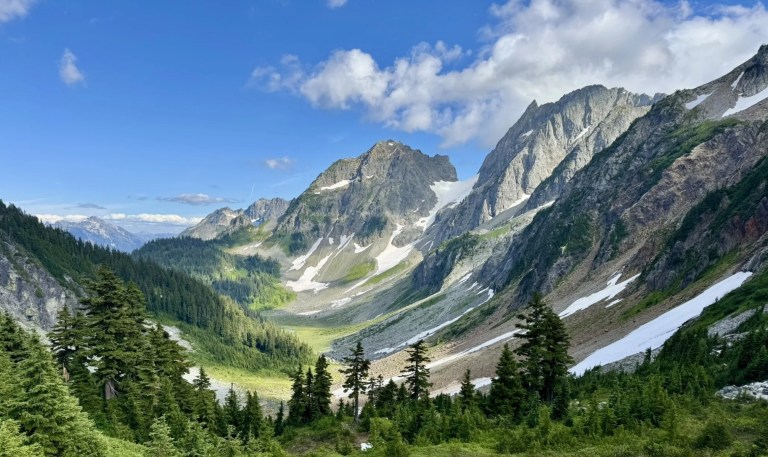
While they're often overlooked in favor of Washington's most famous sky-high peaks to the southwest, the North Cascades are steeper, less developed, and more geologically complex than any other part of the Cascade Range, as well as home to countless hidden secrets. The entire range stretches from Northern California to Canada, creating a 700-mile spine of volcanic peaks and glaciated mountain faces that rise unexpectedly from the surrounding forests. Looking south, the iconic summit of Mount Rainier fills the horizon, while farther north, the jagged, well-loved granite spires of the Enchantments beckon backpackers and climbers into the backcountry. But tucked in between the two lies a stunning, overlooked wilderness area right on the edge of North Cascades National Park that's perfect for skilled, adventurous hikers to explore. This is where the Sahale Arm Trail climbs high above the valley via one of the most stunning day or overnight hikes in the entire Pacific Northwest, and it's a phenomenal lookalike peek into Patagonia's most coveted bucket list sights without the long journey south.
Every corner of Washington State is worthy of exploration, but growing up surrounded by so much beauty, you can easily forget just how special—and volatile—the state actually is. The landscapes around Cascade Pass and Sahale Arm offer a particularly breathtaking view into the PNW's ancient natural history. This area was shaped over millions of years by deep geological forces and the most recent Ice Age, which is why so many glaciers and permanent ice fields still exist here, and why this corner of the state still feels so untouched.

The challenging 12-mile Sahale Armhike begins at the end of Cascade River Road, a long gravel stretch that winds up from the small town of Marblemount through a quiet forest. The first few miles of the hike climb gradually, winding through Washington's trademark hemlock and fir and gaining about 1,800 feet over a series of long, forested switchbacks. In this wet and wild corner of the state, moss hangs thick from the branches, and avalanche chutes cut unexpectedly across the trail right in front of you, leaving corridors of younger growth and loose scree. It takes some serious concentration and path-finding abilities to stay on the trail at various points, so make sure you have a GPS handy. In mid-summer, meltwater spills down the rugged cliff faces in narrow ribbons, and snowfields linger in the trail's shaded gullies, so be prepared for wet socks and unexpected water crossings as well.
Eventually, the trail opens into a gorgeous green basin surrounded by steep rock walls and glacier-capped peaks. This is Cascade Pass, and it's absolutely stunning.

From here, the trail veers and climbs quickly up Sahale Arm, which is a narrow mountain ridge left behind by the slow, grating movement of Washington's ancient glaciers. This portion of the trail gets pretty steep as you start getting deeper into the mountains, gaining a whopping 2,200 feet in just over two miles as it ascends through wildflower meadows and patches of exposed granite to a spectacular viewpoint. The views here, where the valley floor rises to a serrated summit in a matter of horizontal minutes, feel more like the Patagonian Andes than the Lower 48, except you won't have to worry about gale-force Chilean winds or glacier crossings just to reach the overlook. You'll likely spot a few mountain goats as well, instead of traditional Patagonian alpacas.

It's a long uphill grind to get to this point, but an even more incredible feeling to be standing at the top of the world. Geologically speaking, it's pretty incredible that this spot even exists. If you remember back to your middle school earth science class, you know that Washington's mountains weren't formed in a single event, but rather assembled over time from smaller land fragments (terranes) that fused to the edge of the North American continent. It's amazing to think that even today, Washington's landscapes are still changing as the plates beneath the northwest continue to cause volcanic activity and shuffle landscapes around.
While many people think of glaciers as forming during an ancient Ice Age, it was actually during the relatively recent Pleistocene that vast ice sheets advanced and retreated across this corner of U.S., carving deep U-shaped valleys and sharp ridgelines. Sahale Arm is what remains of the area between two such valleys, called an arête, which are created when two parallel glaciers grind down the surrounding terrain while missing the high ridge in between. Similar geologic features are also what make up the iconic landscapes of Patagonia’s Cordillera Paine. Except here in Washington, small glaciers still cling to the shaded faces of these mountains, although they're sadly retreating more every year. The Sahale Glacier, like many other glaciers in the Cascades, has diminished in volume and surface area over the last several decades.
With so much elevation gain, loose scree, and questionable trail definition, this hike definitely isn't for novices, but those in solid physical condition and well-versed in backcountry climbs will have plenty of views to stop and admire along the way as the topography grows more dramatic with every mile. Finally, at around 7,600 feet, Sahale Glacier Camp sits on a rock shelf overlooking the entire valley. Wildlife often roams the area, and on clear days, views extend south to Glacier Peak and north toward the Canadian border. Campsites here require a permit through a lottery system, but lucky chosen hikers who are willing to carry gear to the top of Sahale are rewarded with one of the most expansive, death-defying alpine camping locations in the country. The panoramic views are incomprehensibly beautiful, and it's nearly impossible to put into words just how fresh and clean the air is here when you're above the tree line and above the clouds (sometimes literally).
If you time your hike right, you'll see wildflowers blooming in colorful, meandering ribbons during the winter melt, and larch season—which is brief and vivid and absolutely magical—arrives in late September. However, since snow tends to linger well into summer, the Sahale Arm Trail can be dangerous without proper equipment or timing. Weather in the North Cascades is notoriously unpredictable, and afternoon storms can move in quickly, especially at this elevation.

From the end of the Sahale Arm Trail, it’s also possible to continue to the summit of Sahale Mountain if you're feeling extra adventurous, but you'll want to budget an extra day or two to make the most of it. The typical route involves a short glacier crossing (the Sahale Glacier) and a Class 3 scramble up the summit. In late summer, the glacier is usually relatively safe to traverse, but conditions vary from year to year.
For hikers and explorers drawn to the breathtaking drama of Patagonia's Torres del Paine National Park, Laguna Esmeralda, or Tronador, but are looking for something a lot closer to home, Sahale Arm delivers a similar bucket list-worthy experience that checks all the boxes: a difficult trail that climbs quickly above the valley floor, breathtaking mountain views defined by eons of geology, and rugged, untouristed adventure. What more could you ask for from the state that brought you the wild beaches of Olympic National Park, the iconic drama of Mount Rainier, and the otherworldly basalt canyons of the Columbia River Gorge? Just be safe out there!
Subscribe to our newsletter
Get the latest updates and news
Thank you for subscribing!