The Emmons Moraine Trail in Washington Allows Nature’s Beauty to Freeze in Time
Washington's Ice Age relics may be dwindling, but these year-round frozen wonders still hold undeniable beauty.
Ready for a deep dive into Washington's ancient geology? Don't worry, it's a lot more accessible than you think!
Awe-inspiring and captivating with their sheer size, dramatic iceberg calving, and piercing blue color, glaciers are often seen as timeless and immovable, but these icy behemoths are anything but static. Glaciers are fascinating ancient rivers of ice, formed and frozen over millennia, that are constantly in motion, carving valleys and shaping the Earth’s surface with their sloooow currents.
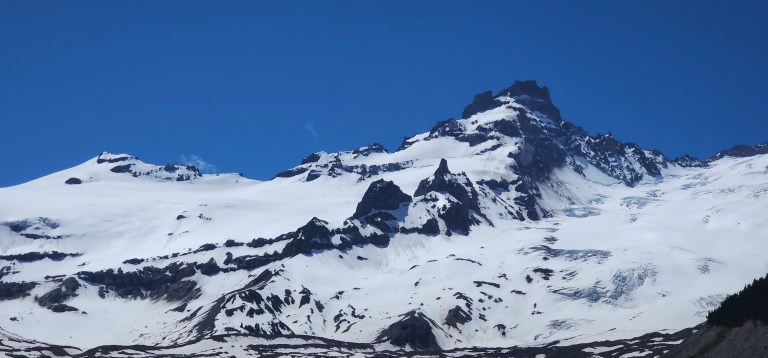
Since this little corner of the PNW isn't quite in the Arctic, people rarely associate Washington with glaciers — but they should! Those iconic, snow-capped peaks we all know and love are rarely topped with snow alone. Emmons Glacier, draped across the northeastern flank of Mount Rainier, is a prime example of these incredible natural wonders — a living, but frozen, relic of Washington’s ancient past and a humbling reminder of the powerful geological forces that continue to sculpt the state's diverse landscape.
It's no secret that winter holds a postcard-perfect kind of timelessness in the Pacific Northwest. Here, the Cascade Mountains wear their frosted crowns for much of the year, harboring a beauty that is indescribably prehistoric in its lush, green attire. There are a million ways to explore Washington's far north scenery — from temperate rainforests and waterfalls to frozen lakes, alpine ski runs, and spectacular summits — but for those who seek the extraordinary, Emmons Glacier on Mount Rainier offers a unique peek into an ancient world of ice and stone.
Clinging to the northeastern slopes of Mount Rainier, Emmons Glacier is actually the largest glacier in the contiguous United States by surface area. It covers over four square miles, descending from the summit at 14,411 feet to just under 5,000 feet above sea level. What an awesome wonder to have right here in our backyard!
Even better? Emmons Glacier is one you can actually visit for yourself without a frigid Pacific Coast glacier tour or dangerous backcountry hike.

Washington’s glaciers, including Emmons, owe their existence to a combination of unique geological and climatic conditions. Millions of years ago, the Pacific Plate collided with the North American Plate, uplifting massive sections of the earth’s crust to create Washington's treasured Cascade Range. Volcanic activity followed, with Mount Rainier forming about half a million years ago. Its towering height traps moisture-laden air from the Pacific Ocean, which cools as it rises, delivering heavy snowfalls that feed the mountain’s glaciers.

Emmons Glacier, in particular, likely formed during the last Ice Age, estimated around 20,000 years ago. As temperatures fluctuated, it expanded and retreated, carving out valleys, depositing layers of till, and leaving behind moraines that mark its ancient boundaries. Today, it's still an active glacier, constantly moving and reshaping its environment, though it, like many others, has been shrinking over time.
While Mount Rainier boasts over two dozen glaciers (fun fact for trivia night!), Emmons is unique in its prominence and accessibility. Its surface is a mix of snow, blue ice, and debris, with crevasses that hint at the powerful forces beneath. The glacier’s terminus feeds the White River, a glacially-fed torrent carrying fine, powdery sediment called “glacial flour,” which gives the water its striking milky hue. And, unlike some of its steeper counterparts, Emmons Glacier offers a relatively gentle slope, allowing visitors to get a closer look at its icy expanse on foot.
The moraine, a ridge of debris left by the glacier’s movement, is another highlight of this unique frozen landscape. Hiking along the Emmons Moraine Trail is one of the best ways to experience every part of this ancient relic. It reveals sweeping views of the glacier, the White River Valley, and Mount Rainier’s rugged eastern slopes. The trail is relatively short at just three miles round trip, making it an accessible option for hikers eager to immerse themselves in glacial history first-hand.

Another distinctive feature along this trail is Emmons Glacier Lake, a gorgeous seasonal body of water that forms from meltwater pooling at the glacier’s edge. Depending on the time of year, visitors might find a tranquil, jewel-toned lake tucked away in the glacial valley or a dry, rock-strewn basin bearing witness to the glacier’s retreat. Just think, all that lake water is likely thousands of years old!
For those seeking more of a challenge, the connecting Glacier Basin Trail offers a longer eight-mile journey into the heart of Rainier’s alpine terrain, complete with wildflower meadows and dramatic vistas of Emmons. While you can't get up close and personal with the glacier on either trail (as far as I know), you’ll have excellent views of the ice, crevasses, and meltwater streams from strategic vantage points on this trail.
However, do note that these trails, like most others in the national park, are only open seasonally due to road closures. But even in spring, the year-round icy views are pretty neat, especially juxtaposed against wildflowers and bright green foliage!
Standing before Emmons Glacier, whether on the Moraine Trail, Basin Trail, or viewed from a distance, it’s impossible not to feel the weight of its history. Every layer of ice tells a story, preserving atmospheric particles, volcanic ash, and ancient snow from centuries past. Scientists studying Emmons have found invaluable records of climate patterns, helping to piece together a timeline of environmental activity. This glacier, though remote and seemingly immutable, is a living archive of Earth’s past.
While Emmons may be the largest glacier in Washington, it's far from alone. Mount Rainier’s other glaciers, including Nisqually, Carbon, and Paradise, each have their own character and appeal. Nisqually Glacier, for instance, is famous for its dramatic icefalls, while Carbon Glacier boasts the greatest thickness and volume of any glacier in the lower 48 states. Together, these glaciers form a vital part of the Pacific Northwest’s ecosystem, supplying water to rivers and sustaining a rich array of plant and animal life.
Just when you thought Mount Rainier couldn't get any cooler, right?
A trip to Emmons Glacier is not without its challenges, though. Mount Rainier National Park is beautiful but can be incredibly dangerous for those who are unprepared. Stick to the trails, research early road closures and weather forecasts beforehand, and make sure you have your park passes and emergency gear handy. This ancient frozen wonder is something truly special and definitely worth experiencing in person at least once!
Subscribe to our newsletter
Get the latest updates and news
Thank you for subscribing!