Only the Brave Attempt This Claustrophobic Hike in Washington
It's cold, it's dark, and it's not even big enough to stand up in. But it's also one of the most unique volcanic remnants in the state.
Washington is renowned for its dramatic hiking experiences: alpine lakes framed by sky-high peaks, mossy forests, and panoramic views that show off the entire Pacific Coast. But while these bucket list-worthy trails are absolutely worth the effort, not every hike in the Evergreen State is about sweeping horizons. Some trails in Washington are literal hidden gems, trading breathtaking summits that tower above sea level for dark caverns, maze-like tunnels, and sketchy descents into the very depths of the Earth. Such trails naturally cater to a certain type of hiker with a taste for adrenaline and a touch of risk, so if you're that kind of hiker, you're in good company! But don't grab the spelunking gear quite yet. For an easy hike that might just get your heebie-jeebies worked up while also appealing to your inner cave-diver, bundle up and head to Mount St. Helens National Volcanic Monument because the Trail of Two Forests on the south side of Mount St. Helens is definitely a claustrophobic scramble worth attempting.
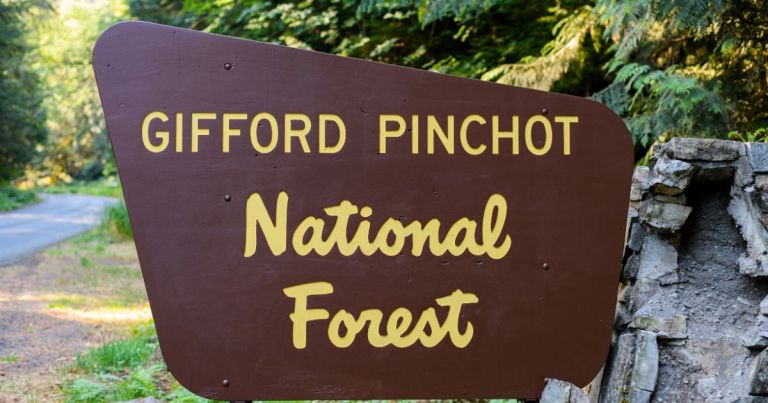
Washington's two most famous volcanoes, Mount Rainier and Mount St. Helens, are just a small peek into the volcanic underpinnings of the PNW. On any given day, thousands of tumultuous forces are brewing underfoot, biding their time until conditions are just right. At the same time, labyrinths of hardened lava from previous outbursts are hidden from view just beneath the surface. The 13,000-foot Ape Cave in the Gifford Pinchot National Forest, arguably the most famous lava tube in the entire state, is one such example of Washington's volcanic activity. It's an absolute must-visit for anyone who enjoys developed, low-stress caving experiences and long underground walks through complete darkness. But if you'd like to experience a slightly more claustrophobic adventure away from the crowds, the Trail of Two Forests nearby is definitely worth a detour.
The 1.3 million-acre Gifford Pinchot National Forest engulfs the Mount St. Helens National Volcanic Monument, hiding scenic and explosive surprises galore—waterfalls, canyons, natural bridges, lava fields ... and lava tubes. In fact, there are literally hundreds of them, if you know where to look. Ape Cave happens to be the biggest of the bunch. However, the half-mile Trail of Two Forests will lead you to a particularly special group of lava tubes that don't get quite as much attention. And yes, you can walk through them, or rather, crawl.

In liquid lava eruptions, lava tubes form on their own in a few different ways. Most commonly, as the upper surface of the lava flow begins to cool, the lava underneath continues to flow, eventually forming a solid roof as everything cools. That's not quite the case here! In the Trail of Two Forests region, an eruption around 1,900 years ago charged through the forest, burning the ancient trees (literally igniting them, according to the volcanology records) but leaving impressions where they stood or lay. Essentially, the lava solidified the trees in stone.

The Trail of Two Forests is a short, accessible boardwalk trail that loops through this volcanic landscape, passing through not one, but two forests that stand side by side, separated in age by around 2,000 years. The first is an old-growth forest of Douglas fir and Western red cedar, untouched by time, and the other is a young forest that is slowly healing following the original eruption of Mount St. Helens over two millennia ago. This part of the forest is where you'll find a series of volcanic tree casts and tree wells.
The Mount St. Helens National Volcanic Monument is run by the Forest Service, rather than being an official national park, and the short interpretive trail is incredibly well marked with signage that explains Washington's eruptive history in detail, as well as how these unique tree casts formed. But while this easy stroll through a unique slice of Washington history is both pretty and educational for all ages, the coolest part of the trail is actually hiding right under your feet. Along the trail and dotting the forest, you'll find a series of these volcanic tree casts and tree wells that look like holes in the ground.

As you reach the end of the boardwalk, you'll come to a hollowed-out tree well that looks like a giant pit. It's not terribly deep, only 9-10 feet, and you can climb down into it via the provided ladder if you wish to embark on the next phase of the trail.
Calling this a hike might just be a misnomer, though. Once you're at the bottom, switch on those headlamps (optional), zip up (because it's chilly), and prepare to get your knees dirty, because next you're going to literally crawl through a set of perfectly encased volcanic tree trunks—a one-of-a-kind lava tube that might just bring out your forgotten claustrophobia.

Unlike traditionally-formed lava tubes, which can be massive, the Lava Crawl on the Trail of Two Forests is a tight squeeze through complete darkness. As you literally shuffle-crouch-bear crawl your way through the ancient tree trunk, you can reach up and touch the knobby lava texture of the ceiling just inches above your head, feel the trunk-like grooves of the lava channels under your knees, and experience the hardened tree bark walls brushing your shoulders and closing in around you at various points. It's that narrow.

Tight though it may be, the Lava Crawl is short enough in length for even little ones to manage safely—only around 10 minutes total. But if darkness or small, enclosed spaces send your neurons into a panic spiral, even this short crawl might feel endless, so wiggle through the narrow tube at your own risk. It's also important to note that if your knees are a little less adventurous than you are, you might have a tough time with this one. Standing up definitely isn't an option.
Finally, you'll come out of the tunnel via a small, cave-like opening and wonder how you possibly fit through. But you'll also feel like you just accomplished a spelunking adventure, no special gear or training required.

Ready to try the Lava Crawl for yourself? The Mount St. Helens National Volcanic Monument requires a Digital Day Pass, Northwest Forest Pass, or Interagency Recreation Pass to access. Pack light here, as you'll need all the wiggle room you can get!
If dark, enclosed spaces are your jam, there are quite a few other options you might want to explore in Washington as well. For fans of dark, enclosed, historic train tunnels, the Spruce Railroad Trail is a great option. Or, after you've checked off both Ape Cave and the Trail of Two Forests, spend some time hiking through the many volcanic wonders of the monument on the Lava Canyon Trail nearby. It's a steep, narrow, admittedly sketchy hike after the first mile, but it shows off some epic formations and lava fields formed by the 1980 eruption that you can't see anywhere else. Then, head back toward Castle Rock to enjoy a cooler side of Mount St. Helens: a dip in Coldwater Lake.
Looking for even more epic adventures? Use Only In Your State's AI Travel Planner to find epic destinations no matter where you are!
Subscribe to our newsletter
Get the latest updates and news
Thank you for subscribing!