The Epic 8-Mile Trail in the West Cascades That’s Worth the Sweat
This popular, leg-burning climb is relatively short, but unyieldingly steep. There's a reason why so many die-hard backpackers use it to prepare to climb Rainier.
I'll be honest: I didn't come from a hiking family. I didn't even realize people slapped on backpacks and boots and scrambled up mountains until long past the age when it was common knowledge to my peers. Growing up in northwest Washington meant I missed out on years of adventure and discovery in arguably the most beautiful corner of the country. Fortunately, I'm making up for lost time now!
If you're from western Washington, most likely, you've heard of Mount Si (whether you've climbed it or not). If you’ve spent any time in the state's hiking circles, you’ve probably also heard a few people complain about the crowds here … which is fair. But what’s less talked about is just how good this hike really is. There’s a reason why thousands of ambitious hikers grind their way up the 4-mile climb every weekend between April and October, because while it's painfully steep and deceivingly short (especially if you decide to make it your first hike of the season), the payoff is absolutely worth every hard-fought step.
Mount Si is located just outside North Bend, Washington, about a 45-minute drive from Seattle. It’s part of the Mount Si Natural Resources Conservation Area in the West Cascades, which is a state-managed recreation area, as opposed to federal. That means you’ll need a Discover Pass to park at the trailhead, not a Northwest Forest Pass or National Park pass. Fortunately, they're cheap and can be bought at the trailhead kiosk, online, or at most REI stores.
The road to the Mount Si trailhead is paved and manageable for all vehicles, but the lot fills up fast, especially on weekends. If you're not there by 8:00 a.m. on a summer Saturday, expect to park down the road and add an extra jaunt to your uphill grind.
Speaking of uphill slogs ... even for experienced hikers, the Mount Si Trail is far from being a casual stroll. Despite not being the tallest peak in the Cascades' western foothills, it climbs an impressive 3,150 feet in four miles, topping out at about 3,900 feet. That’s around 800 feet of gain per mile—and unfortunately for your calves, there’s no flat section to “ease into it.” The climb starts almost immediately and doesn’t really ease up until the end.

You’ll begin your hike in a dense second-growth forest of mostly Douglas fir, western red cedar, and hemlock that's typical of Washington's temperate rainforest ecosystems. The first mile is full of tight, dizzying switchbacks, and depending on the season, muddy sections. If you’re hiking in spring or after a rain, you’ll want solid traction, like trail runners with real lugs or lightweight hiking boots at a minimum.
While there are no wide-open views in this stretch, there's plenty to look at. Lush sword ferns and moss-covered logs flank the trail, and in spring, the forest floor pops with trillium, bleeding hearts, and salmonberry. Woodpeckers are common here, and on quiet mornings, you'll hear countless other birds trilling in the trees. A few small runoff creeks sometimes cross the trail—the most notable one about half a mile in—but they’re all easily stepped over or crossed via wooden footbridges.
By mile two, the elevation gain becomes more obvious, visually as well as physically. Soon, you’ll start seeing glimpses through the trees of the Snoqualmie Valley behind you. Look back over your shoulder and you’ll catch glimpses of Mount Teneriffe and the hazy mountain ridges that stretch into the distance, as well as peek-a-boo views of the landscape. As you climb, the views just keep getting better, so be sure to look around now and then!

Around the three-mile mark, you'll pass the junction for the old trail, which is steeper, unmaintained, and not recommended for those without experience. Stick to the main trail unless you enjoy bushwhacking. However, from here things start to feel more familiar and less rainforest-y. You can see the Seattle skyline in the distance, with the always-prominent Space Needle jutting upward, as well as the Puget Sound in full, shimmering blue beyond the city. If you know your geography and where to look, you can even see Bainbridge Island.
The last half-mile somehow manages to get even rockier, and you'll soon reach Snag Flat, which is a brief respite in a stand of old-growth trees. Beyond this, vertical formations are everywhere you look. This is where many hikers turn around, but the real summit is still just ahead—and it’s worth going the extra distance.

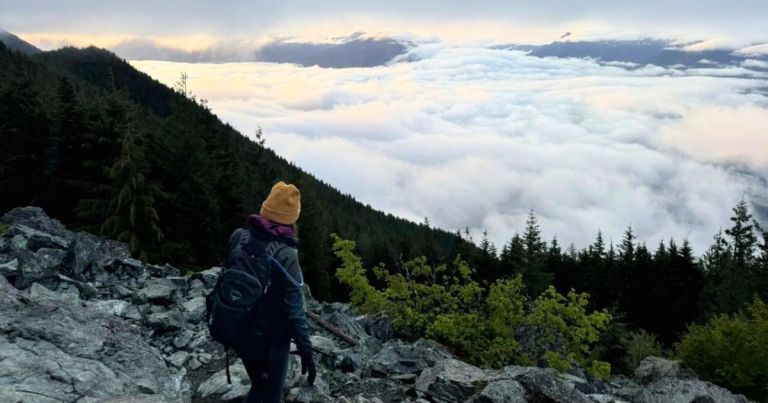
The Haystack is a large hunk of rock at the top, and it marks the true summit of Mount Si, although there's no logbook to document your climb. You’ll also see a viewpoint just below it that offers sweeping views across the Snoqualmie Valley. From here, Mount Rainier dominates the skyline, so close you can almost touch it. Often you're quite literally above the clouds, and it. is. incredible. Golden hour is especially spectacular, but you'll love every season and every time of day shows off a new type of beauty.


If you're feeling ambitious and have proper footwear, you can choose to climb the Haystack. However, this involves some scrambling, and you definitely don't want to attempt it when it's wet or icy, no matter how skilled you are. Fortunately, sticking to the base of the rock offers views that are just as good, but without the risk.
Mount Si is part of the western edge of the Cascade Range, and its craggy, scenic summit is the remnant of an ancient volcanic intrusion that formed around 33 million years ago. You won’t see any recent volcanic rock here like you do near Mount St. Helens or Rainier. Instead, you'll find plenty else to admire! Keep an eye out for black-tailed deer and mountain goats closer to the top. Bears are rare here but have been spotted in the area, so stay aware of your surroundings even as you huff and puff your way up.
If you're looking for even more views, but with a little less climbing involved, Mount Si towers over Borst Lake, which has a gorgeous loop trail of its own. Or, you can admire Mount Si from the Rattlesnake Mountain Trail, among others in the area.

Another important note: camping is not allowed on Mount Si, either on the trail or at the summit. If you’re looking to overnight nearby, check out campsites in Olallie State Park or primitive spots near Mount Teneriffe. Also, be aware that because of its elevation and exposure, the Mount Si summit area is often snow-covered into late spring, and the weather can change quickly even in the height of summer. Microspikes are a good idea if you’re hiking in the shoulder seasons.
Typically, hikes this long and steep (7.9-mile loop) offer the benefit of an alpine lake as a reward, or at least a flat spot to pitch a tent in the backcountry so you can enjoy the sights bathed in a golden glow. Mount Si has neither. Instead, this challenging trail in the Cascades offers epic views from start to finish, and all it takes is a day-hike to enjoy them—even if that hike happens to be a thigh-burner for most. Not too shabby for a semi-urban hike!
Looking for more things to do around North Bend? Use Only In Your State's Travel Planner to find more trails, eats, and hidden gems.
Subscribe to our newsletter
Get the latest updates and news
Thank you for subscribing!