12 Best Places to Watch Whales in the U.S., From Icy Fjords to Warm Lagoons
From coast to coast, we've curated a list of the best places to watch whales in the U.S, whether from a boat or on the shoreline.
You don't need a passport or a five-figure expedition to watch a whale breach in open water in the U.S.
Humpbacks feed off Alaska all summer, gray whales cruise past California bluffs every winter, and North Atlantic right whales, one of the rarest animals on the planet, still pass close enough to Cape Cod to spot from a boat. Here are 12 of the best places in the U.S. to see whales, plus when to show up and where to stand (or which boat to book) once you're there.
1. Juneau, Alaska
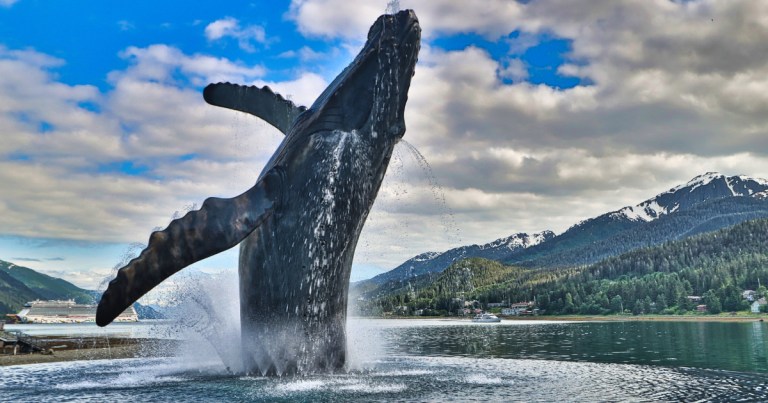
- Claim to Fame: Alaska's capital comes with a front-row seat to the world's biggest feeding frenzy.
- Good to know: June through August is peak season for the most reliable sightings, but book early. Juneau's cruise traffic fills up whale-watching boats fast in midsummer.
Humpback whales pour into the waters around Juneau from May through September, drawn by the krill and herring stirred up along the Inside Passage. This narrow, glacier-carved waterway concentrates prey and whales in a way the open ocean doesn't, so boats don't have to travel far to find bubble-net feeding groups working in coordinated packs, a behavior almost unique to this stretch of Alaska. Orcas pass through too, both resident pods and transient groups following salmon runs.
2. San Juan Islands, Washington

- Claim to Fame: An island literally named for orcas, and it delivers.
- Good to know: Bring a chair and some patience. Rangers and volunteers at Lime Kiln Point track daily sightings, so it's worth checking in before you settle in for the afternoon.
The San Juan Islands sit inside the summer range of the Salish Sea's resident orca pods, plus visiting humpbacks, minkes, and gray whales passing through. Lime Kiln Point State Park on San Juan Island, nicknamed Whale Watch Park, is one of the few places in the country where you can reliably see orcas from shore without a boat. Peak viewing runs mid-April through September, though Bigg's (transient) orcas turn up in the Puget Sound in winter too.
3. Depoe Bay, Oregon

- Claim to Fame: Oregon's whale-watching capital doesn't require a boat ticket.
- Good to know: Spring migration (late March through May) brings the highest whale counts, sometimes 30 or more per hour from elevated viewpoints.
Depoe Bay calls itself the Whale Watching Capital of the Oregon Coast, and the town backs it up. A resident pod of gray whales feeds just offshore from March through December, and the state-run Whale Watch Center sits right on the harbor with staff who point out active pods in real time. Oregon's volunteer-staffed Whale Watching Week brings 24 lookout points to life each spring, with trained volunteers helping visitors spot migrating pods.
4. Mendocino, California

- Claim to Fame: Coastal bluffs, no boat required, and one of the best land-based whale-viewing spots in the country.
- Good to know: Mendocino Headlands State Park is free, open year-round, and requires nothing more than binoculars and a jacket.
Mendocino sits directly above the gray whale migration corridor, and its elevated bluffs make shore-based viewing genuinely effective, a rarity along the California coast. Gray whales pass by from December through April, and Point Arena Lighthouse, about 15 miles south, offers one of the most dramatic vantage points on the Northern California coast. The town's annual Whale Festival each March adds guided viewing sessions led by naturalists.
5. Monterey Bay, California

- Claim to Fame: The most reliable place in California to see multiple species on a single trip.
- Good to know: Summer, June through September, is the strongest window for humpback and blue whale sightings together.
Monterey Bay's underwater canyon pulls cold, nutrient-rich water close to shore, part of why the area supports 29 documented cetacean species, more diversity than almost anywhere else in the state. Humpbacks and blue whales feed here roughly April through December, gray whales pass through December to May, and orcas make brief appearances in spring and again in late summer and fall. Monterey Bay Whale Watch runs the only tours in the area led by marine biologists.
6. San Diego, California

- Claim to Fame: Year-round whale watching, with a new visitor added to the calendar.
- Good to know: Wind and swell, not rain, are what cancel tours here. Operators typically call ahead if conditions look rough.
San Diego's coastline stays active with whale activity year-round. Gray whales migrate past from mid-December through April, blue whales feed offshore from May through September, and humpbacks show up with peaks in spring and fall. Since 2017, a pod of Eastern Tropical Pacific orcas has begun returning to Southern California waters, most often spotted from December through April and again in September and October. Cabrillo National Monument's western overlook is a solid land-based option if you'd rather skip the boat, and just up the coast in Dana Point, Captain Dave's runs a year-round dolphin and whale safari worth the drive.
7. Maui, Hawaii

- Claim to Fame: Around 10,000 humpback whales choose this island to give birth.
- Good to know: Federal law requires vessels to stay 100 yards from humpbacks, so a good pair of binoculars matters as much as your choice of boat.
Every winter, thousands of humpback whales migrate roughly 3,000 miles from Alaska to the warm, shallow waters of the Maui Nui Basin to breed and nurse calves. The season runs December through May and peaks in February and March, with sightings from shore common along the island's western coastline. Boats out of Maalaea Harbor put you close enough to hear the whales breathe, and nearby Kihei has built its whole identity around this whale season.
8. Provincetown, Massachusetts

- Claim to Fame: The whale-watching capital of the East Coast sits at the edge of a federally protected feeding ground.
- Good to know: Peak season runs late spring through early fall. Many local operators guarantee a sighting or offer a rain check.
Stellwagen Bank National Marine Sanctuary protects 842 square miles of nutrient-rich water just off the tip of Cape Cod, drawing humpback, minke, finback, and pilot whales from spring through fall. It's also one of the few places left where North Atlantic right whales, a critically endangered species with an estimated population under 400, still turn up regularly. Boats depart straight from Provincetown's MacMillan Pier.
9. Bar Harbor, Maine

- Claim to Fame: Cold water, lobster country, and some of the most consistent whale sightings on the East Coast.
- Good to know: September brings fewer crowds and the whales are still around, plus you get Acadia's fall foliage as a bonus from the water.
The Gulf of Maine's cold upwelling waters concentrate krill and herring, drawing humpback, finback, and minke whales from April through October, with June through August offering the most consistent activity. Tour boats run 3- to 4-hour naturalist-led trips out of Bar Harbor, the gateway town to Acadia National Park. Land-based viewing is possible from Acadia's coastal trails too, though it's a longer shot than a boat trip.
10. Cape May, New Jersey

- Claim to Fame: One of the longest whale-watching seasons on the entire East Coast.
- Good to know: Late summer and early fall tend to bring the most consistent humpback activity, but the season's length means almost any month has a real shot.
Cape May's season stretches from March through December, longer than almost anywhere else on the Atlantic coast, thanks to humpback whales feeding on eels and herring close to shore. Tours here also turn up Atlantic bottlenose dolphins and, less often, blue whales that can stretch up to 50 feet. The Cape May Whale Watcher departs from the town's harbor for trips that typically run a few hours.
11. Virginia Beach, Virginia

- Claim to Fame: A winter whale season most East Coast travelers don't know about.
- Good to know: January and February are peak months. Pack real winter layers. Atlantic boat trips run colder than the air temperature suggests.
After migrating south from the chilly Bay of Fundy, humpback whales spend December through March feeding in Virginia Beach's comparatively warm waters, making this one of the few U.S. whale-watching windows that run through winter rather than summer. Guided boat tours head offshore to continental shelf feeding areas, and dolphins are a near-constant presence alongside them. It's one of 12 unforgettable Virginia day trips worth working into a yearly rotation.
12. Montauk, New York

- Claim to Fame: The tip of Long Island, where fin and minke whales pass close enough to shore to be seen.
- Good to know: Combine it with a dolphin-watching add-on. Atlantic white-sided dolphins frequently show up on the same trips.
Montauk sits at Long Island's easternmost point, where the continental shelf runs close enough to the coast to bring fin whales, minke whales, and humpbacks within range of a single-day charter. Local operators like the Viking Fleet run dedicated whale and dolphin watching trips from late May through mid-September, when warm-water baitfish draw whales close to shore. It's one of New York's best outdoorsy towns for exactly this reason.
Whichever coast you start from, the same rule applies: check recent sightings logs before you book, dress warmer than you'd think, and give the whales room. They were here first.
Subscribe to our newsletter
Get the latest updates and news
Thank you for subscribing!