This Minnesota Wilderness Trail Follows a 19th-Century Railroad Bed Into the Boundary Waters
The Centennial Trail in Minnesota's Superior National Forest is a beautiful wilderness hike. It also highlights some fascinating aspects of the area's history.
When I think of the Gunflint Trail in northern Minnesota, I think of winding, narrow road through pristine wilderness in the Superior National Forest and often, adjacent to the Boundary Waters Canoe Area. In a few places, spots for wilderness resorts and private homes are carved out of the forest, but for the most part, all I expect to see are expanses of evergreens, birch, aspen, and poplars, sky blue lakes, and shimmering wetlands. Despite Minnesota's long history with mining, I really did not expect to see evidence of mining along this scenic forest road, let alone a railroad bed. So, I was quite surprised when I encountered both, way up the Gunflint, along the 3.3-mile Centennial Trail.
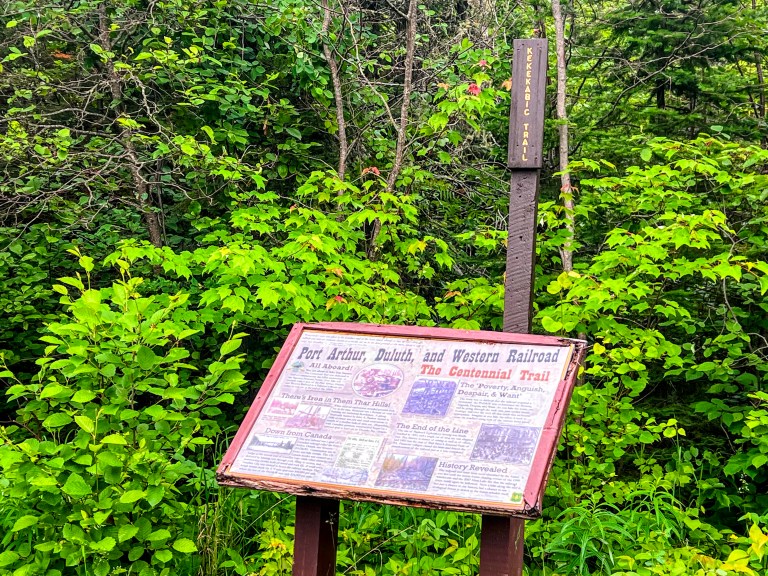
The Centennial Trail shares a trailhead with the longer, more rugged Kekekabic Trail, which runs from the Gunflint to Snowbank Lake near Ely, forming a segment of the North Country National Scenic Trail. A small parking lot is available at the shared trailhead, and though the trail carries an "easy" rating, you should wear sturdy shoes and expect some rocky and muddy terrain. If you head out in the summer, you'll also want a mosquito net and bug spray.

The Centennial Trail opened in 2009, commemorating the 100th anniversary of the Superior National Forest's designation. It's designed as an interpretive trail, and numbered waypoints offer insights and information along the way. Stop by the Tofte or Gunflint ranger stations for a guide to the waypoints, or download a PDF brochure to follow along on your phone. (Be sure to download it ahead of time, though, as there is no cell service on the trail.) There may be some available in a box at the trailhead, but don't count on it.
The first 1.2 miles of the Centennial Trail Loop run contiguously with the Kekekabic, and you'll find the first five interpretive stops along this stretch. Several of these stops highlight one company's attempts to mine iron ore and assay for gold in the late 19th century, with a handful of test pits—including one shaft that's more than 70 feet deep—and mine tailings still visible. Only one car of material was ever removed from the Paulsen (or Paulson) Mine before it was abandoned.

The car was removed via the Port Arthur, Duluth, and Western Railway, which ran from Thunder Bay to its terminus at the Paulsen Mine (it never connected to Duluth). Primarily used to haul timber from the Canadian forests that stretched between Gunflint Lake and the Lake Superior shoreline, the railway was extended across Gunflint Narrows to reach the Paulsen Mine.

Rock was cut from the rugged terrain to make way for and to level the rail bed. At one point along the route, a 500-foot-long, white pine trestle extended to a high rock outcropping on its way to the Paulsen Mine. Its footings are still visible along the Centennial Trail today. After leaving the Kekekabic and looping back toward Round Lake Road and the Gunflint, the Centennial Trail follows the former rail bed, where you can see evidence of the old railway—although all the rails and most of the timbers have been long since removed. You'll find eight additional interpretive points on this part of the trail, including one section that descends 200 feet through a narrow rock cut that, today, feels like a mossy, fern-covered slot canyon.

As you can imagine, I was surprised to discover this aspect of the Gunflint Trail's history. At this point, nature has had nearly a century to reclaim the rail bed, which was finally abandoned and removed in the 1930s, and more than 125 years to heal some of the scars left by the attempted mining. But the evidence is still visible, and although it's not something I expected to encounter walking into the Boundary Waters, it was fascinating to learn about.
Subscribe to our newsletter
Get the latest updates and news
Thank you for subscribing!