Luffas Don’t Come from the Ocean? A Visit to California’s Hidden Luffa Farm
There are only a few luffa farms in all of North American. In Northern California, The Luffa Farm started by accident.
It feels like an adult fantasy, a farm where instead of fruit, sponges hang off trees. As a kid, you dream of trees dripping with candy. As an adult, apparently your fantasies turn to cleaning utensils.
But we adults are lucky, because such a place actually exists— they’re not on trees exactly, but close enough. And while it's no Wonka-fied lollipop grove, it's genuinely rare. There are only two in all of North America.
It's a luffa farm. Those scratchy multipurpose bath sponges you thought came out of the sea? Turns out, you can pluck them right off the vine.
They’re actually land-lovers
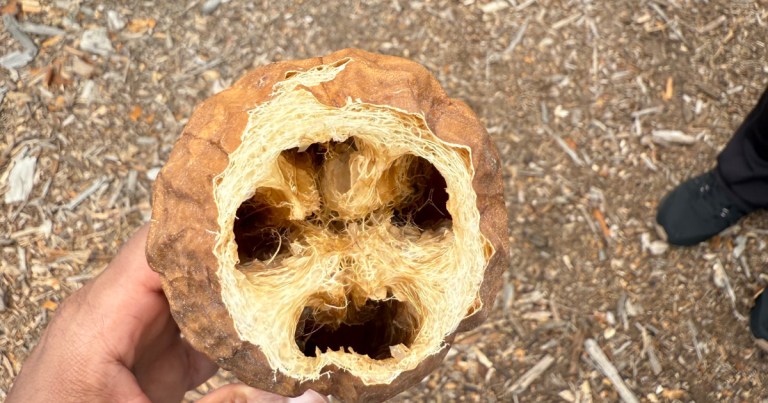
The luffa (or loofah or luffah, take your pick) plant thrives near the equator, which explains why you may not have ever heard of it. They are much more popular in Asia and Africa, going by names like Chinese Okra and Dishcloth Gourd. In this part of the world, they’re mostly grown on home farms—there are only two commercial operations in the entire country. Both are on the West Coast. One, Moonbeam Farm, has a public-facing country store. The other lets you see all the action go down on the vines. That one, The Luffa Farm in Nipomo, California, started by accident.
One day its founder, Deanne Coon, found herself in possession of a couple of mystery seeds. The then-hobby farmer planted them with a friend, curious to see what would sprout. The pair didn’t recognize what came to fruition, so gave up and left the plant to die. But little did they know that death would bring it life: the green gourd dried up, the skin came off, and a fibrous scrubber lay underneath. Coon realized what they'd grown: a luffa. She officially opened The Luffa Farm in 2000.
Most luffas are imported into the US, but buying local makes a difference. Imported luffas— from countries including China, El Salvador, Korea, Taiwan, Guatemala, Columbia, and Venezuela—get fumigated to kill hitchhiking bugs, fungi, and diseases. That heat treatment damages the fibers, shrinking the loose cellulose structures into something hard, compact, and less pliable. The compromised structure makes them more prone to bacterial growth—they don't dry out as easily between uses.
The locally grown Egyptian variety needs no such treatment, so the structures stay airy and open. "And because they're washable, you don't have to worry about bacteria buildup at all," explains our tour guide. "They'll just wear down over time like a washcloth would—could be a few weeks, a few months, even years, depending on how you use them."
Watch out for bees

The Luffa Farm’s whimsical exterior somehow enhances the magic within. Drive up and hand-painted signs guide you forward: "From the land... and the sea... a few more yards... and you will see... we grow sponges." Colorful bottle trees dot the property alongside plywood cutouts of Snoopy and friends. It looks like an artist's brain exploded across the landscape, easy to dismiss as pure fantasy, if not for what the greenhouse holds.
Tours are free and offered year-round. Ours begins with fair warning from our guide: "There may be bees, and they're very busy with the flowers. I've been here 25 years. The only time I got stung was when I reached my hand where I shouldn't have."
We keep our hands to ourselves as we shuffle through. The greenhouse is warm, and humid, simulating a tropical atmosphere. Rows of fences are covered in vines, and off them hang elongated gourds. Luffas are genetically closest to zucchinis or cucumbers, and emerge right from the back of a bright yellow flower. When that flower dies the young luffa is edible, looking and tasting like summer squash. As the gourd matures on the vine, rather than the fruit deteriorating or dropping, the vine draws in moisture and nutrients. This causes the luffa to shift from green to yellow to pale brown as it desiccates while still attached, eventually becoming feather-light and metamorphosing into the resilient, fibrous sponge we recognize. They grow to be up to one to two feet long and four to five inches thick. Once the luffa is fully dried, it’s time to harvest.
Call me a convert

Here’s where that tree—or I guess vine—that bears magical fruit comes in. I'd assumed luffas served one purpose, but they're remarkably versatile. The flowers and leaves are edible. Sloughed off skin can be used like aloe for healing and moisturizing. Young luffas, around three months old, can be eaten raw or cooked.
The mature luffa sponges are safe for daily bathing. But most Americans never think beyond the bathroom. They're also excellent household scrubbers, non-abrasive enough for Teflon and stainless steel, safe with any cleaner. "The edges of casserole dishes, stovetops where food cooks on, hard water spots around the faucet—luffas are perfect for those jobs," says my guide. But her favorite use is one I would have never thought of: getting bugs off the car after a road trip.
Forget the candy grove—I’ll take the sponge vines any day. I walked into the Luffa Farm knowing nothing about the sponges. I left an evangelist.
Subscribe to our newsletter
Get the latest updates and news
Thank you for subscribing!