Alaska Has a Fjord That Rivals New Zealand’s Milford Sound and You Don’t Need a Passport
Calving glaciers, towering, horsetail waterfalls, and breathtaking natural wonders await at this remote fjord in Alaska—no passport needed.
New Zealand is a bucket list destination for many people, especially if you happen to be a fan of Peter Jackson's "The Lord of the Rings" trilogy, which uses NZ's dreamy technicolor landscapes to portray Middle-earth. One scenic location that doesn't appear in the films, however, is New Zealand’s Milford Sound, a famous corner of the country with sheer cliffs cloaked in mist, waterfalls dropping from impossible heights, and ice-blue water reflecting the lush, green mountains. It's dramatic, remote, and cinematic in every possible way, but there's no need to fly all the way across the pond to enjoy it! Southeast Alaska is equally cinematic, and it’s far less traveled. For those who crave New Zealand's glacial fjords and ancient rock formations but want to skip the long journey overseas, Tracy Arm Fjord in Alaska delivers an equally impressive experience as Milford, plus a sense of isolation that might even top what you'd find in New Zealand's iconic Fiordland National Park.
Beautiful and wild in both danger and scale, it's been said that Alaska looks like the edge of something unfinished. Here in the Last Frontier, the continent breaks off into water without warning, ancient stone cliffs are sheared clean by sheets of ice, and craggy mountains rise straight from the sea to impossible heights, too young to be weathered down by time. Along this torn-up coastline, fjords cut their way through the heart of the state alongside Alaska's many other natural wonders. As the products of glacial collapse and the aftermath of thousands of years of pressure and melt, fjords are incredibly rare across the globe. But, as it so happens, Alaska has dozens of fjords, many still holding onto the same ice that made them.

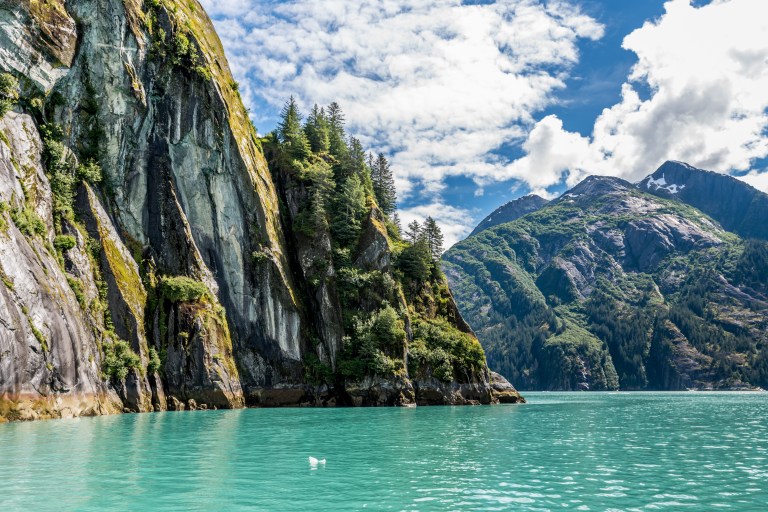
One famous fjord in Alaska is Tracy Arm, a narrow, twisting glacial valley tucked into the rugged spine of Alaska’s Coast Mountains. If you've seen photos of Milford Sound in New Zealand, you already have an idea of what to expect here, but I think this gorgeous fjord is even more impressive than its overseas counterpart. Where Milford is crowned by Mitre Peak and guarded by The Elephant and The Lion, Tracy Arm walls itself in with multiple granite ridgelines and hanging valleys dotted with towering, ribbon-like waterfalls. Even the seals float on ice floes in Tracy just as they haul out on the picturesque rocky shelves of Milford.
Tracy Arm slices through the heart of the massive Tongass National Forest southeast of Juneau. It's fifty miles south of the capital and reachable only by boat or floatplane, with no roads, trails, or towns to visit or to use as base camps. What it does have, though, is stunning (mostly unnamed) peaks that form a rugged backdrop, frigid water in perpetual motion, and some seriously impressive walls of millennia-old glacial ice flowing down from the Boundary Range.

This remote fjord stretches about 30 miles inland from Stephens Passage and splits at its head into two distinct "arms:" one leading to North Sawyer Glacier, the other to South Sawyer. As active tidewater glaciers, both formations end at the sea, which means glacier calving is common, with thunderous chunks breaking off into the dark, silty water. South Sawyer is larger and visually more dramatic, but North Sawyer offers quieter conditions for wildlife sightings and photography. Whichever branch your expedition takes, you'll find hanging valleys feeding waterfalls that freefall hundreds of feet without touching a single ledge, granite so rich that it's nearly black when wet, and brilliant water that glitters jade-green from glacial flour, the fine silt suspended in meltwater. In summer, the water’s surface reflects the cliffs so crisply that the entire fjord seems doubled.

Even though jaw-dropping sights are just about everywhere you turn in Alaska, Tracy Arm comes close to the top.
Since there are no trails into or around the fjord, you can instead admire it from the water. Small expedition cruises, guided kayak trips, and private boat trips sometimes travel through the area, but with so much ice, this corner is less visited than many of Alaska's other bucket list sights. Most visitors arrive via day tours out of Juneau, usually aboard small ships that can maneuver through the fjord’s narrow reaches.
The most visually loaded section of Tracy Arm is the final third of the journey, where the cliffs start to narrow and where icebergs start appearing in bulk. The South Sawyer Glacier, in particular, sits wedged between mountains, often fronted by a chaotic flotilla of blue ice. This is also where most wildlife encounters happen. From the boat, keep your eyes peeled for mountain goats on the cliff faces, bald eagles above the snags, and seals floating like buoys on the ice. Orcas and humpbacks can be spotted patrolling the deeper water near the entrance to the arm. It's its own complete ecosystem, and while visually similar to Milford Sound, this is 100 percent "Alaska."

By air is another option for exploring Tracy Arm, and a floatplane flight over the valley delivers a radically different perspective. From above, the U-shaped geography of glaciation becomes obvious, and you can clearly see how ice has shaped the region. The icefields feeding the fjord are part of the larger Stikine Icecap system, and snow lingers in the high alpine well into August—natural features nearly identical to those seen above Milford, where the Darran Mountains tightly hug the fjord’s narrow corridor. For even more gorgeous sights, the flight path around the area typically includes neighboring Endicott Arm, an equally dramatic fjord system, and the massive Dawes Glacier as well.


Much like the Darran Mountains impact Milford Sound, Tracy Arm's microclimate is shaped by the Coast Mountains and the maritime influence of the Gulf of Alaska. Peaks and tumultuous coastal weather combine to form near-constant cloud cover, and the atmosphere often feels dense and gray with moisture, even when it isn’t actively raining. Fog creeps low along the water in the morning, retreating slowly as the sun rises behind the mountains. The most famous photos here are often taken from the bow of a boat facing South Sawyer Glacier, framed by cliffs with waterfalls pouring down both sides. But the scale is impossible to truly capture. For that, you'll need to visit for yourself.
While many fjords in Alaska share similar traits, Tracy Arm is beautifully, majestically condensed in its drama. It goes from an open inlet to a tight rock hallway in a matter of miles before ending in a wall of ice. It even hosts all five of Southeast Alaska’s most charismatic animals: brown bear, black bear, mountain goat, bald eagle, and harbor seal. Like the fur seals of Milford Sound, these magnificent animals take advantage of the quiet and cold, using fjord's icy ledges as safe ground. This is untouched Alaska wilderness at its finest.
While the misty waterways of Fjordland in New Zealand and its iconic Milford Sound are certainly worth keeping on your bucket list, Alaska's own stunning fjords quietly await adventurous local explorers. With many similar larger-than-life sights, and even many of the same elemental forces at work as its doppelganger in the Southern Hemisphere, Tracy Arm is a gorgeous Alaska adventure worth sticking close to home for.
Subscribe to our newsletter
Get the latest updates and news
Thank you for subscribing!