I Hiked This Historic Hiking Trail in Alaska, Here’s What I Learned
When it comes to hiking in Alaska, with great challenge comes great reward. And maybe a few snowstorms as well.
All across the Last Frontier, there are places where the landscape has been shaped by time and the forces of nature — and other places where it's been shaped by the people who once tried to carve a living from it. Scattered around every corner of the state you’ll find abandoned villages, rusting mining equipment, and forgotten, century-old cabins, all reminders of the boom-and-bust history that Alaska is known for. Over the years, thousands have traveled to Alaska's remote corners looking for gold, silver, and opportunity, only to turn back when the harsh realities of the wilderness proved too much or when the last of the ore dried up. Places like the Kennecott Mine and Whittier are proof that the scenic Land of the Midnight Sun, so vast and unforgiving, often reclaims what was built.
In one such corner, just outside the small towns of Haines and McCarthy, the Bonanza Mine Trail offers a glimpse of what it looks like when man and nature collide. What starts as a quiet, forested climb turns into a strenuous journey through a unique slice of Alaska that few make the time to see. The remnants of the Bonanza Mine, abandoned over half a century ago, still linger high up in the Wrangell Mountains of Wrangell-St.Elias National Park, tucked away on a mountainside that’s just as rugged as the miners who once sought their fortune here. As I learned first-hand, the hike isn’t an easy one, but the reward is a rare chance to walk through history.
Growing up in the heart of the PNW, summitting mountains is something I do pretty regularly. As such, I like to consider myself at least somewhat skilled in the basics of backcountry adventuring. When I had the opportunity to visit family in Anchorage recently, naturally I made it my mission to find the most challenging hike I could that didn't cross into extreme backpacking or loss-of-limbs territory, while also avoiding most complexities of inner-Alaska travel. Visiting the Kennecott Mine National Historical Landmark had already been on my list for awhile, so when I stumbled upon the Bonanza Mine Trail nearby, it immediately topped my list as the perfect Day Two adventure.
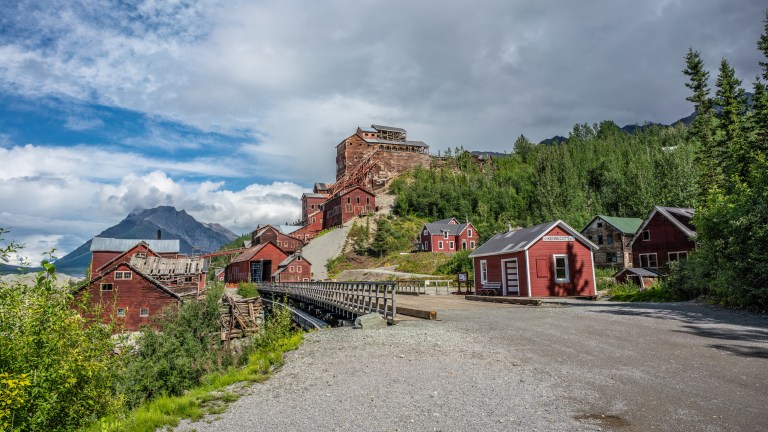
Located near McCarthy, Alaska, the Bonanza Mine Trail is a steep, unrelenting climb that’ll make your legs and lungs burn for just over eight miles out and back. But the payoff is huge, with sweeping views of the Kennicott and Root Glaciers that are hard to beat.
The trailhead for this historic hike is easily accessible within the Kennecott Mine National Historical Landmark, not too far from the action and tour area. Just past the Kennecott Mill, the main dirt path branches. To the right is the Bonanza Mine Trail, and be warned: it's not for novices or those unfamiliar with high-altitude treks. The first few miles follow an old wagon road and can easily lure you into a false sense of security as the trail climbs steadily, but not too steeply, through the trees — but the challenge only increases from there.

Along the way, you'll get to enjoy overlooks of Mount Blackburn, Root Glacier, and the town of McCarthy. You'll see a few sparse mining remnants as well, but the real show-stopper is about two miles farther up the trail, with some seriously stunning sights en route.
As the trail intensifies, the views open up to reveal gorgeous waterfalls, lush green valleys (if you're hiking in early summer), rocky outcroppings, and even the distant pinpoint of the Bonanza Mine. It's an absolutely stunning hike, best enjoyed with frequent breaks to rest your weary, wobbly legs and rehydrate. As you climb, the terrain becomes increasingly treacherous, with sheer edges and loose rock, so step carefully. The tree cover also quickly disappears, so you'll be fully exposed to the elements and resident wildlife.

Even in summer, those elements can include snow, snowpack, storms, snowstorms, and any other combination of wind, sleet, rain, hail, and bad weather that you can think of.
Fortunately, while you'll definitely want to have an emergency GPS and trail map handy, the trail leads straight to the mine without a lot of extra navigation involved. But keep an eye on the skies — you definitely don't want to get caught on the narrow trail sections in bad weather (which is exactly what happened to us).

The Bonanza Mine, now just a dilapidated echo of what it once was, was built in the early 20th century during a wave of mineral exploration that followed the Klondike Gold Rush of the late 1890s.
The mine sits over 3,800 feet high in the Wrangell Mountains. In the last century, its location made mining access a major logistical challenge. Undeterred, miners constructed a network of structures, including over 2,000 feet of tramways to continue unearthing minerals. Yet, even at its peak, the site only supported around 25 workers during the summer months, though winter operations were rare due to snow accumulation and avalanche risk. Multiple metals were found here, but never in large enough quantities to justify maintaining operations at such a remote site.

By the mid-1950s, operations at Bonanza had ended entirely. The buildings, which were constructed mostly of local timber, began to collapse under decades of freeze-thaw cycles and heavy snow loads. Today, the ruins include partial walls, rusted boilers, tram towers, and fragmented foundations. The site is unmanaged, unkempt, and slowly returning to the elements.
That said, leave it as-is, please.
While most people turn around at this point, after a moment or two of admiring the handiwork of Alaskans that have come before, a short walk beyond the mine leads to a stunning panoramic viewpoint. Or, if you're feeling extra enthusiastic and have legs like a mountain goat, you can also hike up the unmaintained and unmarked scree trail up to Bonanza Peak. I definitely did not attempt this portion, and from what I've heard, even skilled hikers and climbers have gotten stranded up there. So I recommend avoiding it!

The hike down is exactly the same as the way up, but with a little more caution on the loose rock (thanks, gravity), and a second helping of spectacular views when the weather is clear.

To say that this historic trail is challenging would be an understatement. It's definitely not for the faint of heart or those looking for a quick photo op. But once we reached the mine and looked out over all the sweeping beauty that Alaska has to offer, it was even more challenging to not immediately pack everything up and relocate here permanently! Along the way, I learned that the weather up in the Far North changes far more rapidly and aggressively than I gave it credit for, but I have no regrets. Alaska is so rich with both natural beauty and untold history that it'll take a lifetime to discover all of it, and this challenging day hike was just the first of many more to come — although I'll be a little more prepared next time. Note, however, that without careful planning, you might just wind up in cloud cover at the top of the trail and not be able to see anything at all. Use extreme caution if you decide to attempt this hike.
If abandoned places like this fascinate you, there are plenty of unique spots to explore around Alaska that don’t require a grueling hike to reach. The Independence Day Mine Historical Park is just one of many historical areas in Alaska that offers an accessible peek into a bygone era, all carefully maintained for anyone to enjoy with its gentle, all-ages interpretive trails. The Last Frontier is pretty massive, and there's plenty of history and beauty to discover around every corner!
Subscribe to our newsletter
Get the latest updates and news
Thank you for subscribing!