The 15 Most Unique Grocery Stores in the U.S. Worth Traveling to Visit
From immersive art installations disguised as supermarkets to sprawling international markets and over-the-top roadside stops, these grocery stores are anything but ordinary.
Grocery shopping is rarely considered a travel bucket-list item. But maybe it should be. Across the country, a handful of markets have shattered the mold entirely, trading outdated fluorescent-lit aisles for bourbon bars, live jazz, animatronic singing vegetables, and nightclub dance floors.
These aren't places you pop into for a gallon of milk. They're destinations in and of themselves; spots where the experience of being there is the whole point. In fact, grocery store tourism has been on the rise over the past few years. According to Hilton's 2026 travel trends report, 77% of travelers already participate in grocery store tourism, and 35% plan to visit a local supermarket on their next trip. For all the road-tripping travelers, foodie lovers, or farmers market chasers, these 15 unique grocery stores in the U.S. are well worth the detour.
1. Jungle Jim's International Market: Fairfield, Ohio
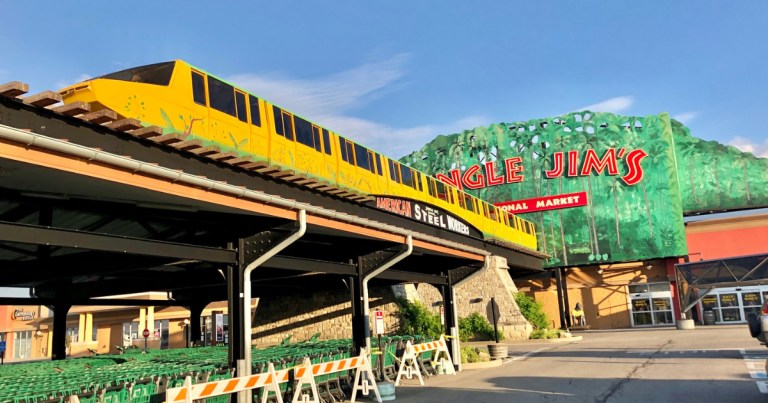
Why it's worth the trip: It's genuinely impossible to see everything in a single visit, and that's part of the charm.
If a theme park and a grocery store had a very ambitious food baby, it would be Jungle Jim's. Sprawling across nearly 300,000 square feet, this legendary market near Cincinnati stocks over 180,000 different products from more than 75 countries, with entire rows dedicated to hot sauce (1,200 varieties), global sodas, and every chip flavor imaginable. There are even insect-based snacks if you're feeling adventurous.
The décor is pure sensory overload: animatronics, life-size jungle displays, singing Campbell's Soup cans, and restrooms that once won the title of "America's Best Restroom." Serious shoppers can sample from the beer and wine tasting bar, then swing by The Oscar Station, the store's own bourbon bar, open Thursday evenings, featuring handcrafted cocktails, chef-made bites, and a cigar lounge.
2. Buc-ee's: Sevierville, Tennessee

Why it’s worth the trip: The ultimate American road trip pit stop, blown up to almost unbelievable proportions.
The Sevierville Buc-ee's isn't just a convenience store; it's a full-blown roadside attraction on the gateway to the Great Smoky Mountains. When it opened in 2023, the massive travel center briefly held the title of the world's largest convenience store, spanning more than 74,000 square feet with 120 fueling stations, a giant car wash, and enough snacks, souvenirs, and hot food to keep travelers occupied for hours.
Inside, you'll find the products that have earned Buc-ee's a cult following: walls of beef jerky, fresh fudge, warm candied nuts, Texas-style barbecue carved to order, bakery counters, and the chain's famously addictive Beaver Nuggets. Beyond the food, entire sections are devoted to quirky Buc-ee's merchandise, home goods, outdoor gear, and Smoky Mountain-themed souvenirs.
3. Stew Leonard's: Norwalk, Connecticut (and locations in CT, NY, NJ)

Why it's worth the trip: It's the only grocery store in America where the entertainment is genuinely worth the trip on its own merits.
The New York Times once called Stew Leonard's "the Disneyland of Dairy Stores," and the Guinness Book of World Records recognized it for having the greatest sales per square foot of any single food store in the United States.
Founded in 1969 in Norwalk, Connecticut, this family-owned grocery chain has built its reputation on one unforgettable hook: animatronic characters who perform for shoppers while they browse. The Farm Fresh Five (a quintet of singing milk cartons), Diva Cheese (a glamorous wedge of provolone in a feather boa), and the Avocado Girls greet customers throughout the store. There's also a seasonal outdoor petting zoo where children can meet farm animals, costumed characters roaming the aisles, and more free samples than you can reasonably accept. Even Snoop Dogg has publicly declared himself a fan.
4. Mariano's: Chicago, Illinois

Why it's worth the trip: Where else can you catch a jazz set, knock back a craft cocktail, and pick up dinner ingredients all at the same time?
In Chicago, asking someone where to grab happy hour drinks might get you directions to the produce section. Mariano's, a beloved Chicago-area grocery chain, has built a cult following around its in-store bars and legendary Live at Mariano's events: every Friday from 4 to 8 p.m., more than 20 locations host live jazz, blues, piano duels, and local musicians while shoppers sip $5 wine and $2 pint beers at full-service bars with high-top tables. Some locations also feature oyster bars, a dedicated BBQ grill where a cook will sear your meat to order, and a smoothie bar.
5. Uwajimaya: Seattle, Washington

Why it's worth the trip: A full-day cultural immersion without ever leaving the building.
Founded in 1928 when a Japanese immigrant began selling fish cakes from the back of a truck in Tacoma, Uwajimaya has grown into one of the most beloved Asian grocery destinations in the Pacific Northwest. The flagship Seattle store in the International District carries over 30,000 items: fresh sashimi-grade seafood, house-made poke bowls, Japanese Wagyu, imported snacks, and sake from small-batch breweries, alongside an entire food court anchored by spots like Bean Fish (fish-shaped waffles with sweet or savory fillings), Beard Papa's (fresh Japanese cream puffs from Osaka), and a ramen house.
But Uwajimaya is more than a grocery store: the same building houses a Kinokuniya bookstore, Japanese beauty products, ROYCE' Chocolates from Hokkaido, and, in a delightful touch, Gashapon capsule toy machines stocked with anime figurines and miniature surprises from Japan. Weekly shipments arrive directly from Tokyo's Toyosu Market, the world's largest seafood market.
6. DeLaurenti Food & Wine: Seattle, Washington

Why it's worth the trip: Nearly 80 years of Italian import mastery in one beautiful, fragrant shop.
Two back-to-back Seattle grocery stores? Okay, but hear me out. DeLaurenti is the kind of place that rewards slow exploration, especially since it's been a staple inside Pike Place Market since 1946. This Italian specialty market carries over 200 cheeses (including hard-to-find regional varieties), a meticulously curated wall of cured meats, 1,800+ wines, and an upstairs wine department that doubles as one of the city's most complete Italian wine collections.
Founder Pete DeLaurenti was among the first in Seattle to offer espresso, cheese cut to order, and pizza by the slice, and the tradition of firsts continues today, with handmade fresh mozzarella available on Friday and Saturday mornings (arrive early). The deli counter serves legendary Parma sandwiches loaded with prosciutto, arugula, white truffle oil, and shaved Parmesan on an Italian roll.
7. Central Grocery: New Orleans, Louisiana

Why it's worth the trip: One sandwich changed American culinary history. You can eat it at the source.
Central Grocery has been a fixture of the French Quarter since 1906, and it holds a legitimate claim to culinary history: this is the birthplace of the muffuletta, one of New Orleans' most iconic sandwiches. Italian immigrant Salvatore Lupo is credited with inventing it here: a round Sicilian sesame loaf piled with Italian cured meats, provolone, and the store's signature olive salad.
The shop itself is a wonderfully unchanged time capsule, packed floor to ceiling with Italian imports, olive oils, pastas, canned goods, and jars of olive salad that visitors carry home by the armful. The line for a muffuletta often stretches out the door, and rightly so; they're still made the same way they have been for over a century.
8. Berkeley Bowl: Berkeley, California

Why it's worth the trip: If you've ever thought you understood what a produce section could be, Berkeley Bowl will politely correct you.
Berkeley Bowl is what happens when a single-minded obsession with produce quality meets an encyclopedic approach to variety. The store carries an almost bewildering array of fruits and vegetables; multiple varieties of every common item (eight types of apples, six colors of beets, heirloom tomatoes in more shades than a paint store), plus international produce that's nearly impossible to find elsewhere in the Bay Area.
The original 1977 store was built in a former bowling alley, which gave it its name, and the produce section alone draws regular visitors from across the region. A second, larger location opened in 2009 with an expanded Asian grocery section and Japanese-imported cookware. The wine and beer selection is deep, and the prepared foods are excellent.
9. Erewhon Market: California

Why it's worth the trip: Equal parts grocery store, wellness cathedral, and window into how a certain corner of American culture eats.
No list of unique American grocery stores is complete without Erewhon, the luxury health-food market that has become a genuine cultural phenomenon in Los Angeles. What sets it apart isn't just the price tags (though those are remarkable); it's the curation. The tonic bar serves elaborate, single-origin, celebrity-collaboration smoothies that sell out by midday. The refrigerated cases are stocked with house-made bone broth, local biodynamic cheeses, and vegan ice creams from small producers who exist nowhere else. The dry goods section offers ingredients most shoppers have never encountered. And the produce section looks more like a still-life painting than a grocery display.
Erewhon has become a destination in its own right; a place people specifically visit, photograph, and experience as part of the LA landscape, alongside the Getty and the farmers' market.
10. Mazzaro's Italian Market: St. Petersburg, Florida

Why it's worth the trip: It's the closest thing to a Roman alimentari outside of Italy, and it's in a Florida strip mall, which somehow makes it even better.
Wedged into a nondescript strip mall in St. Pete is one of the most beloved food destinations in Florida. Mazzaro's has been operating since 1979 as a full-scale Italian import market, importing wheels of aged Parmigiano-Reggiano, a staggering selection of cured meats, fresh-made pastas, imported olive oils, and cannoli filled to order.
The cheese wall alone is enough to stop you in your tracks. The bakery turns out authentic Italian breads daily, and the prepared foods counter (roasted vegetables, lasagna, fresh mozzarella) rivals any trattoria. There's also a café serving espresso and panini, and the staff's depth of knowledge about Italian food is remarkable.
11. Eataly: New York, New York (Flatiron District)

Why it's worth the trip: It's a full Italian food education packaged as a beautiful, enormously fun shopping experience.
Calling Eataly a grocery store is technically accurate but wildly undersells it. The flagship NYC location at 200 Fifth Avenue in the Flatiron District sprawls across 48,000 square feet of Italian food culture: a maze of open-air market counters, sit-down restaurants, a bakery, a pastry counter, a gelato bar, a coffee bar, and aisle after aisle of imported Italian products organized by region of origin. The cheese department alone carries wheels of Parmigiano Reggiano aged to different stages, rotating regional varieties, and staff who will teach you the difference between them over a sample.
Multiple in-store restaurants let you taste a dish using the exact ingredients you can then buy and take home. There's even a cooking school. Founded in Turin, Italy, in 2007 and now spanning multiple U.S. cities, Eataly's NYC flagship remains the gold standard: equal parts museum of Italian food culture and genuinely excellent place to stock your pantry.
12. Buford Highway Farmers Market: Doraville, Georgia

Why it's worth the trip: A living snapshot of American immigration culture, told entirely through food.
The Buford Highway Farmers Market is a different kind of international market entirely; one that reflects the extraordinary ethnic diversity of the Buford Highway corridor itself. Owned by a Korean family and open since the 1970s, the market stocks products from 71 countries, with a particularly strong focus on Latin American, Korean, Chinese, Southeast Asian, and Eastern European foods.
The produce section leans into the exotic: durian (nicknamed the "corpse fruit" for its smell, beloved for its caramel-custard flavor), whole jackfruit, fresh bitter melon, and dozens of herbs and greens you won't find in a standard supermarket. The meat and seafood counters are expansive, and the prepared foods, like house-made kimchi, fresh tamales, and Filipino-style pastries, all reflect the neighborhood that built this place.
13. Omega Mart: Las Vegas, Nevada

Why it's worth the trip: A surreal, story-driven grocery store that turns an everyday errand into a mind-bending art experience.
Omega Mart is not your typical supermarket—it’s a fully immersive installation tucked inside Area15 in Las Vegas, created by the avant-garde arts collective Meow Wolf. At first glance, it looks like a quirky grocery store stocked with offbeat products, but hidden doors, secret passages, and interactive exhibits quickly reveal a much stranger reality beneath the surface.
Shelves are lined with bizarre, fictional brands and satirical takes on American consumer culture, from surreal “foods” to cryptic packaging that hints at a larger narrative. Push deeper, and you’ll uncover an interconnected story told through psychedelic rooms, neon-lit corridors, and multimedia installations that blur the line between art, storytelling, and retail. It’s equal parts grocery store, escape room, and immersive theater, completely unforgettable and unlike anything else in the country.
14. Mitsuwa Marketplace: Torrance, California

Why it’s worth the trip: One of the closest experiences to stepping into a modern Japanese food hall without ever leaving the United States.
While Mitsuwa Marketplace has locations across the country, the Torrance flagship in Southern California is widely considered its most iconic. Located in the heart of one of the largest Japanese American communities in the country, the massive marketplace goes far beyond grocery shopping, functioning as a cultural hub packed with specialty food vendors, bakeries, imported goods, and one of the best Japanese food courts in America.
The shelves are lined with everything from regional Japanese snacks and premium rice to hard-to-find sauces, fresh sashimi-grade seafood, wagashi sweets, and seasonal imports that rarely make it into mainstream supermarkets. The real attraction, however, is the food hall, where visitors can sample steaming bowls of Hokkaido-style ramen, handmade udon, tempura, Japanese curry, mochi donuts, and other specialties under one roof.
15. Seed to Table: Naples, Florida

Why it's worth the trip: It's part grocery store, part nightclub, part farm-to-table restaurant. There is nothing else like it.
Seed to Table calls itself "the happiest place in the universe," and honestly, it's hard to argue. This 75,000-square-foot farmer's market-style store is owned by Oakes Farms, whose 3,500 acres of Southwest Florida farmland supply the store with produce harvested and stocked within 24 hours. But the real jaw-dropper is the atmosphere: three bars (including Hops & Vines, a full-service liquor bar open until 2 a.m. on weekends), multiple restaurants, a wine-tasting bar, and live music every single night of the week, from reggae to country to Latin bands.
With grocery store tourism on the rise, it's only fair that we shed some light on the best and most unusual grocery stores across the USA.
Subscribe to our newsletter
Get the latest updates and news
Thank you for subscribing!