The Remote Town in Nevada We Simply Can’t Get Enough Of
Austin is a teeny-tiny town in rural Nevada. It's a place you may not know even exists.
Nevada is full of small, rural, remote towns and a couple of big cities. The big cities seem to get all the attention, but anyone who truly knows and loves Nevada knows that the small towns are charming and deserve recognition, too. In fact, if you take the time to step away from the city lights and head out into the darker, isolated, less-visited parts of The Silver State, you may quickly fall in love with one or several of Nevada's lesser-known towns.
One Nevada town that is especially tiny but mighty is Austin. This village of fewer than 100 inhabitants is located in almost the true middle of the state. Most people—even Nevada residents—don't even know it exists. I came across it while crossing Nevada on famous U.S. Route 50, the road that was dubbed "The Loneliest Road in America" by Life magazine in 1986. Almost 40 years later, this road is still pretty lonely and desolate, but it's a lot of fun to drive across.
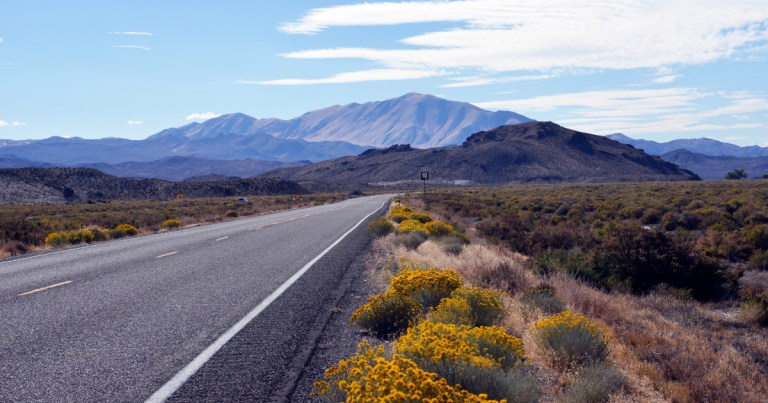
In fact, U.S Route 50 through Nevada is not like any other drive I've undertaken in this vast country of ours. The road goes straight across most of the state, and travelers only pass through a few towns on the entire route. Travel Nevada offers the Nevada Highway 50 Survival Guide to interested parties; we picked up our copy at the Carson City Chamber of Commerce. As you cross the state and pass through these towns, you can get your booklet stamped at businesses along the way. If you get stamps in at least five towns on your journey, you can mail the book in for a cool certificate proving that you made—and survived—the drive.
This program is a lot of fun and encourages people to stop in Dayton, Fernley, Fallon, Austin, Eureka, Ely, and Great Basin. All of these towns are relatively small, but Austin is the smallest of them all. Although I'm a huge fan of small towns in general, it's unlikely I would have stopped in Austin without the booklet as a motivator. There are several places in each town where you can get your book stamped, but my companion and I were drawn to the Austin Justice Court Building in particular in Austin. It was once the county courthouse for Lander County, a county that covers 5,519 square miles and has an overall population of about one person per square mile.

The Austin Justice Court Building was built in 1871 and was added to the National Register of Historic Places in 2003. It was quiet inside with just a few people working at desks in offices. The building's receptionist was more than happy to stamp our booklet for us. She was extremely friendly and made us feel very welcome. She asked us if we had any questions about the town or if we were looking for any recommendations, but we told her we were just passing through.
As we continued on our way, I found myself intrigued by Austin, so I made an effort to learn more. After all, it was 70 miles to our next stamp stop in Eureka, so I had plenty of time. As someone who has always lived in more heavily populated areas, I couldn't imagine what it would be like to live in such a small and remote town.
It turns out that Austin wasn't always so small. It was initially occupied by Western Shoshone people; settlers began to move to the area in the mid-1800s. By 1863, Austin was named the county seat of Lander County and it had a population of 7,000 people, most of whom were drawn there by the silver rush. Unfortunately, the silver boom didn't last long. Major silver production in this area ended in 1887, and the town's population has been in decline ever since. The county seat was moved to Battle Mountain in 1979.

Today, Austin is considered by some to be a "living ghost town" and is one of the best preserved examples of a Nevada mining town that is still occupied and maintained. There are a number of structures in town that are listed on the National Register of Historic Places, including three churches, Austin Cemetery, the old city hall, the Austin Masonic and Odd Fellows Hall, a store, and Lander High School. Almost all of the town is designated as the Austin Historic District. Further, the International Hotel, which was built in 1863, is thought to be the oldest hotel in the state. It no longer offers accommodations, but the bar and cafe that it has become is a cool spot for food and drinks in a historic setting.
Another interesting building just outside of town is Stokes Castle. This Italian-style, three-story stone tower was built by Phelps Stokes, a wealthy man from New York in 1897. He built it with the intention of using it for a summer home, but he and his family only lived in it for a month. It has been abandoned ever since he and his family sold their mine in 1898 and never returned. It, too, was placed on the National Register of Historic Places in 2003.
I learned that there are actually quite a few things to do in and near Austin, Nevada. In addition to all of the historic buildings, there's an art gallery in town—Jason's Art Gallery—that's worth a visit, along with several well-rated restaurants like Champs Burgers and Grandma's. Outside of town, visitors can check out the Hickison Petroglyphs or visit Toquima Cave to see pictographs. Hot springs enthusiasts will also enjoy taking a dip in nearby Spencer Hot Springs. And, there are plenty of hiking trails near Austin, too, for people who want to explore the western slopes of Nevada's Toiyabe Range.

Austin may be a tiny town, but it's a very cool town that's certainly worth a closer look. You can plan your own trip to Austin with Only In Your State’s AI-powered itinerary planner. Or, maybe you want to explore another small town in Nevada. Either way, there are plenty of hidden gems just waiting for you.
Subscribe to our newsletter
Get the latest updates and news
Thank you for subscribing!