Why I’m Mesmerized and Haunted by the History of the Great American Chestnut
Once accounting for billions of trees in the Appalachians, the American chestnut became functionally extinct by the 1950s.
I've always been fascinated with trees. I remember the first time I ventured to California, standing amongst the redwoods was at the top of my list. Having lived on the East Coast for my entire life, I couldn't quite imagine a forest of such giants. And yet, for the better part of the past millennium, Virginia was home to its own towering tree: the American chestnut.
The American chestnut could be found along the Appalachian Mountain range, a towering specimen that grew over 100 feet tall, 10 feet in diameter, and could live hundreds of years. Billions of these trees populated the forests from Maine to Mississippi, abundant for many reasons: fire resistance, rapid growth, and a significant annual nut crop. Yet they couldn't survive a devastating blight that virtually wiped out their entire population in the early 20th century, and today, a mature American chestnut is a nearly impossible find.
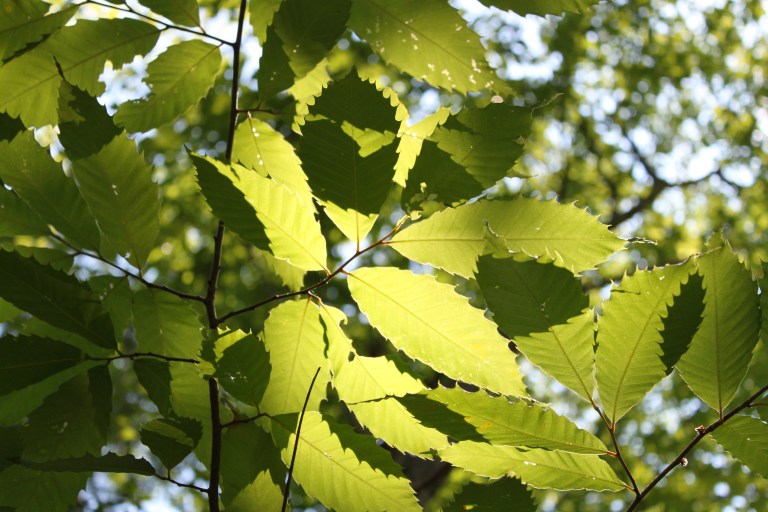
The American chestnut tree was synonymous with life in the Appalachian Mountains for centuries. Making up a quarter of all the trees in their native region, American chestnuts loomed large over the forest canopy, providing shade, shelter, and bounty in the form of lumber and nuts. Families could harvest bushels of chestnuts, using them to trade for other goods and necessities. Chestnut wood was also used for building everything from homes to bridges, barns, railroad ties given the wood's characteristic resistance to rot.

For hundreds of years before European settlement, Indigenous Peoples depended on the trees for an important food source. As the original inhabitants of the Appalachians, they actively managed the landscape to protect the trees and encourage their growth in the forests.
In the springtime, typically after the last frost, the trees would bloom with large white flowers. There were so many of these blooms in the forest that it almost looked as though the mountains were covered in snow. Eventually, these flowers would transform into burrs, which would then break open in the fall and reveal delicious, nutrient-dense nuts. It wouldn't have been uncommon for the forest floor to have several inches of chestnuts, which could then be gathered and used for trade.
The forest ecology would be forever changed after a trade in 1870 that brought Asian chestnuts to New York City. These trees carried with them a deadly fungus that the American variety had no resistance to. It's reported that in 1904, workers at the Bronx Zoo noticed that the chestnut trees began to develop rings of dead bark. And these were ancient trees—nearly 700 years old. Frantically, researchers began cutting down chestnuts in an effort to stop it from spreading, but it was too late. The chestnut blight could be carried by the wind and rain, and it had spread rampantly.

By 1950, virtually every American chestnut tree had been wiped out. Populations of animals and people living throughout the Appalachians were devastated, not only for the loss of the magnificent tree but also for the food and shelter it provided. It's believed that the extinction of the American chestnut is also one of the contributing factors to the passenger pigeon, once the most abundant bird in North America, going extinct.
Anyone who's studied this loss can agree that it was a nearly unprecedented ecological disaster. Yet there's hope. Thanks to the ongoing efforts by The American Chestnut Foundation, the chestnut may soon be restored to its native range. Through breeding, biotechnology, and biocontrol, TACF is making exciting progress towards a genetically diverse and disease-resistant chestnut that can grow beyond a seedling or stump sprout.
I highly recommend spending some time on the The American Chestnut Foundation site—there, you'll find tips for identifying different chestnut trees and a wealth of information about their impressive restoration efforts. While we may never witness the mighty chestnuts as they once stood throughout most of Virginia's modern history, it's encouraging to think these giants could someday return. American chestnuts are still growing in the woods, but can't reach maturity before the blight or root rot kills them.

Knowing such a vital part of the forest could be wiped out in a single generation is haunting, and it gives me a greater understanding of our fragile ecosystem. I may never get to walk among towering American chestnuts, but I also won't take any part of our native landscape—the mourning doves, flame azaleas, or tulip poplars—for granted.
Subscribe to our newsletter
Get the latest updates and news
Thank you for subscribing!