6 American Cities That Changed Music Forever
American music didn’t emerge from a single source; it was carved from cities all across the country and shaped by immigration, economics, politics, and more.
Many of the American cities that changed music forever are still cultural powerhouses today. From smoky jazz clubs to legendary recording studios, these music cities in America helped create the sounds that defined generations and shaped global music culture.
Music may be the one thing that unites people across the planet, but the roots of many iconic genres can be traced back to specific places. American music didn’t emerge from a single source—it was forged in cities across the country and shaped by immigration, economics, politics, and cultural movements. From Prohibition-era speakeasies to electric block parties, cities that shaped American music history, like New Orleans, Detroit, Memphis, Nashville, Macon, and Seattle, helped develop distinctive sounds that would eventually transform the global music landscape.
Let’s take a look at six American cities that changed music forever.
1. New Orleans, Louisiana
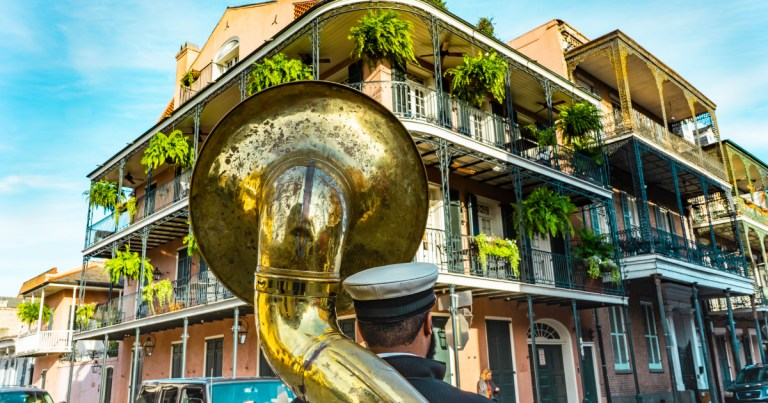
New Orleans is the birthplace of jazz and a cornerstone of American music. Historians don’t know exactly when jazz was born. Perhaps it was born out of the drumming and Voodoo rituals that took place at Congo Square before the Civil War. Maybe it was born when Buddy Bolden started his first band in 1895. Or maybe it was in 1917 when Nick LaRocca and his Original Dixieland Jazz Band recorded the first jazz record. Ferdinand ‘Jelly Roll’ Morton believes he invented jazz in 1902. The truth is that they all played a role in the creation of the genre.
Louis Armstrong, Jelly Roll Morton, Pete Fountain, Kermit Ruffins, Trombone Shorty, and Harry Connick Jr. are just some of the jazz legends that you can learn more about when visiting the New Orleans Jazz Museum. Heck, wander around the French Quarter for 15 minutes, and you’re bound to hear a brass band or two. If you’re lucky, you’ll get to watch a Second Line, one of the most magical musical moments in New Orleans.
2. Nashville, Tennessee

Music City is certainly no stranger to a melody. Nashville has been a music publishing city since the 1800s, with the Fisk Jubilee Singers' 1871 tour helping raise funds for the education of formerly enslaved people.
While Nashville is strongly associated with country music, it was also a major hub for R&B, jazz, and blues, with artists like Etta James and Jimi Hendrix recording here. During the Depression, nightclubs and speakeasies along Jefferson Street often hosted jazz and rhythm and blues nights that helped solidify Nashville as an R&B hub.
Of course, Nashville’s ties to country music are legendary. When the Ryman Auditorium opened in 1892, it quickly earned the nickname “Carnegie Hall of the South,” and musicians from all over the world came to play here. Louis Armstrong, Marian Anderson, and Nat King Cole were among some of the names to step onto the stage. From 1943 until 1974, the Grand Ole Opry came to the Ryman every weekend. Country Music Hall of Fame stars such as Hank Williams, Johnny Cash, Patsy Cline, and Dolly Parton all performed here.
It was during one of these performances at the Grand Ole Opry, in 1945, that Bill Monroe, playing the mandolin with Lester Flatt on guitar, Chubby Wise on the fiddle, and Howard Watts on the bass, created a new genre of music: bluegrass. Later on, Earl Scruggs and his banjo would join the group and solidify that iconic bluegrass sound.
The Opry is the longest-running radio show in America—it’s been a weekly live broadcast since 1925!
3. Macon, Georgia

Known as the birthplace of Southern rock and soul music, Macon, Georgia, is home to musical legends such as Otis Redding, Little Richard, and The Allman Brothers. The Allman Brothers signed with Capricorn Records in 1969 and lived in a home that’s now known as The Big House. At one time, Capricorn Records was the largest independent label in the country and generated almost $200 million in record sales. Icons like Percy Sledge, The Charlie Daniels Band, James Brown, and Lynyrd Skynyrd all recorded at Capricorn Studios.
Visitors can see the world’s largest collection of Allman Brothers memorabilia at this interactive museum, where Dickey Betts wrote Blue Sky in the living room and Ramblin’ Man in the kitchen.
Little Richard, who was born in Macon in 1932, grew up singing gospel at church and performing at what is now the Tic Toc Room, a restaurant in downtown Macon. The Little Richard House, his childhood home, is now a historical landmark and a community center.
4. Memphis, Tennessee

A pillar of American music, Memphis is known as the birthplace of rock ’n’ roll and a key hub for blues and soul. Carl Perkins, Jerry Lee Lewis, and Johnny Cash all recorded tracks in the famous studios in Memphis and played a key role in solidifying Memphis’ musical history. Musicians from the past and present come through the city to play Beale Street and make their mark.
Sun Studio and Stax Records are two of the most iconic music studios in Memphis. Sun Studio was started by Sam Phillips (one of the founding fathers of rock ’n’ roll) in 1950. B.B. King, Ike Turner, Jerry Lee Lewis, and Elvis Presley all recorded there. Sun Studio actually produced the first rock ’n’ roll record: “Rocket 88,” in April 1951.
Stax Records opened in 1957 and brought gospel, funk, and Delta blues to the table. Otis Redding was the biggest name there, but after his death in 1967, the studio struggled to compete with Detroit’s Motown.
5. Detroit, Michigan

The rise of Motown in Detroit in the 1960s cemented its place in American music history. Motown Records was founded in 1960 by Berry Gordy Jr. and went on to produce icons like The Temptations, Marvin Gaye, and Aretha Franklin. The name Motown was a cannibalization of “Motor Town,” the nickname for Detroit. Gordy used his background in the automotive industry to run the studio; employees worked long hours, there was a strict quality-control system, and a weekly Friday-morning product evaluation meeting where only the best music would make the cut.
One of Gordy’s key early signings was Smokey Robinson, who later became what Gordy described as “the soul of Motown.” Robinson composed the Motown company song and went on to write lyrics for songs such as “My Girl,” “Tracks Of My Tears,” and “I’ll Try Something New.” Plan a visit to the Motown Museum to learn more.
6. Seattle, Washington

Seattle was key to the late 80s and 1990s grunge scene, producing household names like Nirvana, Pearl Jam, Soundgarden, and Alice in Chains. Grunge was born out of the economic realities of the time. The city was poor, and the predominantly working-class people were struggling. Add in a little heroin, and you’ve got the foundation of Grunge music.
Seattle embraced the counter-culture, and grunge artists popped up all over the 80s and 90s. Kurt Cobain was living in his car when the Nevermind album was released.
Even beyond grunge, Seattle’s music scene is shaped by legends like guitarist Jimi Hendrix, who was born here. Long before grunge was around, folks like Ray Charles and Quincy Jones were playing at the Elks Club on Jackson Street. Seattle’s music history is long and varied, but the heyday was Grunge. Visitors to the Museum of Pop Culture (MoPOP) can learn all about the sounds that shaped Seattle.
Whether you're a country music connoisseur or a Motown aficionado, music lovers of all genres should take a trip to one of these American cities that helped shape the history of music. Plan your own musical adventure with Only In Your State’s itinerary planner.
Subscribe to our newsletter
Get the latest updates and news
Thank you for subscribing!