Perhaps The State’s Best Hidden Treasure, Hardly Anyone Knows These Incredible Deep Sea Coral Habitats Exist Off The Coast Of North Carolina
Researchers from NOAA are studying deep-sea coral habitats in North Carolina's submarine canyons, revealing diverse marine life and underwater landscapes.
With our tall mountains, low-lying coastal plains, and other natural wonders, it is no surprise to find the existence of deep-sea coral habitats in North Carolina. Researchers of the National Oceanic and Atmospheric Administration (NOAA) have been working hard observing these important environments found off the coast of North Carolina in Keller, Hatteras, and Pamlico submarine canyons. Many sea creatures rely on us to keep the waterways clean, as they find cozy homes and habitats in the deep-sea corals and sponges.
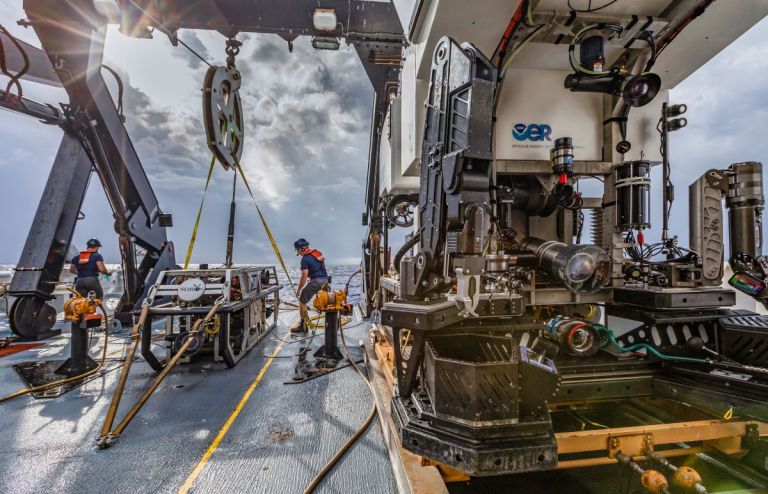
The remotely operated Deep Discoverer imaged unexplored areas of the Blake Plateau, Blake Ridge, and Blake Escarpment submarine canyons offshore of North Carolina.
The submerged cultural heritage sites are areas predicted as suitable habitats for gas seeps, deep-sea corals and sponges, and inter-canyon areas.
Down under, the sophisticated equipment does the job as imaging objects can help determine when a shipwreck occurred with many remnants located along the southeastern offshore, including Cape Hatteras, North Carolina.

An octant (the reflecting instrument used in navigation) was observed during Dive 09 of the Windows to the Deep 2018 expedition on the potential 19th-century wreck.
The device has also captured this colorful, glass sponge, one of many different sponge species found in the area.

The name comes from their skeletons comprised of four and or six-pointed glass-like silicon spicules.
The autonomous underwater vehicle Sentry, part of the National Deep Submergence Facility, discovered stunning rock walls covered in a diversity of corals at Pamlico Canyon off the coast of North Carolina.

Pamlico Canyon, south of Hatteras Canyon, is the least explored and a priority for DEEP SEARCH investigations.
Spindly Brisingid sea stars, deep-sea-dwelling starfish, collect along the edge of the canyon wall.

Instead of forming rock-like reefs, these cold-water corals form mound structures or groves of feather, tree, fan, or column shapes, sometimes reaching dozens of feet tall, as this video shows.
Unlike tropical reefs, deep-sea corals live from approximately 150 feet to more than 10,000 feet below sea level, where sunlight is practically nonexistent.

But even in the darkness where no one can see, beauty is everywhere like this bright squat-lobster, a common sight among the live coral colonies. His arms are raised like a tick in hopes of capturing yummy treats floating by.
Graceful illex squid swim above a lone octopus in Keller Canyon.

For more in-depth articles about deep-sea coral habitats in North Carolina, visit the NOAA's webpage.
While we can't visit these habitats, discover why the Outer Banks was named the most beautiful place in North Carolina.
Subscribe to our newsletter
Get the latest updates and news
Thank you for subscribing!