I Connected with the Past on a Docent-Led Tour of Chimney Rock National Monument
There's so much to see in our national parks system. You can enhance your experiences in them even more through docent and ranger-led tours.
I'm a national parks enthusiast -- to say the least. A more accurate description of my feelings about U.S. National Park Service-managed sites is that I'm head-over-heels in love with them, and I'm not exaggerating. I adore national parks, and I try to visit as many of them as I can, whenever I can. They're beautiful, educational, inspirational, historical, and tremendously varied, and I haven't yet found one that didn't impress me in at least some small way. Most of them impress me BIG.
Our country's National Park Service is responsible for the management of 431 individual units. They cover more than 85 million acres and are present in all 50 of our states, plus in Washington D.C. and in U.S. territories. I want to visit every single one.
So far, I'm only about a quarter of the way through them but hey, dare to dream, right?
I feel very fortunate to have visited the vast majority of National Park Service sites that are within reasonably driving distance of my home in Denver, Colorado already. Of course, I also try to hit as many as I can when traveling anywhere else in our nation, too, but it's great that there are so many available to me and my fellow Coloradans in our own backyard.

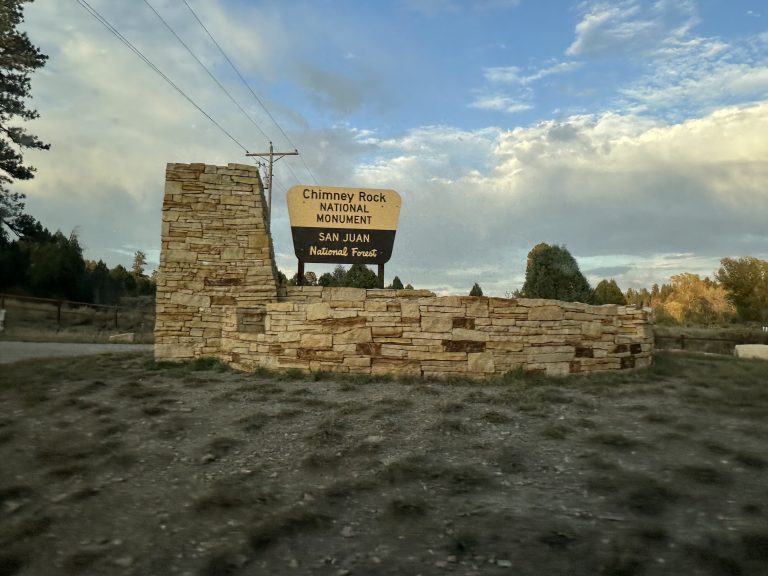
Recently, I had the opportunity to visit Chimney Rock National Monument in southwestern Colorado. It's located between Pagosa Springs and Durango. It's not often that I'm in that corner of the state and I'd missed this site in past visits to the area. Initially, I couldn't figure out how that had been the case, considering my ravenous appetite for parks sites everywhere, but I later realized that I'd likely missed in the past due to the fact it's only open seasonally. Chimney Rock National Monument is open to the public from only mid-May to mid-October each year; this is rare for National Parks Service sites, but isn't entirely unheard of.
Further, Chimney Rock National Monument was only designated as a National Park Service site in 2012 - making it one of the newer units in the system - although its been on the National Register of Historic Places since 1970. Previously, it was under control of the U.S. Forest Service and the Chimney Rock Interpretive Association, and today, those two groups continue to manage it. This is rather unusual and uncommon, as most National Parks Service sites are almost always staffed instead by National Park Service park rangers and associated volunteers, but in this case, it seems that the powers that be decided to keep it in the hands of the people who know and love it best.
The property of this site covers 4,726 acres. While its namesake rock formation, Chimney Rock, and the adjacent rock formation, Companion Rock, can both be easily seen from the main road, there's so much more to see when you take the time to enter the monument property. In addition to beautiful vistas and interesting rock formations, Chimney Rock National Monument is also home to vast archeological treasures.

Normally, when I visit National Park Service sites, I prefer to explore on my own and with my travel companions. I usually stop at the visitor center, visit all the overlooks, and take it all in - in my own way.
Sometimes, I'll venture out on a few short, easy hikes - but not always. Although I love nature and being out in it, if we're being honest, I'm not much of a hiker. I know that there's much to be seen in these parks beyond the roads and pull-offs, but I have always felt that I see plenty of good stuff from them to satiate me.
This visit to Chimney Rock National Monument was about to be very different. Our group had enlisted a docent to teach and guide us, and we were going on a hike all the way to the top. I had my reservations about this, but I went along with it. And in the end, my experience was far richer because I did.

We met our volunteer docent, Michael Bezney, near the entrance to the park and then followed him in our vehicles to the upper parking lot. Once we really met him and introductions were made, it was immediately obvious that Mike was a very colorful individual. He told us that he had been a volunteer docent for Chimney Rock Interpretive Association for many years. He informed us that he lived half the year in Pagosa Springs and half the year in Florida. He explained that he was extremely dedicated to this place, that he loved it so much, and that he couldn't wait to share it with us. He also made us all laugh nearly a dozen times in as many minutes. Mike is super outgoing and boisterous; his enthusiasm was contagious, and we were all ready to learn.

First, Mike took us down a paved path and gave us background about the site. We learned that this are was inhabited about 1,000 years ago by Ancestral Puebloans, specifically the Chaco people. Between AD 925 and 1125, over 2,000 people lived in this community. They left many structures and artifacts behind. Much of the site has been excavated, but Mike told us there's surely much more yet to be discovered.
Mike certainly had a lot to say, but every minute was interesting. His presentation was interactive and he asked our group many questions to help keep us focused. When one of us answered a question correctly, he gave us a reproduction arrowhead as a prize; we all wanted to get one, and so we enjoyed the friendly competition. He regularly referred to his notes - not because he didn't know the material, as he clearly knew it inside and out and backwards and forward - but because he didn't want to leave anything out.
This lower, paved path passed by unexcavated sites and the Great Kiva, a large, circular ceremonial space on the side of the mountain. Its construction was impressive; it was still in excellent shape after over a thousand years.

We returned to the parking lot and quickly began our climb to the top. This was the part that the lazy person in me was kind of dreading, and it seemed awfully steep to me from the get-go. However, Mike stopped frequently and I never found myself out of breath. The views on both side of the trail were impressive, and the temperature was perfect. I found myself enjoying the hike right away, and I was learning so much about the site from Mike that I hardly even noticed the effort required.
In addition to telling us about Chaco culture, Mike also pointed out plants, animals, and birds along the way. Before we knew it, we were at the top. At the summit, we came upon the Great House Pueblo - a huge, meticulously constructed stone building that looked almost new, despite being over a century old. It consists of 36 rooms and two kivas, and its believed that it was built in two sessions - one in AD 1076 and one in AD 1093.
Being able to walk around and explore such an ancient place was a true joy. I contemplated times long ago and tried to imagine what it had looked like when this area was densely populated. I felt connected to the past in a very special way, and my visit to the Great House Pueblo is something that I'll surely never forget.

Mike still had more to tell us. Now that we were within sight and nearly at eye level with Chimney Rock and Companion Rock, he explained the reason that the Chaco people were drawn to this site. Every 18.6 years, for a period of 16 months, the moon rises directly between these two rock formations if you're standing at the Great House Pueblo. This occurrence, known as a lunar standstill, clearly had great religious significance for the people who lived in this region at the time. The Great House Pueblo was built as a viewing location for this spectacle.
This rare natural event is still a sight to see today. Although visitors aren't allowed to climb this trail at night, park staff livestream this phenomenon to the public on a regular basis when it happens. Coincidentally, 2024 is, in fact, a lunar standstill year at Chimney Rock.
Later, I learned that this short but steep hike was only a third of a mile long, and I laughed when I looked back at the hesitation I'd had before undertaking it. It was really nothing, and I shouldn't have balked at all - not even internally. I learned so much on this short hike with Mike Bezney, and I realized how much of this National Park Service site I would have missed out on without his guidance.
This experience at Chimney Rock National Monument made me realize how important it is to participate in park staff-led tours and talks when visiting the parks. I've certainly learned a great deal about our nation's national and historic sites by spending time in visitor centers and by reading signage as I explore. However, I now realize that I'm never going to get the same, thorough, overall experience from doing just that as I will from learning directly from the people who know and love these places best.
So thanks, Mike, for teaching me not only about your beloved Chimney Rock National Monument, but for teaching me this lesson, too. I'll be sure to make an effort to participate in guided hikes and ranger-led talks in our parks moving forward, and I'm sure my experiences will be richer than every before thanks to doing so. I suggest you do the same. Every National Park Service website includes a list of tours and events that you can check out during your visit, and almost all of them are absolutely free. Don't miss out - plan ahead, or ask a ranger what's upcoming when you stop by each visitor center, and you'll get even more out of our National Parks system than you possibly ever could on your own.
Subscribe to our newsletter
Get the latest updates and news
Thank you for subscribing!