Blucifer: The One Denver Airport Conspiracy That’s Actually True
Denver International Airport has more conspiracy theories than gates, but this one isn't a theory at all. The 32-foot blue mustang staring down travelers on Peña Boulevard comes with a real, documented, and genuinely unsettling backstory.
Denver International Airport has spent three decades collecting conspiracy theories the way other airports collect lost luggage. There's the fence with barbed wire angled inward, the murals people swear predict apocalypse, and the rumors of tunnels running deep beneath the tarmac. Most of it falls apart the second you ask an actual airport employee about it.
Then there's Blucifer, the Colorado conspiracy that draws a ton of attention to the airport. And here's the part that trips people up: this one's real.
What Blucifer Actually Is
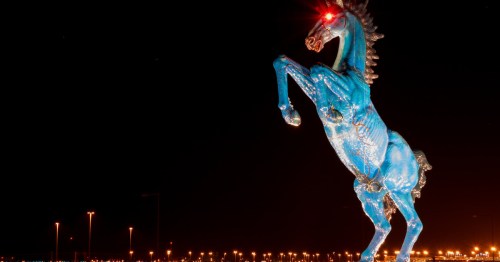
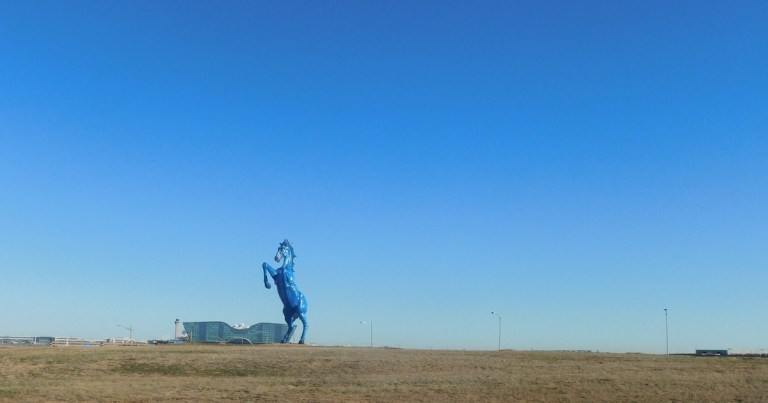
Officially, the 32-foot blue mustang rearing up in the median of Peña Boulevard is called "Blue Mustang." Nobody calls it that. Travelers dubbed it Blucifer almost the moment it went up, a mashup of "blue" and "Lucifer" that fits a lot better than the artist ever wanted. The fiberglass sculpture weighs about 9,000 pounds, stands on its back legs like it's about to come down on the highway, and stares out at passing cars with two glowing red eyes that don't turn off, ever.
Denver commissioned the piece in 1992 for $300,000, years before the airport itself even opened. The original plan called for a herd of bison, but the city scrapped that idea since bison had already been hunted to near extinction across the region. Sculptor Luis Jiménez pitched a mustang instead, a fitting stand-in for the Old West and one of Colorado's own wild horse herds.

The Story Locals Actually Care About
Here's where the legend stops needing embellishment. In 2006, while Jiménez was still working on the sculpture in his New Mexico studio, a section of it broke loose and fell on him, severing an artery in his leg. He died from the injury. His sons finished the piece in his memory, and Blue Mustang finally went up outside DIA in February 2008, sixteen years after it was first commissioned and two years after it killed the man who built it.
That single fact, more than any hidden symbol in the terminal murals, is why Blucifer earned its nickname and its reputation. People weren't imagining a menace. They just weren't wrong to feel like they were looking at something with a body count.
Even the eyes have a real story behind them. Jiménez's father ran a neon sign shop in El Paso, and the sculptor grew up learning welding and paintwork there. The blood-red LED eyes are a tribute to him, rather than being an ominous signal to anyone or anything else.

So Is the Denver Airport Actually Cursed?
Denver's airport CEO has joked publicly that he has no plans to remove the statue, mostly because he doesn't want to find out what happens if he tries. That's about as close as officials have come to acknowledging the whole thing feels a little haunted. Under the city's public art rules, any commissioned piece must remain on display for at least five years before anyone can even petition to take it down. That window closed back in 2013. Nobody's seriously pushed to remove it since then, and by now most Denverites would probably fight to keep him.
Blucifer has survived a decade of hailstorms, a 2019 graffiti attack, and no shortage of online campaigns calling for his removal. A conservation crew inspects and repaints him every year, checking for chips and cracks from Colorado's wind and weather. He's not going anywhere.

Where to See Him
You don't need a ticket to see Blucifer. He stands in the median of Peña Boulevard on the drive in or out of DIA, impossible to miss whether you're arriving at sunrise or catching a red-eye out. There's no pull-off and no parking nearby (a planned viewing area was scrapped after 9/11 for security reasons), so the best view is from your car window, ideally not while you're the one driving.
I saw Blucifer for myself on a recent press trip through Denver and Aspen, and only because someone warned me he was out there first. If I hadn't been looking for him, I might have driven right past without ever knowing what was watching me from that median. Now that I know, I can't say it's made flying in or out of Denver any easier. Some things you're better off not knowing are staring back at you.
Next time you're flying out of Denver, look for him on your way to the terminal. Unlike most of the airport's conspiracy theories, this one doesn't need a theory. Just a photo, and maybe a quick glance in the rearview mirror.

Frequently Asked Questions
- Why is the Denver airport horse statue called Blucifer? Locals combined "blue," for its color, with "Lucifer," for its demonic stance and glowing red eyes. The name stuck almost immediately after the statue was unveiled in 2008, even though its official name is Blue Mustang.
- Did the Denver airport horse statue really kill someone? Yes. Sculptor Luis Jiménez died in 2006 after a section of the statue broke loose in his studio and severed an artery in his leg. His sons completed the piece after his death.
- Where exactly is Blucifer located? The statue stands in the median of Peña Boulevard, the main road leading to and from Denver International Airport. There's no dedicated parking or viewing area.
Want to dive even deeper into Colorado haunted history? Good thing you've come to the right place.
Subscribe to our newsletter
Get the latest updates and news
Thank you for subscribing!