The Beautiful Abandoned Spot In Idaho That’s Hidden In Plain Sight
The Camas Prairie Railroad in Idaho, known for its towering trestles and scenic views, is a historic and abandoned rail line worth visiting for photography and nostalgia.
It's no secret that there is a simple, whimsical nostalgia to trains and rail travel that dates back to old steamers of the 1800s and on up to the modern locomotive - the clickity-clack of tracks underway, the gorgeous landscape panoramas in the distance, the excitement of every whistle. Nearly every Idahoan has grown up with a railroad in their backyard or fallen asleep to the sound of distant cars lumbering over the tracks!
While luxury train travel is no longer a transportation option in the Gem State, there's a unique beauty to be found in old railbeds, their remnants, and even the ornate train stations that still stand proudly in many cities. (Curious? Check out our Historic Train Depot Road Trip!) But one particularly magnificent sight towers above the rest: an abandoned railroad that boasts a century's worth of history, a worldwide reputation that still stands the test of time, and a heartbreaking story of beauty and tragedy.
Few people realize that some of the most magnificent train trestles in the world are located right here in Idaho as part of the beautiful and historic Camas Prairie Railroad.
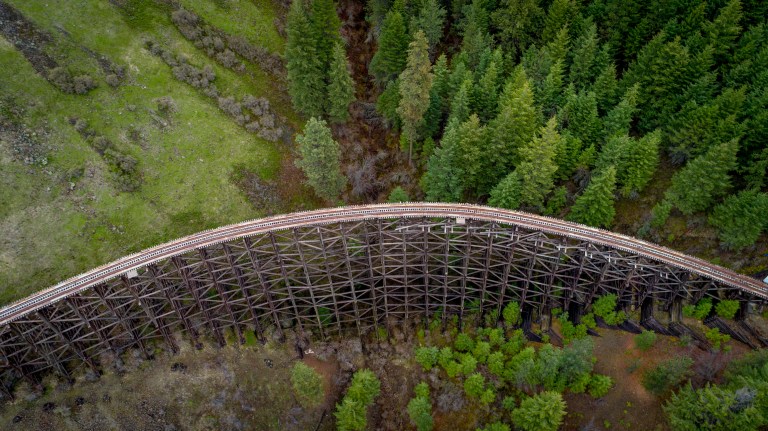
This stunning stretch of railbed is positively legendary for its towering trestles, which soar above multiple canyons in the high Camas Prairie of Central Idaho. The manmade wonder blends seamlessly with the colorful prairie to form a sight that is nothing short of breathtaking.
From a distance, the intimidating and seemingly spindly trestles are a truly remarkable feat of engineering, towering sky high above the valley floor - they couldn't possibly bear the rumbling weight of a locomotive. Right?

Yet, today the remains of the now-abandoned Camas Prairie Railroad stand despite all odds.
Meandering over 150 miles of picturesque terrain, this rugged, stately rail line traverses a magnificently diverse portion of Idaho, from a roller coaster of rural farmland near Grangeville to lush pine-scapes near Lewiston.

Today, this fantastic line is no longer in use. However, this gorgeous piece of Idaho history is well worth a visit to capture a few photographs of the impressive trestles, many of which tower over 250 feet above the landscape.

Historically, the Camas Prairie Railroad is officially referred to as the CSP. It was jointly owned by both the Union Pacific and Northern Pacific, which had created the line as a means of settling a profit dispute.

Opposite sides of the railroad were built simultaneously by the two begrudgingly cooperating companies, literally meeting in the middle with a huge sigh of relief.
Enormous steel girders had to be built to withstand the pressure of hundreds of tons of locomotive, passengers, and ore being hauled over the canyon.


Altogether, this historic railroad climbs nearly 3,000 feet: from less than 800 feet at its lowest to an elevation of over 3,700 feet near Craigmont.

Incredibly, the timbers for every mile of this glorious second subdivision stretch were cut on-site from nearby pines.
The most scenic point is east of Culdesac, where an eight-mile loop hugs the Lapwai Canyon and uses multiple trestles to span the vibrant landscape.

Here, the curvaceous Half Moon trestle arcs in a graceful bend at 141 feet above the ground. This famous stretch also includes six tunnels and eighteen trestles that allow the track to wind up one side of Lapwai Canyon, switch back on itself, and continue up the hill to the top.
Aging tunnels dot the extensive railbed, many of which have crumbled upon themselves.

The treacherous, rocky Lawyer's Canyon is especially beautiful in its disrepair. A steel viaduct had to be built to run 1,520 feet across the canyon, with the height topping 280 feet. As the steel was being hauled over the canyon to build this very trestle, it had to be carried across the newly-built - yet still unfinished - portions of the railroad, testing the line's stability. With every groan and ache of the girders, no doubt builders were holding their breath.
In 1908, the railroad was finished, and for nearly a century, the Camas Prairie Railroad hauled grain and lumber products from the prairie to distant markets.

A gradual decline became particularly noticeable in 1975 after the building of the Lower Granite Dam on the Snake River, which allowed Lewiston to become its own inland seaport, thus bypassing the railroad.
The last train left the Camas Prairie on November 28, 2000, hauling just four cars of canola and three empty tankers. Then, the railroad was abandoned completely.

Since then, exposure, disuse, and time have taken their toll.

Rotting wood, sun-damaged metal - weakened and pitted with holes - and even human activity has made this historic line a dangerous, albeit beautiful, historic reminder of the past.
Multiple fires have also scorched many of the high-elevation trestles and entire portions have collapsed.

Piles of wood beams and metal rails dot the outskirts as the tracks wind their way through West-Central Idaho. In fact, many portions of the line have been stripped completely bare.

Most experts agree that the Camas Prairie Railroad is unlikely to be transformed into a rails-to-trails route, or even play host to an attraction of any kind due to finances. But there's still hope.
Night may have fallen on this incredible railroad's unique history and peak architectural beauty, but it's still a beautiful and impressive part of Idaho history, worthy of future preservation efforts.

You can visit portions of the railroad and check out the splendor from portions of the highway. In some areas, you can even get up close to photograph the trestles themselves - but climbing or hiking along the rails in any way could be fatal. Stay safe, Idaho!
A special shoutout to Jeff Zenner Photography for contributing some of the awesome photos above!
For another phenomenal sight in the area, Idaho's annual canola bloom is unexpected, colorful, and positively mesmerizing.
Subscribe to our newsletter
Get the latest updates and news
Thank you for subscribing!