The Strange Appeal of Unexpected Chain Restaurant Locations
Hidden gem chain restaurants located in the most unusual places you need to check out a.s.a.p.
Hilary Pollack is an editor, strategist, and culture journalist who’s written award-winning pieces for the likes of VICE, Pitchfork, The Fader, NY Mag, and more.
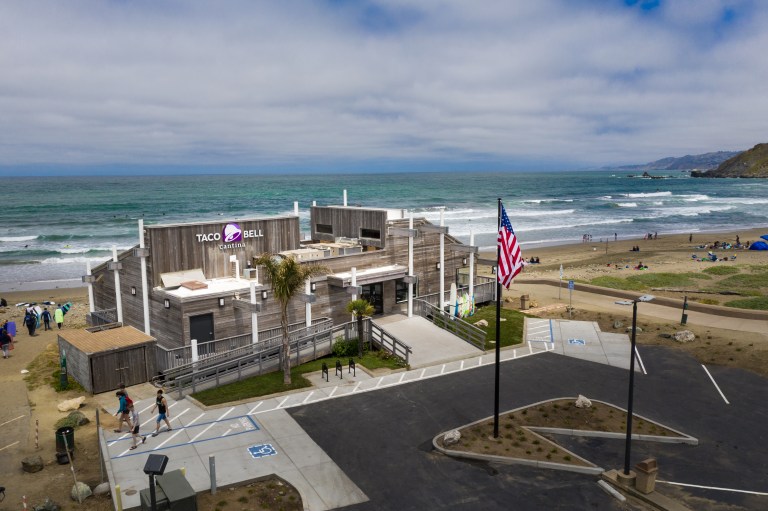
If you traverse the famously scenic curves of California's Highway 1, you'll pass through a town called Pacifica. Swaddled in San Francisco's famously romantic fog and soundtracked by the gentle crash of waves, it's a quaint, beautiful coastal suburb with a name that fittingly means "peaceful" in Spanish. It's a world-famous surfing destination with a population just under 40,000 locals, and was the longtime home of a charming mid-century bowling alley called Sea Bowl, which closed after 65 years of business last year. These days, Pacifica's most famous attraction isn't a big wave or a retro time capsule: it's a Taco Bell.
Perched on the shore of Linda Mar beach, the "most beautiful Taco Bell in the world," as it's been dubbed many times over by various outlets and observers, serves the same Cheesy Gordita Crunches and Crunchwrap Supremes as the other 8,000-ish locations of the "Mexican-inspired" fast-food chain. It has no unique menu items there, although it is a "Cantina" franchise, because it serves booze.There’s no white tablecloths or fancy upgrades, save for the kiosks that let you order your meal without having to wait in line. The floors are sandy and the parking lot smells like saltwater, and there’s a walk-up order window for surfers and beach visitors instead of a drive-thru window for commuters.
There's no doubt that the cerulean horizon view of the Pacific Ocean and rolling green hills of Northern California is the primary attraction here, but there is an undeniable poeticism to the practice of enjoying the familiar lukewarm, umami-rich experience of a Taco Bell beef soft taco amid this staggering scenery. There's a reason that this particular Taco Bell stands out as so singular: You couldn't legally build a fast food restaurant in that same location today. The rustic-looking, wood-paneled building in which the Taco Bell is housed has served as a restaurant since the 1960s, predating a 1972 coastline-protecting initiative that strongly tightened regulations on the establishment of new businesses along the California coast, with the intent of preserving its natural beauty and ensuring public access without any nightmarish tourist traps. It is truly a one-of-a-kind example of a many-of-a-kind fast-food chain restaurant; of all the thousands of Taco Bells in all the world, each with virtually identical menus of shredded cheese and flour tortillas and ground beef and soda, it stands alone.

While the Pacifica Taco Bell is perhaps the most famous and potent example of a fast food location in a less-expected context, it's far from the only such restaurant. There's the Maine McDonald's housed in a 150-year-old colonial mansion, where you can enjoy McNuggets at a carved mahogany table, and sometimes even order a lobster roll. (Apparently, the lobster rolls at McDonald's are better than one might expect.) In Sun Valley, Idaho, you can get your Frappuccino at a Starbucks in an old rustic church, the inside of which resembles a high-end ski lodge. And in Painted Post, New York, a former bank building has been reborn as a KFC location known as the "Crystal Bucket," thanks to its glimmering floor-to-ceiling windows and circular vaulted ceiling. What these locations all have in common is that they meld the recognizable with the novel, taking the familiar (a restaurant that serves mass-produced comfort-food classics) and transforming it into a curious gem unique to a small town.
In theory, it could be alarming to see these stunning architectural landmarks transform into chain restaurants serving French fries and diet soda, stoking the same sort of cognitive dissonance as seeing a hermit crab use a broken light bulb as a shell. A case could be made that these buildings would be better suited to housing small, independent businesses or public centers emphasizing their historical value, such as local museums. But when we see fast food restaurants in surprising skins, it can actually illuminate our appreciation for them. The Taco Bell on the shore of Pacifica isn't frowned upon, but beloved by locals and travelers alike because it combines the ubiquitous and the unusual in previously unseen ways. For those road-tripping down the picturesque California coast, it's an attraction that highlights the majesty of the region while also offering a taste of home—wherever that may be in America, it's surely not too far from a Taco Bell. This epitomizes the wonder of the open road; it's the quest for awe, connection, and resonance in unfamiliar surroundings.

Why do Americans love chain restaurants? The reasons are plentiful—namely, affordability, convenience, consistency, and proximity. A Big Mac tastes exactly like a Big Mac wherever you may be. Whether you're exploring on the open road or running errands just a few blocks from your house, fast food chains ensure that you can have a taste of home regardless of your environment—and when the environment of the location is extraordinary, it only highlights the bizarre sense of comfort that these cultural institutions offer by reliably serving the same burgers, tacos, fries, and shakes you've come to know and love.
When Warhol famously made a Campbell's soup can into pop art, it demonstrated that the recognizability of food brands holds emotional resonance in and of itself. Those Golden Arches or the pink and purple bell may feel kitschier in a mansion or on a beach, but these new contexts also illuminate how we've let them become mundane when it's actually quite extraordinary that you can get the same chalupa at 8,000 different places in America, including at a walk-up window while the waves of the Pacific crash behind you.
Subscribe to our newsletter
Get the latest updates and news
Thank you for subscribing!