Can’t Make It to the San Juan Islands? Connecticut Has Its Own Version
Connecticut's own archipelago is teeming with coastal charm, secluded homes, and a fascinating history.
Washington State's San Juan Islands are absolutely captivating, with their rugged coastlines, otherworldly old-growth forests, and endless opportunities for island hopping. To be fair, there isn't much along the East Coast that can compare to the sheer scope of this archipelago. But if you're looking for something that's equally captivating, I invite you to explore Connecticut's Thimble Islands.
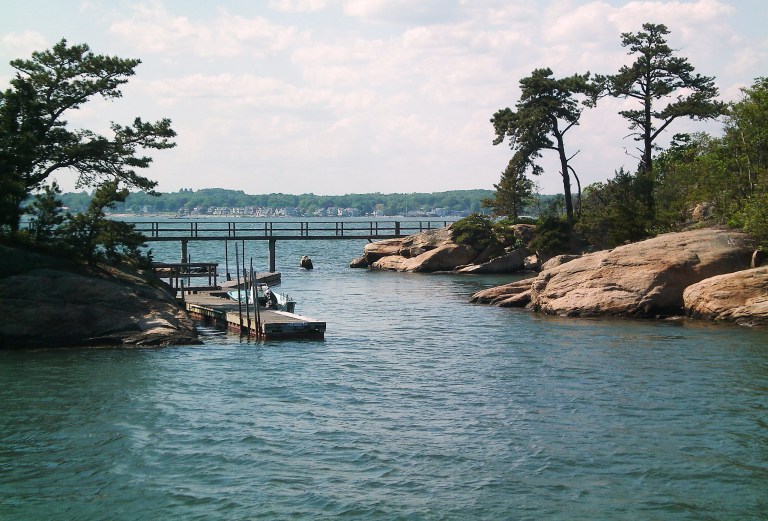
Just off the coast of Branford's Stony Creek harbor, the Thimble Islands are made up of one hundred—or 365, depending on how "island" is defined—small, rocky islands dotted with Victorian-era cottages. This Long Island Sound archipelago is comprised of pink granite and was once a collection of hilltops before the last ice age. The Europeans discovered the islands in 1614, but long before then, they were known to the Mattabeseck Indians as Kuttomquosh, which can be translated to "beautiful sea rocks." The Thimble Islands aren't named for their small size but rather a native berry that grows throughout the area called the thimbleberry bush.

By the mid-1800s, a few buildings were constructed on the islands, the first being the Thimble Island Hotel on Pot Island. After the Civil War, vacationers built summer cottages and homes on the island, and ferries were bringing people to and from the mainland several times a day.
Today, the islands are a quiet summer community. Life on the islands is remote, and only six have power thanks to underwater cables. The largest of the Thimble Islands is 17 acres across and is called Horse Island. It's owned by Yale University and functions as an ecological laboratory. I was fascinated to learn that another Thimble Island, Bear Island, is famous for its granite quarry, which was used in three iconic landmarks: the Statue of Liberty base, the Lincoln Memorial, and Grant's tomb.

Their Pacific Northwest counterparts, the San Juan Islands, are decidedly larger; there are over 400 of them, although just 128 are named. Similar to the Thimble Islands, they too are part of an ancient, submerged mountain range. The San Juan Islands are probably most famous for their whale watching opportunities, with the peak season being mid-May through mid-September. Sadly, the Thimble Islands don't offer whale watching, but that doesn't mean there isn't wildlife around. Seals are frequently spotted sunbathing on the islands, as are green herons and roseate terns.
To get to the Thimble Islands, you can take a ferry or charter a private boat. The ferry typically runs between April and October, and you'll want to take a look at the schedule beforehand to confirm details. For a shorter tour, opt for a Thimble Island Cruise aboard the Sea Mist, which is less than an hour. If you're looking for a tailored private group tour, those are available too, offering visitors a seldom-seen view of the islands.

Most Thimble Island adventures are enjoyed by the water. In addition to boat tours, you can also rent a kayak. Most of the islands feature private residences, but there is a place where you can stay for a few nights. This secluded home on Narrows Island is actually accessible via car thanks to the permanent land bridge. This home is incredibly peaceful and restorative, and the views are unmatched.
So while there may not be a substitute for the iconic San Juan Islands, there's no arguing that the Thimble Islands aren't enchanting, mystical, and positively bucket-list-worthy.
Subscribe to our newsletter
Get the latest updates and news
Thank you for subscribing!