Explore the Chilling History of the Monte Cristo Trail in Granite Falls, Washington
Do you love the outdoors and creepy local history? Check out this abandoned miner's town located just a few miles from Seattle in Granite Falls, Washington!
Having grown up in Washington, much of its supposed "moodiness" eluded me, at least until I met my husband. Driving along Highway 101 from Olympia to Shelton, he'd look out the car window into the smear of dark forest and comment on how mysterious and austere the landscape seemed to him. I'd glance at the same view and think, "Well, that looks exactly like one of the spots I would've hunted for Sasquatch as a kid!"
Seeing a familiar place with new eyes is strange, but the experience is usually enlightening. For a while, I tried to convince my husband, who hails from the east coast, of what I saw. Then, I learned to embrace his vision of the region I've come to know so well. A cascade of realizations emerged from this perspective shift. While I still view the Pacific Northwest as a place of incredible beauty, I also celebrate its eeriness.
One of my favorite ways to explore Washington's cryptic side is through its lesser-known history, and if you love the outdoors, there's no better way to do this than by hiking to one of our state's abandoned communities. Of Washington's 116 ghost towns, the most accessible is Monte Cristo, located within two hours of Seattle. All you need to step back in time is the right pair of shoes.
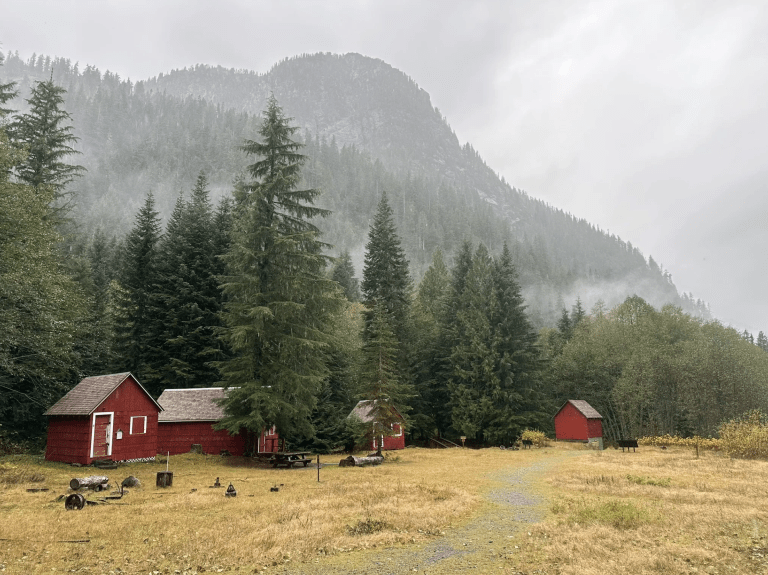
Tucked in Snohomish County, Monte Cristo sits in the dale between Silvertip Peak and Cadet Peak of the Cascade Mountains. It's one of the many communities in Washington that sprang to life in the 19th century following a gold and silver boom. Thousands poured into the state, many of them by foot, bringing along their dreams for the future, their families, and their stories.

For some time, Monte Cristo seemed gilded — a rare place that could deliver on its promise. Newcomers and investors alike believed its lead-silver district could become the most productive in the Western world. This buzz built upon itself, drawing more and more fortune-seekers. At a time when Seattle's population hovered at around 42,000 people, Monte Cristo's was a bustling 1,000 strong. Then, just as locals began erecting infrastructure to facilitate mineral extraction, a series of catastrophic floods devastated the nascent community. In a historical atmosphere of quick luck and even quicker privation, most miners abandoned Monte Cristo for Klondike, by then a rising star of mining's boom-bust world.

Like so many other Washington mining towns, Monte Cristo's mineral veins weren't robust enough to sustain all the hopeful who settled there. By 1907, the ore was exhausted. Monte Cristo languished as a tourist destination for the next 80 years, relying on outsiders to keep itself afloat. In a peculiar symmetry, a serious flood would also mark this period's end when the county road washed out in 1980. The community persevered for three more years until the guest lodge — Monte Cristo's last operating building — burned down in 1983.

Luckily, a nonprofit organization quickly jumped in to help preserve the area's remaining structures. Today, you can visit via the Monte Cristo Trail. Though it's a little over eight miles long, it's a relatively flat route, making it approachable to casual hikers and experienced families. Like other ghost towns, Monte Cristo evokes the uncanny sense of life interrupted. Some buildings have collapsed, entombing the sofas, tables, and clutter of the lives lived within. The surroundings — Mount Baker Snoqualmie National Forest — are breathtaking in their own right, but the enduring trees and mountains only heighten your awareness of people's ephemerality. Those who made their lives in Monte Cristo thought that it would last. Now, it's a place we hike through, searching for echoes of the past within the decay.
If you love history and Washington's outdoors, I recommend heading to the Monte Cristo Trail. This local ghost town holds fascinating stories. You'll come for the natural splendor of the Cascades and stay for the poignant remnants of our state's not-so-distant past.
Subscribe to our newsletter
Get the latest updates and news
Thank you for subscribing!